On June 3 local time, the U.S. White House issued an executive order, “Strengthening Customs Enforcement,” requiring the U.S. Department of Homeland Security (DHS) and U.S. Customs and Border Protection (CBP) to comprehensively strengthen import oversight, raise the entry threshold for importers, and intensify enforcement against tax evasion, underreporting of prices, transshipment trade, and forced labor.
The main provisions of this executive order include:
• Prohibiting foreign-registered importers from using informal entry procedures for low-value goods, closing the loophole that previously allowed foreign sellers to dump large quantities of goods through this channel with almost no penalties;
• Prohibiting foreign-registered importers from using continuous bonds during formal entry, requiring them to obtain Customs-Trade Partnership Against Terrorism certification, or to process customs clearance through a U.S. customs broker holding that partnership’s certification credentials;
• Raising the minimum coverage amount of bonds, while requiring registered importers to maintain a minimum level of domestic tangible assets, ensuring that every batch of cleared goods is backed by actual assets as a guarantee, so that duties and penalties can be fully recovered;
• Requiring relevant parties to disclose beneficial ownership, business affiliations, and domestic asset information, and directing U.S. Customs and Border Protection to audit the registered importer roster, remove importers that have long been inactive, and manage importers on a tiered basis according to risk level;
• Establishing compliance-eligibility requirements, completely barring non-compliant entities from engaging in import business, including entities caught importing fentanyl, nitazene-class substances, and related precursor chemicals;
• Setting a minimum penalty standard, with fine amounts not lower than 50% of the assessed penalty, and no longer reducing or waiving penalties for repeat offenders;
• Focusing on cracking down on illegal acts such as forced labor, misclassification of goods, underreporting of value, and illegal transshipment, while conducting investigations related to the Enforce and Protect Act;
• Requiring foreign exporters to submit to U.S. Customs and Border Protection the full set of documents they declare to their own country’s customs—a brand-new measure that will powerfully combat underreporting of value and falsification of country of origin.
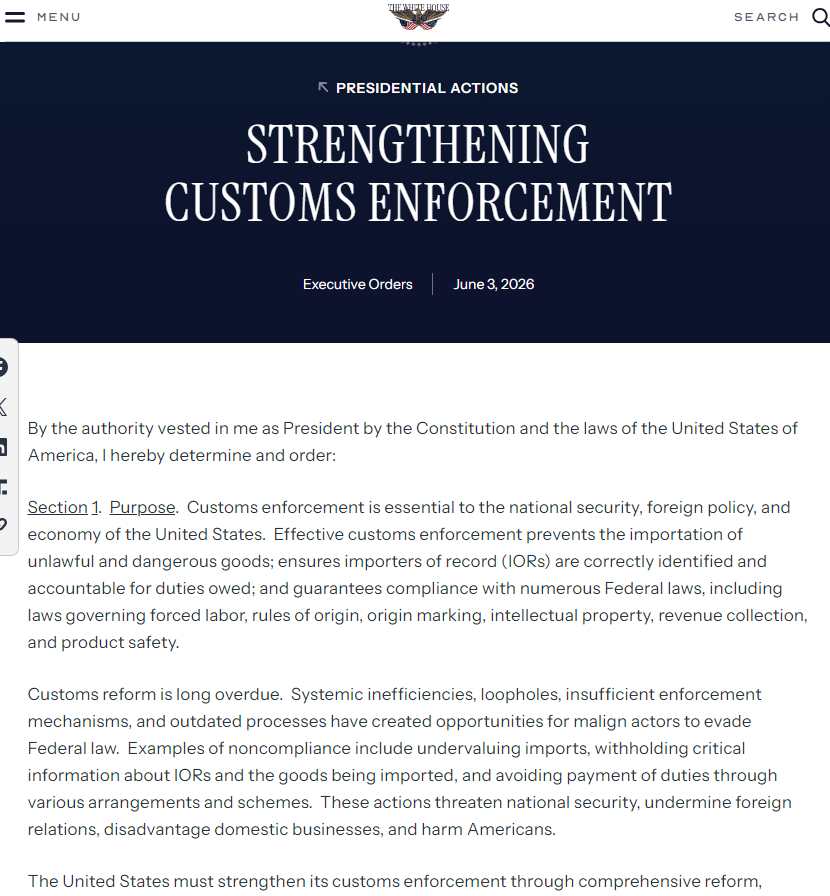
For Chinese sanitary ware enterprises, this means that future exports to the U.S. market will face not only high tariff pressure, but also stricter customs compliance scrutiny.
01 Multiple Impacts on Chinese Sanitary Ware Enterprises
From the perspective of actual impact, this executive order will not directly raise the tax rate for Chinese sanitary ware products entering the U.S. market in the short term, but it will significantly increase the overall cost of the export process.
The first is increased compliance costs.
In the future, U.S. importers will need to bear higher responsibility and risk, and accordingly they will also require suppliers to provide more complete product and supply chain information. For sanitary ware enterprises, every link—from raw material procurement, to manufacturing, to export customs declaration—may face stricter scrutiny.
The second is the increased difficulty of transshipment trade. In recent years, as China-U.S. trade friction has continued, some enterprises have begun to lay out operations in Southeast Asian countries such as Vietnam, Thailand, Malaysia, and Indonesia, hoping to reduce the impact of trade barriers through overseas production capacity.
But this executive order explicitly strengthens the enforcement of rules of origin and anti-circumvention investigations (EAPA). In the future, models of simply changing packaging, changing labels, or light assembly will face higher risks.
In other words, overseas layout is still effective, but it must be a transfer of manufacturing capability in the true sense, rather than a mere transfer of trade.
The third is that U.S. customers’ procurement strategies may change.
As import responsibility increases, U.S. purchasers will pay more attention to the stability and compliance capabilities of suppliers. Compared with price advantages, they may be more inclined to choose partners that possess the following conditions:
-
A sound quality management system;
-
A clear and transparent supply chain;
-
U.S. domestic warehousing capabilities;
-
A local after-sales service network;
-
A long-term stable operating record.
This means that industry resources will further concentrate toward large factories and leading enterprises.
02 Chinese Sanitary Ware Enterprises Need to Re-evaluate Their U.S. Strategy
The United States remains one of the largest sanitary ware consumer markets in the world, and is also an important export destination for Chinese sanitary ware products. From the demand perspective, the U.S. market has not changed fundamentally.
But the market-access threshold is clearly rising.
The core of future enterprise competition may no longer be simply manufacturing cost, but comprehensive operational capability.
On the one hand, enterprises need to establish a more complete rules-of-origin and supply chain management system, ensuring they can provide complete procurement, production, and export records; on the other hand, overseas production capacity layout must possess genuine manufacturing capability, in order to meet U.S. requirements for country-of-origin determination.
At the same time, enterprises also need to further optimize their market structure.
In the past two years, the growth rate of the Middle East, Latin America, Southeast Asia, and some Eastern European markets has been markedly faster than that of traditional mature markets. For large export enterprises, hedging bets on multiple fronts will be inevitable; while maintaining competitiveness in traditional markets, accelerating diversified layout and reducing dependence on a single market has become an increasingly important strategic choice.
Accelerating North American Purchasers’ Re-examination and Adjustment of Supply Chain Strategies
In addition to the impact on export enterprises, this will also accelerate U.S. home and building materials purchasers’ re-examination and adjustment of their supply chain strategies.
Take U.S. company FGI Industries (FGI) as an example. In its financial performance briefing at the beginning of 2026, the company explicitly pointed out that the uncertainty of tariff policy and geopolitical risk have prompted it to actively implement a “China+1” procurement strategy. Currently, FGI has established new supply partnerships in regions outside China, such as Thailand, to reduce dependence on a single market.
In addition to brand suppliers, building materials retail giants that directly participate in bulk overseas procurement and operate their own private labels are doing the same.
-
Lowe’s: Advancing Regional DiversificationAs a major residential improvement retailer in North America, Lowe’s has continued to advance its “Total Home” development strategy in recent years. In terms of supply chain management, faced with the risks of tariffs and increasingly strict customs review, Lowe’s has gradually dispersed the procurement of some building materials and household goods to Southeast Asia and South America. The new policy’s strict scrutiny of importer (IOR) qualifications will drive up the import costs of its private-label sanitary ware and furniture, forcing it to further optimize its global logistics and OEM factory layout.
-
The Home Depot: Strengthening Responsible Sourcing and Risk ControlAs a large global home and building materials retailer, although most of The Home Depot’s merchandise is sourced from North America, a large number of product categories still depend on the global supply chain. The Home Depot has long adopted a risk-based assessment mechanism in its day-to-day supply chain management. After the implementation of the new customs policy, U.S. domestic customs brokers and retailers will bear higher joint compliance liability, which will prompt the company, when assessing global OEM factories, to place more emphasis on the transparency of the supply chain and the ability to cope with sudden policy adjustments.
-
Kingfisher plc: Cross-regional Allocation to Assess RiskAs a European building materials retail giant owning well-known brands such as B&Q and Castorama, Kingfisher has long conducted large-scale procurement through its Asia procurement center (Kingfisher Asia) established in Hong Kong and Shanghai. Although its core market is in Europe, the combined impact of U.S. customs policy on the global shipping and logistics chain and on exporting countries’ policies is likewise prompting the group to assess the overall risk resilience of its supply chain, and to gradually divert a portion of its everyday hardware and sanitary ware orders to Turkey and other parts of Southeast Asia.
Reference links for policy and event sources:
-
Official text of the White House executive order “Strengthening Customs Enforcement to Protect American Consumers and Businesses”:
https://www.whitehouse.gov/presidential-actions/2026/06/strengthening-customs-enforcement/ -
FGI Industries, Ltd. (FGI) 2026 business outlook and “China+1” supply chain diversification strategy explanation (Zacks / TradingView earnings record):
https://www.fgi-industries.com/investor-relations/ -
Lowe’s Companies, Inc. (Lowe’s) 2026 business transformation and supply chain regional risk control report (financial market disclosure):
https://markets.financialcontent.com/stocks/article/finterra-2026-3-10-lowes-low-in-2026-the-tech-driven-evolution-of-a-home-improvement-giant -
The Home Depot official disclosure of global compliance and responsible sourcing standards:
https://corporate.homedepot.com/sites/default/files/2023-07/2023_Responsible_Sourcing_Report_Final.pdf -
Kingfisher plc official disclosure of its global procurement network and Asia procurement center (Kingfisher Asia):
https://www.kingfisher.com/contact-us

Originally published in WeChat by Chu Wei Zi Xun on 2026-06-08. Translated and edited for English-language readers.