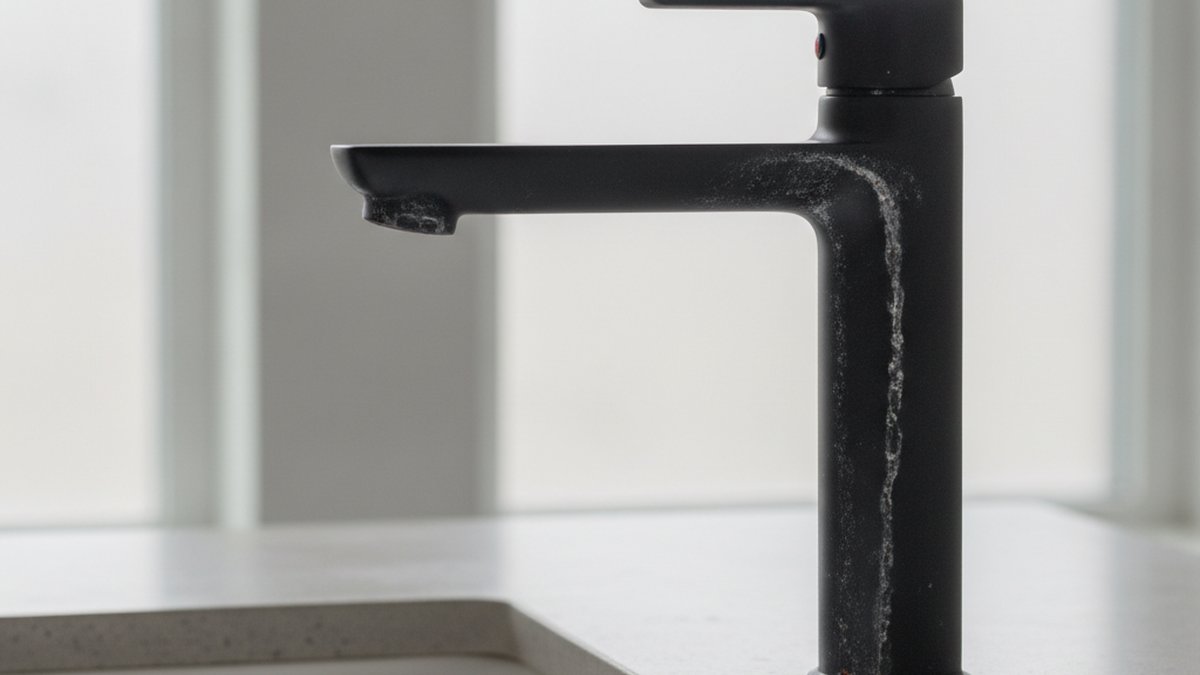
If you’re staring at a black faucet with hard water stains — those chalky white or rust-tinted streaks that seem to reappear the day after you clean them — you’re dealing with mineral deposits, not dirt. Black finishes (matte black, oil-rubbed bronze, and matte-black PVD) show water spots more dramatically than chrome because the white minerals sit against a dark background. The good news: the stains are almost always removable, and the fix is cheap. The catch: black faucets are the one finish where using the wrong cleaner does more damage than the stains ever would. Below is exactly what works, what to avoid, and how to stop the spots from coming back.
Why does my black faucet get white hard water stains so fast?
Because your water is “hard” — it carries dissolved calcium and magnesium, and when a droplet evaporates on the faucet, those minerals stay behind as a white crust. On a matte black surface, even a light film of minerals scatters light and reads as a dull gray haze, so a black faucet looks dirtier than a chrome one with the exact same amount of scale.
Water hardness is measured in grains per gallon (gpg) or parts per million (ppm). Anything above 7 gpg (about 120 ppm) is considered hard, and large parts of the U.S. — the Southwest, Texas, the Midwest — run 10–25 gpg. The harder your water, the faster the film builds. If your faucet spots up within hours of drying, you likely have very hard water, and no cleaner will “cure” that — you’re managing an ongoing condition, not fixing a one-time mess.
There are two things stacked on the surface: limescale (the white calcium/magnesium deposit) and sometimes iron staining (the orange-brown tint, from iron in well water or old pipes). They respond to slightly different treatments, which is why one cleaner doesn’t always do the whole job.
What actually removes hard water stains from a black faucet — step by step?
White vinegar is the answer for 90% of black faucets. It’s a mild acid that dissolves calcium carbonate without the harshness of commercial descalers, and used correctly it’s safe on most black coatings. Here’s the method that works without wrecking the finish:
- Mix 1:1 white vinegar and warm water. Don’t use straight vinegar on matte black — dilute it. Warm (not hot) water helps it work faster.
- Soak a soft cloth or paper towel in the solution and drape it over the stained areas. For the spout tip and handle base, wrap the cloth so it stays in contact.
- Wait 5–10 minutes. Set a timer. Leaving acid on a black PVD or painted finish for 30+ minutes is how you get discoloration.
- Scrub gently with a soft microfiber cloth or a soft-bristle toothbrush. Work in small circles. Never use a green scrub pad, steel wool, or a “magic eraser” (melamine foam) — those are abrasives that scratch and dull black finishes.
- Rinse thoroughly with clean water to remove all acid residue.
- Dry immediately with a clean microfiber towel. This step is non-negotiable — drying prevents the next round of spots.
For a black faucet with hard water stains that are old and thick, repeat the cycle two or three times rather than leaving the vinegar on longer. Patience beats potency here. If the spots are only on the aerator (the screen at the tip of the spout), you can often unscrew that piece and soak just the aerator in vinegar — that’s covered in detail in our guide on how to clean sink faucet head buildup.
What about rust-colored (orange) stains specifically?
Orange or brown staining is iron, not limescale, and vinegar alone often won’t lift it. Make a paste of baking soda and a little water, apply it gently with a cloth (baking soda is very mildly abrasive but soft enough for most black finishes when used with a cloth, not a pad), then rinse. For stubborn iron stains, a dedicated rust remover made for coated finishes works, but always spot-test first. Avoid the classic lemon-juice-and-salt trick on black — the salt scratches.
Will vinegar or CLR damage a matte black or oil-rubbed bronze finish?
Diluted vinegar used briefly is safe on most matte black PVD finishes; strong descalers like CLR, Lime-A-Way, and full-strength vinegar are risky and can permanently dull or discolor them. This is the single most important thing to understand about cleaning a black faucet: the finish matters more than the stain.
Here’s why. There are three common “black” finishes, and they don’t react the same way:
| Finish type | How it’s made | Durability vs. acid | Safe cleaner |
|---|---|---|---|
| Matte black PVD | Physical vapor deposition — molecularly bonded, very tough | High — resists most acids briefly | Diluted vinegar, dish soap |
| Matte black powder-coat / paint | Sprayed and baked coating | Medium — acid can etch or fade it over time | Dish soap + water; vinegar only briefly, spot-test first |
| Oil-rubbed bronze (living finish) | Chemical patina, often unsealed | Low — acid strips the patina to bare metal | Mild soap only; avoid vinegar |
PVD (physical vapor deposition) is the gold standard and what quality brands, including Vevetta, use for black finishes — it bonds the color at a molecular level, so it shrugs off brief acid contact and daily use. Cheaper faucets use powder-coat or paint, which can etch if you leave vinegar on too long. And oil-rubbed bronze is a “living finish” designed to age and patina; acid will strip it to shiny bare metal in patches, which you usually can’t undo. When in doubt, start with the gentlest option — warm water and a drop of dish soap — and only escalate to vinegar if that fails.
Hard “no” list for any black faucet, regardless of finish:
- Bleach or bleach-based cleaners — discolor and corrode.
- Abrasive powders (Comet, Bar Keepers Friend on matte finishes) — scratch and leave shiny spots.
- Melamine “magic erasers” — micro-abrasive; they buff the black right off.
- Ammonia or glass cleaners with ammonia — can cloud coatings.
- Scouring pads / steel wool — permanent scratches.
How do I stop hard water stains from coming back on a black faucet?
The only real prevention is keeping water off the faucet and treating the water itself. Cleaning removes stains; these habits stop them from returning:
- Dry the faucet after use. A quick wipe with a microfiber cloth once a day (or after the last dish of the night) is the highest-impact habit. No standing droplets means no minerals left behind.
- Do a light vinegar wipe weekly before deposits get thick. Thin film comes off in seconds; a month of buildup takes real scrubbing.
- Apply a car wax or dedicated fixture wax a couple of times a year. A thin coat of paste wax (yes, the kind for cars) on a clean, dry black faucet makes water bead up and roll off, and it protects PVD. Buff it out well.
- Treat the water at the source. If your whole house is hard, a water softener eliminates the problem for every fixture. For a targeted fix, an inline filter or a filtered aerator reduces mineral content at the tap.
If your issue is broader than just faucet spots — think cloudy glasses, stiff laundry, scale in the kettle — the underlying water chemistry is the real culprit. Our overview of tap water filters and what they actually remove is a useful primer on point-of-use filtration, and upgrading the aerator is often the cheapest first move — see what a Neoperl aerator upgrade does for how a better aerator changes the spray and reduces splashing that spreads mineral spray onto the faucet body.
My black faucet finish is peeling or has gray spots — is that hard water or something else?
If you’re seeing gray or silvery patches, faded areas, or actual peeling, that’s finish damage — not hard water — and it usually can’t be cleaned off because there’s nothing left to clean. It’s the coating that’s gone. This most often happens on cheaper painted or powder-coat faucets after someone used an abrasive pad, a harsh chemical, or left a strong descaler on too long.
Hard water stains sit on top of the finish and come off with the right cleaner. Finish failure means the black layer itself has worn through to the metal underneath. There’s no safe DIY way to re-coat a matte black faucet to match — touch-up options for black are limited and rarely match the sheen. (For chrome, small touch-ups can sometimes work; we cover that in our look at whether chrome tap touch-up paint actually works.) If your black faucet is peeling, it’s typically time to replace it — and it’s worth choosing a genuine PVD finish next time so it lasts.
One quick test: dampen a cloth with soapy water and wipe the questionable area. If it lightens or comes clean, it’s mineral staining. If the gray patch doesn’t change no matter how you wipe, the finish is compromised.
How often should I clean a black faucet in a hard water area?
In hard water areas, a quick daily dry-off plus a gentle weekly vinegar wipe keeps a black faucet looking new; without those habits, expect visible spotting within 24–48 hours. The frequency scales with your water hardness — the harder the water, the more you’ll lean on the daily wipe-down. Think of it like maintenance, not deep cleaning: 20 seconds a day beats a 20-minute descaling session every few weeks, and it’s far gentler on the finish.
A realistic maintenance rhythm for very hard water (15+ gpg):
- Daily: microfiber wipe to remove droplets after last use.
- Weekly: diluted vinegar wipe, rinse, dry.
- Every 3–6 months: fixture wax for water repellency.
- As needed: soak or descale the aerator if flow drops or spray goes sideways.
Author note & why you can trust this
This guide was written by the Vevetta product team, drawing on hands-on testing of black PVD faucets in high-hardness water regions and years of fielding customer questions about spotting and finish care. Vevetta designs and sells faucets and bathroom fixtures direct to consumers, and our matte black finishes use molecularly bonded PVD tested against standard abrasion and corrosion benchmarks (the same industry durability standards referenced by ASME/CSA faucet finish testing). Every Vevetta black faucet is backed by our finish warranty — which specifically covers finish integrity, not damage from abrasive cleaners, so following the care steps above also keeps your coverage intact. We recommend the gentlest effective method first precisely because we’ve seen how quickly the wrong product ruins an otherwise perfect finish.
FAQ
Can I use CLR or Lime-A-Way on a black faucet?
Not recommended. These strong descalers can strip or dull matte black and oil-rubbed bronze finishes, and once the coating is etched there’s no fixing it. Start with diluted white vinegar, which handles almost all household hard water stains safely. Only consider a stronger product if you’ve confirmed your finish is durable PVD and you’ve spot-tested a hidden area first.
Why does my black faucet look faded or chalky even after cleaning?
Two possibilities. If a fresh soapy wipe temporarily makes it look normal, that’s a thin mineral film — clean it with diluted vinegar and dry it. If the dull or gray area never changes no matter what you do, the finish itself has worn through and can’t be cleaned back to black; that faucet needs replacing.
Is matte black harder to keep clean than chrome?
It shows water spots more obviously because white minerals contrast against the dark surface, but it isn’t actually harder to clean — the minerals wipe off the same way. The real difference is that matte black is less forgiving of abrasive or harsh cleaners than chrome, so you have to be gentler. A daily dry-off makes matte black very low-maintenance.
Will a water softener stop the stains completely?
Largely, yes. A whole-house water softener removes the calcium and magnesium that cause limescale, so faucets, glasses, and shower doors stop spotting. It won’t remove iron staining (that needs an iron filter), and it’s a bigger investment than a wipe-down routine, but it solves the root cause for every fixture in the house.
Can I use baking soda to scrub hard water off my black faucet?
Yes, carefully. Baking soda is only mildly abrasive and is useful for iron/rust stains, but always apply it with a soft cloth — never a scrub pad — and rinse well. On a delicate painted finish, test a hidden spot first. For everyday limescale, diluted vinegar is gentler and usually enough on its own.
How do I clean hard water buildup inside the spout and aerator, not just the outside?
Unscrew the aerator at the tip of the spout and soak it in a small cup of diluted vinegar for 10–15 minutes, then brush the screen with an old toothbrush and rinse. For the spout interior, wrapping a vinegar-soaked cloth around the tip or using a small vinegar-filled bag secured over the spout works well. Restoring flow this way is covered step by step in our sink faucet head buildup guide.