Figuring out what to know when replacing a kitchen faucet comes down to measurements, not brand hype. A gorgeous pull-down faucet is useless if it won’t fit your hole configuration, clears your window ledge by half an inch too little, or needs supply lines you don’t own. This guide walks you through every decision — hole count, spout style, valve compatibility, finish, and the install itself — in plain language, so you order the right faucet once and install it without a second trip to the hardware store.
At Vevetta, we sell and stress-test kitchen faucets every week, and the single biggest reason people return a faucet isn’t quality — it’s fit. So we’re going to fix that first.
How do I know how many holes my kitchen sink needs for a new faucet?
Look down at your existing faucet and sink deck and count the holes — including the ones hidden under a cover plate. Most kitchen sinks have 1 to 4 holes: hole 1 is the faucet, and the extras are for a sprayer, soap dispenser, air gap, or a hot-water dispenser. This single number decides which faucets you can even consider.
Here’s the part that trips people up: a single-hole faucet can usually cover a 3-hole sink using an included deck plate (also called an escutcheon). But a 3-hole widespread faucet cannot squeeze into a single-hole setup. So going from more holes to fewer is easy; going from fewer to more is not.
- 1 hole: Single-lever faucet only, unless you drill more holes.
- 2 holes: Faucet + separate handle or side sprayer.
- 3 holes: Faucet + two accessories, OR a single-hole faucet with a deck plate hiding the outer two.
- 4 holes: Faucet + sprayer + soap dispenser + air gap, or any subset with the rest capped.
If you have spare holes you won’t use, don’t panic — a stainless or matching-finish hole cover ($5–$12) fills them cleanly. Standard kitchen faucet holes are 1⅜” to 1½” in diameter, and standard hole spacing on a 3- or 4-hole sink is 4″ or 8″ center-to-center. Measure it; don’t assume.
What measurements do I actually need before buying a kitchen faucet?
You need five numbers: hole count, spout height, spout reach, deck-to-window clearance, and under-cabinet depth. Get these before you shop and you’ll eliminate 90% of fit problems.
Spout height is how tall the faucet stands. A high-arc gooseneck (8″–10″+) makes filling pots easy but can splash in a shallow sink or hit an upper cabinet or window. Spout reach is how far the water lands from the base — you want it aimed at the drain, roughly the center of the bowl, not the back wall. Clearance matters most under a window: measure from the deck to the lowest point the faucet would swing or the window would open. Pull-down faucets need vertical room; some can’t fit under a low sill.
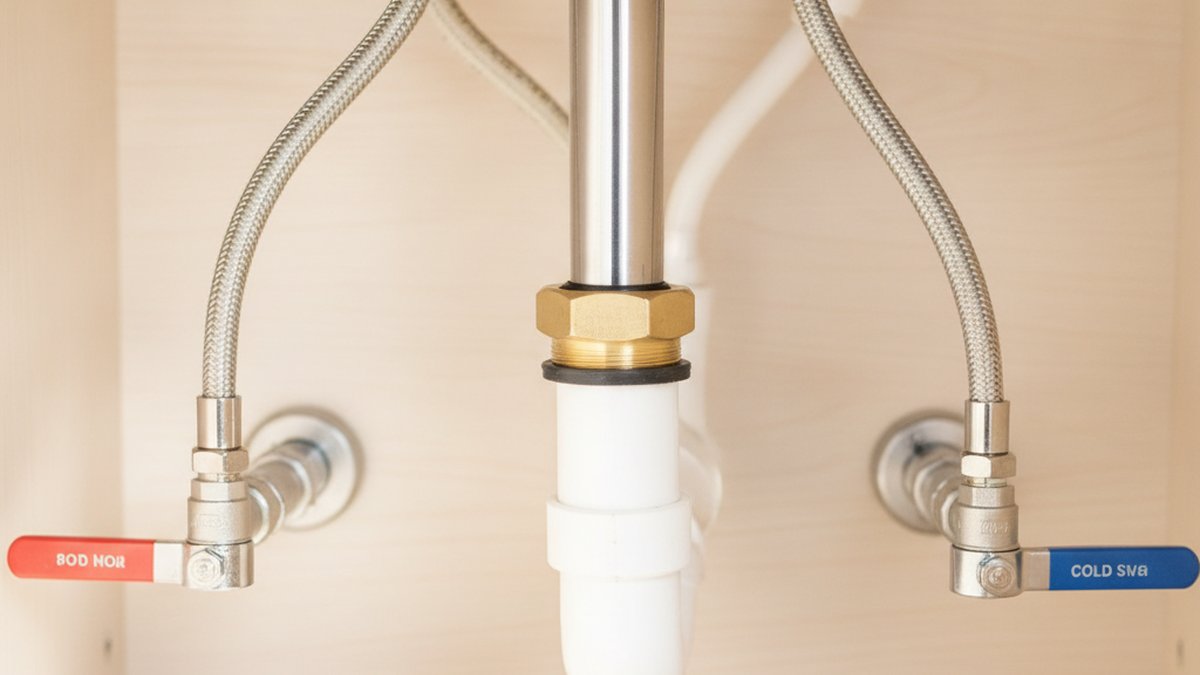
Under the cabinet, check that there’s room for the faucet body, the supply connections, and your hands with a wrench. If your existing supply lines are old or too short to reach new shut-off valves, budget for new ones — braided stainless lines are cheap insurance. If you’re unsure whether your current lines will reach, our guide to picking the right 48 inch faucet supply line explains how to measure length and choose the correct connector size so you’re not stuck mid-install.
Which kitchen faucet type is best for my sink — pull-down, pull-out, or standard?
For most modern kitchens with a single deep bowl, a pull-down faucet is the best all-around choice: the high-arc spout gives clearance for big pots and the spray head drops straight into the sink. Choose a pull-out if you have a low window or upper cabinet that limits height, and a fixed standard spout only if you specifically want a two-handle bridge or commercial-style look.
| Faucet Type | Best For | Typical Price | Watch Out For |
|---|---|---|---|
| Pull-down | Deep single-bowl sinks, pot filling | $120–$400 | Needs vertical clearance; hose weight over time |
| Pull-out | Low windows, small/shallow sinks | $90–$300 | Shorter reach; less arc for tall pots |
| Standard / single-lever | Budget builds, laundry, bar sinks | $40–$150 | No spray flexibility |
| Bridge / two-handle | Farmhouse & vintage kitchens | $200–$600 | Needs 3 holes; harder to install |
| Touchless / motion | Busy family kitchens, accessibility | $180–$500 | Needs power/batteries; more parts to fail |
One quiet spec that decides how a faucet feels for the next decade is the cartridge — the valve inside the handle that mixes hot and cold and shuts off flow. Ceramic-disc cartridges are the durable standard and resist mineral wear far better than old rubber-washer designs. If you want to understand why this part matters more than the shiny finish, read our explainer on the purpose of a faucet cartridge before you buy.
What tools do I need to replace a kitchen faucet myself?
You can replace most kitchen faucets with a basin wrench, an adjustable wrench, a bucket, a towel, and plumber’s tape — plus a flashlight and maybe a hair dryer for old plumber’s putty. The basin wrench is the non-negotiable one; it’s built to reach the cramped mounting nuts behind the sink where nothing else fits.
- Basin wrench — for the mounting nuts up behind the bowl.
- Adjustable wrench or pliers — for supply line connections.
- Bucket + towels — the lines and hoses always hold leftover water.
- Plumber’s tape (PTFE) — wrap male threads for a leak-free seal.
- Silicone or plumber’s putty — under the deck plate, if not gasketed.
- Flashlight/headlamp — the under-sink cabinet is always dark.
If your old faucet’s nuts are corroded solid, penetrating oil and patience beat brute force. Don’t have the right wrench and don’t want to buy one you’ll use once? Our roundup of where to find a kitchen faucet installation tool nearby covers rentals and which specialty tools are actually worth owning.
How do I replace a kitchen faucet step by step?
The core process is: shut off the water, disconnect the old faucet, drop in the new one, connect the supply lines, and test for leaks. Most people finish in 45–90 minutes. Here’s the reliable sequence.
- Turn off the water. Close both shut-off valves under the sink, then open the faucet to release pressure. No under-sink valves? Shut off the main.
- Disconnect the supply lines from the faucet tailpieces. Keep the bucket underneath — water will drip.
- Loosen the mounting nuts with the basin wrench and lift the old faucet out. Scrape off old putty or gunk from the deck.
- Feed the new faucet through the hole(s), set the gasket or deck plate, and hand-align it facing straight.
- Tighten the mounting hardware from below — snug, not gorilla-tight, or you’ll crack the base.
- Connect supply lines (hot to hot, cold to cold), wrapping threads with PTFE tape. For pull-downs, clip on the hose weight per the instructions.
- Turn the water back on slowly, run hot and cold, and check every joint with a dry paper towel. Retighten only where you see moisture.
Do not skip the final leak check under load. A joint can look dry for two minutes and then weep once full pressure returns. Run the faucet for a full minute on hot and cold and pull the spray head in and out a few times before you call it done.
How much does it cost to replace a kitchen faucet in 2026?
Doing it yourself, expect $90–$400 for the faucet plus $10–$40 in supply lines and tape if you need them — so most DIY jobs land between $100 and $450 all-in. Hiring a plumber adds roughly $150–$350 in labor, putting a professional install in the $250–$800 range depending on your area and complications.
What drives cost up? Corroded valves that need replacing, adding new holes to a solid-surface countertop, upgrading to a touchless or filtered system, or premium finishes. What keeps it down? A clean, accessible under-sink cabinet, working shut-off valves, and reusing your existing supply lines when they’re the right length and in good shape.
Which finish should I choose, and will it match my kitchen?
Pick the finish by how much cleaning you’re willing to do and what your cabinet hardware already is. Brushed/stainless hides water spots and fingerprints best and matches almost everything; matte black looks striking but shows hard-water film and dried droplets; chrome is cheapest and easiest to wipe but reads more traditional; warm tones like champagne bronze and brushed gold are on-trend but pricier and harder to color-match across brands.
If your water is hard, finish choice becomes a maintenance decision, not just an aesthetic one. Dark and glossy finishes reveal mineral spotting fastest. Whatever you choose, look for a physical vapor deposition (PVD) coating on the spec sheet — PVD finishes resist scratching and tarnish far better than cheap electroplated ones and typically carry longer finish warranties.
What easy upgrades should I do while the faucet is already off?
While your water’s shut off and your hands are already under the sink, swap the aerator and inspect your shut-off valves — two five-minute jobs that are annoying to do later. A quality aerator controls splash, adds a softer stream, and can cut water use without hurting pressure. Upgrading to a name-brand insert like a Neoperl faucet aerator is the cheapest way to make a mid-range faucet feel high-end.
This is also the moment to replace crusty old shut-off valves if they don’t fully close or they weep — you’ll never have a better opening. And if your old faucet felt weak, a new cartridge and a clean aerator often restore full flow without any other changes.
FAQ
Do I need a plumber to replace a kitchen faucet?
No, most kitchen faucet replacements are a solid DIY job if your shut-off valves work and the under-sink space is accessible. Call a plumber if the valves are seized, you need to add holes to a stone countertop, or you’re moving/adding plumbing lines. A straightforward like-for-like swap takes an average homeowner under 90 minutes.
Will any kitchen faucet fit my sink?
No — fit depends on your hole count and spacing. A single-hole faucet fits most sinks (and can cover 3 holes with a deck plate), but a 3-hole widespread faucet won’t fit a single-hole sink. Always match the faucet’s required hole configuration to your sink or countertop before buying.
How long does a kitchen faucet last?
A quality kitchen faucet lasts 10–20 years, with the ceramic-disc cartridge being the part most likely to need replacing along the way. Cheaper faucets with plastic internals or thin electroplated finishes may show wear or drips in 3–5 years. Look for a lifetime finish-and-function warranty as a durability signal.
What size supply lines do I need for a kitchen faucet?
Most kitchen faucets use 3/8″ compression connections at the shut-off valve, but the faucet end varies — some have integrated 3/8″ lines, others need an adapter. Measure the distance from your valve to the faucet inlet and add slack; braided stainless lines in 20″, 30″, or 48″ lengths cover almost every under-sink layout without kinking.
Should I use plumber’s putty or silicone under the faucet?
Use whatever the manufacturer specifies — most modern faucets include a rubber gasket and need neither. If a seal is required, silicone works on all surfaces including stone and won’t stain, while plumber’s putty can discolor natural stone. Never use putty on a base the maker says is gasket-sealed, or you may void the warranty.
Can I reuse my old supply lines with a new faucet?
You can if they’re the right length, the correct connection size, and show no corrosion, kinks, or bulges. But braided stainless lines are inexpensive, and replacing them while everything is disconnected removes a common future leak point. If your old lines are more than 8–10 years old, just replace them.
About the author: This guide was written by the Vevetta product team, who spec, install, and pressure-test kitchen and bathroom faucets year-round. We’ve done hundreds of faucet swaps across single-, two-, three-, and four-hole sink configurations, and our recommendations reflect what actually holds up in real kitchens — not just what looks good on a spec sheet.
Why trust Vevetta: Vevetta is a dedicated faucet and bathroom-fixtures brand at vevetta.net. Every faucet we recommend is evaluated against standard flow-rate and lead-safety expectations (look for WaterSense and NSF/ANSI 61 compliance), and we favor PVD finishes and ceramic-disc cartridges backed by long finish-and-function warranties. When in doubt, we’d rather point you to the right fit than the flashiest model.