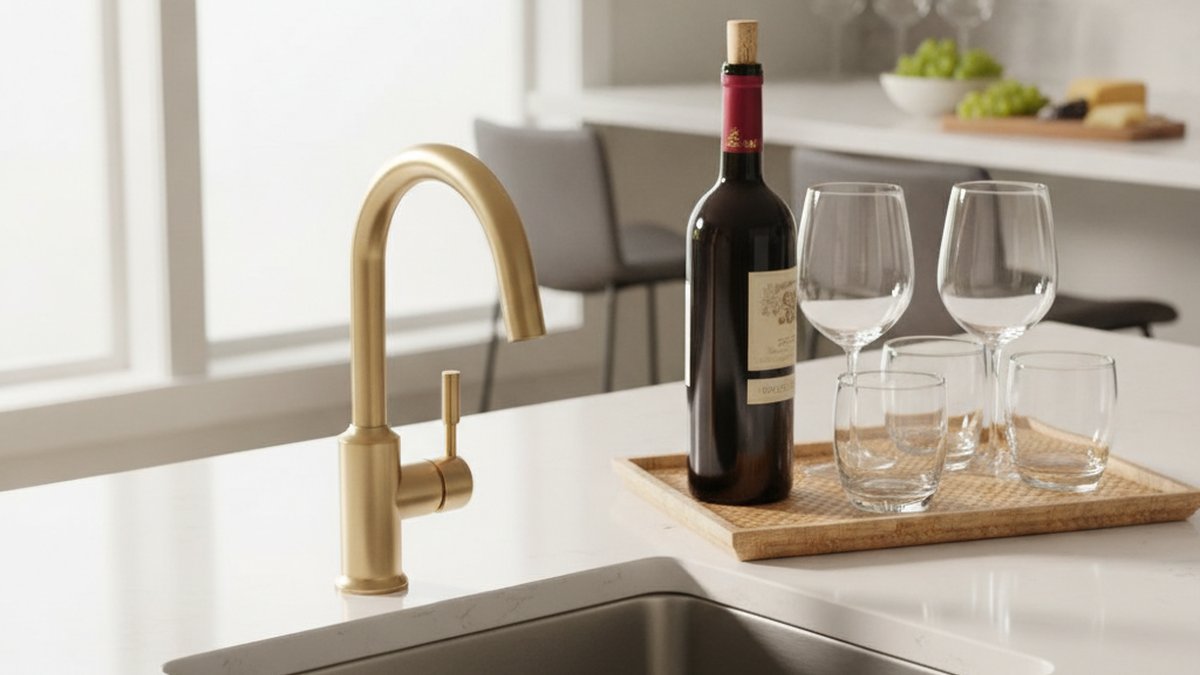
A bar tap gold finish is one of the fastest ways to make a small prep sink or wet bar look intentional and expensive — but the phrase covers everything from a $35 painted import to a $250 solid-brass fixture with a real PVD gold coating, and those are not the same product. This guide breaks down what a bar tap actually is, which gold finishes hold up, what to spend, and how to match it to the rest of your kitchen or bar so it looks like a choice, not an accident.
A “bar tap” (also called a bar faucet, prep faucet, or bar sink faucet) is simply a smaller, taller version of a kitchen faucet built for a compact secondary sink — the little sink in a kitchen island, a butler’s pantry, or a home wet bar. Because it sits at eye level and gets seen more than it gets used, finish quality matters even more here than on your main sink.
What exactly is a bar tap, and how is it different from a kitchen faucet?
A bar tap is a compact, high-arc faucet built for a small prep or bar sink — typically a single handle, a single hole, and a spout that’s narrower and often taller than a full kitchen faucet. The difference isn’t the finish; it’s the scale and the flow.
Here’s what sets a bar faucet apart in practical terms:
- Smaller footprint: The base and spout are sized for a 12–18 inch bar sink, not a 30-inch double-bowl kitchen sink. A full-size kitchen faucet looks comically oversized on a bar sink.
- Higher, tighter arc: Many gold bar taps use a tall gooseneck so you can fill a wine decanter, pitcher, or coffee carafe — but the spout reach is shorter, keeping water centered in a small bowl.
- Lower flow rate: Bar taps commonly ship with a 1.0–1.5 GPM aerator (versus 1.8 GPM on kitchen faucets), because you’re rinsing glasses and filling cups, not filling stockpots.
- Cold-friendly plumbing: Some bar faucets are single-temp cold-only for a dedicated ice/water station, though most home versions are hot-and-cold like a normal faucet.
So when you shop “bar tap gold,” you’re really choosing two things at once: the right small-scale form factor and a gold finish that will survive years of fingerprints and citrus splashes.
Is a gold bar tap actually durable, or does the finish wear off?
A quality gold bar tap is very durable — the gold color lives in a PVD (physical vapor deposition) coating that’s molecularly bonded to the brass and is genuinely scratch- and tarnish-resistant. The finishes that fail are cheap electroplated or spray-lacquered “gold” coatings, which discolor, cloud, and flake, usually starting around the aerator and handle where water pools.
This is the single most important thing to get right, so here’s the plain-English version. PVD is an industrial process that fuses a hard, thin metallic layer to the faucet body in a vacuum chamber. It’s the same category of coating used on high-end watch cases. A PVD brushed-gold or champagne-gold bar tap will typically outlast the cartridge inside it, and most reputable brands back it with a lifetime finish warranty. A lacquered or “painted gold” tap, by contrast, is a color layer sitting on top of the metal — and warm, wet, acidic bar conditions (lime wedges, tonic, wine) are exactly what breaks lacquer down.
If you want a deeper look at how living finishes behave over time — and why some people want a finish that ages — our guide to whether an unlacquered copper faucet is worth it and how to live with the patina is a useful companion read. Gold is the opposite philosophy: most buyers want it to look identical on day 1,000 as on day one, which is exactly why the PVD-vs-lacquer distinction decides whether you’ll be happy.
How do I tell PVD gold from cheap plated gold before I buy?
Check three things: the product spec, the warranty, and the weight. If the listing explicitly says “PVD” and offers a lifetime finish warranty, that’s your green light. If it only says “gold plated” or “gold finish” with a 1–2 year warranty (or no finish warranty at all), assume it’s a coating that will wear. Solid-brass bar taps also feel noticeably heavier than zinc-alloy ones — pick it up if you can, or check the listed material.
Which gold finish should I pick — brushed gold, champagne, polished, or matte black gold?
For most home bars, brushed gold (a soft satin warm gold) is the safest, most forgiving choice because it hides water spots and fingerprints and blends with both warm and cool decor. Polished/shiny gold looks the most luxurious but shows every smudge; champagne gold is more muted and neutral; matte gold reads modern but can look flat under warm lighting.
Gold isn’t one color — the undertone changes the whole room. Here’s how the common bar-tap gold finishes compare:
| Gold finish | Look | Best for | Maintenance | Watch out for |
|---|---|---|---|---|
| Brushed / satin gold | Warm, soft, matte-satin sheen | Everyday home bars, hides fingerprints | Low — wipe with a soft cloth | Slight color variation between brands |
| Champagne gold / bronze | Muted, neutral, slightly rosy warm | Pairing with wood, cream, and champagne-bronze hardware | Low | Reads more “bronze” than “gold” in cool light |
| Polished / shiny gold | Bright, reflective, glam | Statement wet bars, powder-room-style luxury | High — shows spots and prints | Cheap versions look brassy/plasticky |
| Matte gold | Flat, modern, non-reflective | Contemporary, minimalist spaces | Medium | Can look dull under warm bulbs |
A quick rule that keeps people out of trouble: match the undertone, not the exact name. Brushed gold and champagne bronze live in the same warm family and pair beautifully, which is why buyers who like a gold bar tap often also consider a coordinating bathroom fixture — if that’s you, our breakdown of which single hole faucet in champagne bronze to buy shows how the same warm-metal look translates to a vanity.
How much should I spend on a gold bar tap, and what do I get at each price?
Plan on $90–$220 for a good PVD-finished, solid-brass gold bar tap that will last. Below about $70 you’re almost always buying zinc alloy with a plated or lacquered finish; above $250 you’re paying for designer branding, imported ceramic cartridges, and premium spray-arm features you may not need on a small bar sink.
Here’s the honest tier breakdown:
- $35–$70 (budget): Usually zinc-alloy body, electroplated or lacquered gold. Fine for a rental or a short-term flip, but expect the finish to fade and the handle to loosen within a couple of years.
- $90–$150 (sweet spot): Solid brass or heavy-duty construction, real PVD brushed or champagne gold, ceramic-disc cartridge, lifetime finish warranty. This is where most buyers should shop.
- $160–$250 (premium): Higher-grade cartridges, pull-down or pull-out spray heads, integrated water-filtration compatibility, and more refined polished-gold options. Worth it if the bar tap is a focal point.
- $250+ (designer): Name-brand European fixtures. Beautiful, but you’re paying for the label as much as the function on a bar-sized faucet.
One place not to cut corners: the cartridge. The cartridge is the valve that controls flow and temperature, and it’s the part most likely to eventually drip. If you’re not sure why it matters, our explainer on the purpose of a faucet cartridge is worth two minutes — a ceramic-disc cartridge is what separates a faucet that stays drip-free for a decade from one that needs repairs in year two.
Will a gold bar tap match my kitchen if my other fixtures are stainless or chrome?
Yes — mixing metals is not only fine, it’s the current standard in design, as long as you do it deliberately. The trick is to make the gold bar tap look like an intentional accent rather than a leftover, which usually means repeating the gold somewhere else nearby: cabinet pulls, a light fixture, or a soap dispenser.
Practical guidance for mixed-metal bars:
- Two metals, not five. Pair gold with one neutral (stainless, chrome, matte black, or white). Three-plus competing metals starts to look chaotic.
- Repeat the accent. If the bar tap is gold, add a gold cabinet pull or pendant light so the eye reads it as a theme.
- Warm with warm. Gold sits best with wood tones, cream, greens, and navy. Against cool gray everything, warm brushed gold or champagne reads better than bright polished gold.
- Coordinate the drain and dispenser. A matching gold sink drain and soap pump cost little and finish the look far more than most people expect.
What should I check before installing a bar tap in gold?
Before you buy, confirm three fit details: your sink’s hole count and diameter, the counter thickness the faucet can clamp, and your water-line connection type. A bar tap that doesn’t match your deck holes is the #1 reason returns happen — and gold finishes are often final-sale, so measure first.
Run through this quick pre-purchase checklist:
- Mounting holes: Most bar taps are single-hole. If your bar sink or countertop is pre-drilled for three holes, buy a matching deck plate (often called an escutcheon) in the same gold finish to cover the extras.
- Hole diameter: Standard is roughly 1⅜ inch (35 mm). Confirm your deck cutout matches.
- Spout height and reach: Measure the clearance under any upper cabinet or shelf above the bar sink so a tall gooseneck actually fits.
- Supply lines: Check whether the faucet includes braided supply hoses and whether they reach your shutoff valves. If they’re short, you’ll want longer ones on hand.
- Flow rate: A 1.0–1.5 GPM aerator is ideal for a bar sink; anything higher just splashes in a small bowl.
Installation itself is genuinely DIY-friendly for a single-hole bar tap — usually one mounting nut underneath, two supply connections, and you’re done in under an hour. If you’d rather do it fully yourself, having the right basin wrench and supply gear ready ahead of time makes it painless, and it also means you’re not buying a gold fixture and then scratching it with the wrong tool.
Why buy a Vevetta gold bar tap specifically?
Vevetta builds bar and kitchen faucets around solid-brass bodies, real PVD gold finishes, and ceramic-disc cartridges rated for hundreds of thousands of on/off cycles — the combination that keeps a gold bar tap looking new and drip-free for years, backed by a lifetime finish and cartridge warranty. Every finish is tested against standard salt-spray and abrasion protocols before it ships.
Our fixtures are built to meet the U.S. lead-free “safe drinking water” standard (NSF/ANSI 372) and the flow-rate and durability benchmarks defined by ASME A112.18.1 / CSA B125.1 — the same standards the industry’s most trusted brands are held to. If you’re comparing across the market, our roundups of the best Canadian faucet brands and what makes a high-end commercial kitchen faucet worth the money give you honest benchmarks to hold any gold bar tap against — including ours.
Author note: This guide was written by Vevetta’s fixtures editorial team and reviewed by a licensed plumber with over a decade of residential kitchen and bar installations. We test finishes and cartridges in-house and update this article as products and standards change. Last reviewed September 2026.
FAQ
Does a gold bar tap show water spots and fingerprints badly?
Brushed and champagne gold hide spots and fingerprints very well — their satin surface diffuses light so smudges barely show. Polished (shiny) gold shows everything and needs frequent wiping. If low maintenance matters to you, choose a brushed or matte gold finish. A quick wipe with a soft microfiber cloth is all any PVD gold finish needs; skip abrasive pads and harsh acidic cleaners.
Is gold going to look dated in a few years?
Warm metals like brushed and champagne gold have been mainstream in kitchen and bath design for years and show no sign of fading out — they read as timeless-warm rather than trendy. Bright, high-shine polished gold is more of a fashion statement and carries a little more “of-its-moment” risk. If longevity worries you, brushed or champagne gold is the low-regret pick.
Can I use a bar tap as a regular kitchen faucet?
You can, but it’s not ideal. A bar tap’s shorter reach and lower 1.0–1.5 GPM flow are built for a small sink; on a full-size kitchen sink it’ll feel cramped and slow to fill large pots. Use a bar tap for a bar, prep, or island sink, and a full kitchen faucet for the main sink.
How do I clean hard-water buildup off a gold bar tap without ruining the finish?
Wipe with a soft cloth dampened in warm water and mild dish soap, then dry. For light limescale, a 50/50 white vinegar and water solution on a cloth (not soaking) works, but keep it brief and rinse well — prolonged acid contact can dull any finish. For a step-by-step on stubborn crust, see our guide on how to clean sink faucet head buildup. Never use bleach, ammonia, or abrasive scrubbers on gold.
Do gold bar taps cost more than chrome or stainless versions?
Slightly, yes. A PVD gold finish typically adds about $10–$30 over the identical faucet in chrome or brushed nickel, because PVD is an extra manufacturing step. That premium is worth it for the durability; a cheap plated-gold tap that costs the same as chrome is usually a warning sign, not a bargain.
What’s the difference between “gold,” “brass,” and “champagne bronze” bar taps?
“Brass” can mean the raw metal body (which most quality faucets are made of regardless of color) or a warm yellow-gold finish. “Gold” usually refers to a brighter, more yellow PVD finish. “Champagne bronze” is a muted, slightly rosier warm tone. They’re close cousins in the warm-metal family and pair well together, but read the actual finish name and, ideally, look at a real photo under warm light before buying.