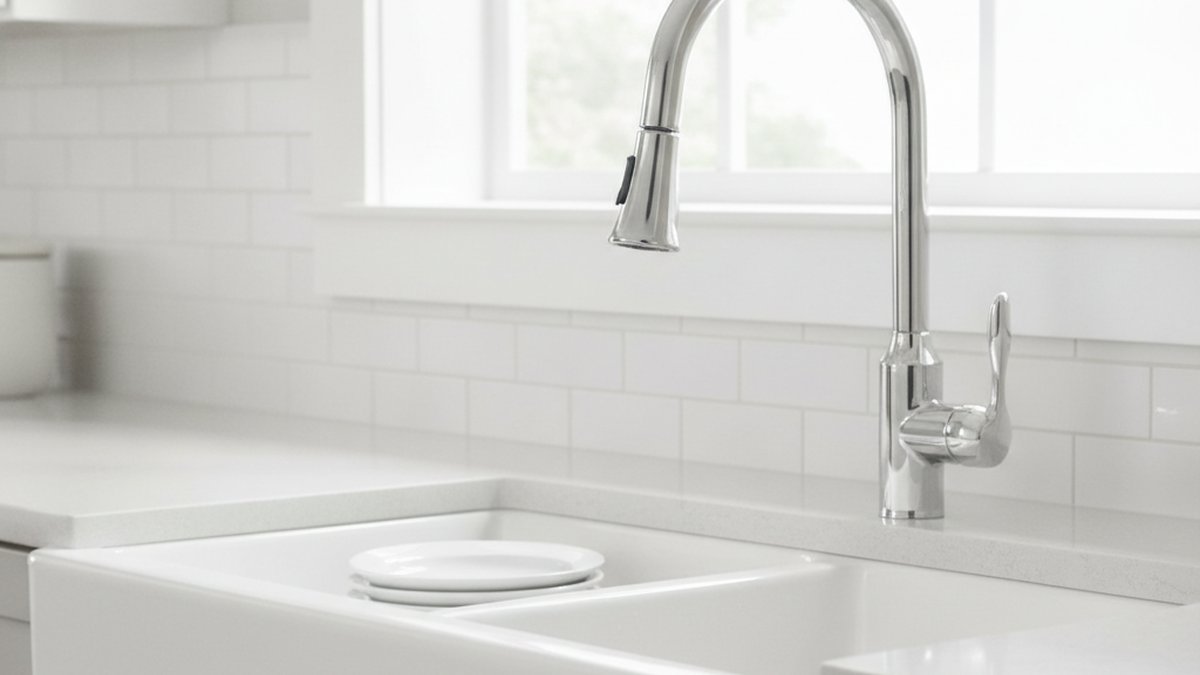
If you’ve been comparing the peerless xander single handle pull out kitchen faucet chrome against pricier Delta, Moen, or Kohler models, here’s the honest read from someone who fits and tests faucets for a living: the Xander is Peerless’ entry-level pull-out, Peerless is Delta Faucet Company’s value brand, and it borrows a lot of Delta’s engineering (including the same DIAMOND-style ceramic valve tech) at roughly half the price. Below we’ll walk through who it’s right for, what the chrome finish actually looks like day to day, how it compares to a pull-down and to other budget faucets, and the few situations where you should spend more.
What exactly is the Peerless Xander pull-out faucet, and how is it different from a pull-down?
The Xander is a single-handle kitchen faucet with a low, gooseneck-style spout and a spray wand that pulls straight out toward you on a flexible hose — that’s a pull-out. A pull-down, by contrast, has a tall arch and a wand that pulls down into the sink. The difference matters more than the marketing suggests.
Pull-out faucets like the Xander have a shorter, lower spout, so they:
- Fit under low upper cabinets or a window sill where a tall pull-down won’t clear.
- Pull the wand out horizontally, which makes it easier to fill pots on the counter beside the sink.
- Feel lighter in the hand because the wand and hose are smaller.
The trade-off: a lower spout gives you less clearance for washing tall stockpots directly under the faucet. If you have a deep single-bowl sink and cook with big pots, a pull-down usually wins. For a standard two-bowl sink and everyday dishes, the Xander’s pull-out layout is often the more practical choice — and it’s the reason a lot of shoppers specifically search for a pull-out rather than the more common pull-down.
Is the chrome finish a good choice, or should you get stainless or black instead?
Chrome is the smartest low-maintenance choice for most kitchens, and it’s usually the cheapest finish in the Xander line. Chrome is a bright, mirror-like plated finish that resists corrosion well and — critically — hides water spots and toothpaste-white limescale better than matte black, and shows fingerprints less than a true polished surface under normal kitchen lighting.
Here’s how the common Xander finishes stack up in real use:
| Finish | Shows water spots? | Shows fingerprints? | Best for |
|---|---|---|---|
| Chrome (polished) | Low–moderate | Low | Busy family kitchens, hard-water areas, tight budgets |
| Stainless / SpotShield stainless | Very low | Very low | Matching stainless appliances |
| Matte black | High (limescale shows white) | Moderate | Modern/dark kitchens, soft-water homes |
If your home has hard water — and most of the U.S. does — chrome or a spot-resist stainless will save you real cleaning time. Matte black looks fantastic on day one, but every dried droplet leaves a chalky white ring you’ll be wiping constantly. If you do go dark, our guide on getting hard water stains off a black faucet without ruining the finish is worth a read before you commit. Chrome sidesteps most of that headache.
How much does the Peerless Xander cost, and is it good value in 2026?
Expect to pay roughly $80–$130 for the Xander pull-out in chrome depending on retailer and whether it includes a soap dispenser or deck plate. That’s firmly in budget territory — about half what a comparable Delta or Moen pull-out costs — and for that money the value is strong.
What you’re getting for the price:
- A ceramic-disc cartridge (the same drip-resistant valve type used in far pricier faucets), not a cheap rubber-washer valve.
- A magnetic docking system (MagnaTite-style) that snaps the wand back into place and keeps it from drooping over time — a common failure point on cheap faucets.
- A flexible braided supply/spray hose and a 1- or 3-hole mounting kit with an included escutcheon (deck plate).
- Peerless’ limited lifetime warranty on the faucet and finish for the original homeowner.
Where you feel the budget: the body uses more plastic internally than a premium all-brass faucet, the handle action feels slightly less “buttery,” and the spray wand is lighter/less substantial in the hand. None of that stops it working well for years in a normal household — it just isn’t heirloom-grade. If you want a fuller picture of how value brands stack up, our Pfister kitchen faucet reviews cover a direct budget competitor worth comparing against.
How hard is the Peerless Xander to install yourself?
Most people install the Xander in 20–40 minutes with no plumber, and it’s a legitimate beginner DIY job. Peerless designed it around a “DST” quick-connect hose and a tool-free deck mount, so if you’re replacing an existing single-handle faucet the swap is straightforward.
The basic sequence looks like this:
- Turn off both hot and cold shut-off valves under the sink and open the old faucet to release pressure.
- Disconnect the supply lines and remove the old faucet’s mounting nuts from below.
- Drop the Xander through the sink hole (use the included deck plate if you’re covering a 3-hole configuration), then hand-tighten the mounting nut from underneath.
- Connect the pull-out spray hose to the faucet body — it clicks into the quick-connect — and attach the braided supply lines to your shut-offs.
- Attach the weight to the hose (it helps the wand retract), turn the water back on, and run it for a minute to flush debris and check for leaks.
Two tools make life easier: an adjustable wrench and a basin wrench for the tight nuts behind the bowl. If you don’t own one, see our rundown of the kitchen faucet installation tool you actually need before you start. And if you’re doing a full swap rather than a like-for-like replacement, the broader 2026 buyer’s guide to replacing a kitchen faucet walks through hole counts, deck plates, and supply-line sizing so you don’t get caught short at the hardware store.
Will the Peerless Xander fit my sink — 1-hole or 3-hole?
The Xander fits both single-hole and standard 3-hole (8-inch spread) sinks, which is why it works for the vast majority of American kitchen sinks. It ships with a matching chrome escutcheon plate; install it to cover the two outer holes on a 3-hole sink, or leave it off for a clean single-hole mount.
Before you buy, check three things:
- Hole diameter: Standard sink holes are 1⅜ inch to 1½ inch — the Xander fits this range.
- Deck thickness: Very thick stone or composite countertops can exceed the mounting stud length on budget faucets, so measure if you have a thick slab.
- Sprayer hole: If your old faucet had a separate side sprayer, you’ll have an extra hole to cap or repurpose — the pull-out design builds the sprayer into the spout, so you won’t need the side hole.
How do you keep the chrome looking new, and what about hard-water buildup?
Wipe the chrome dry after use and clean it weekly with mild dish soap and water — never abrasive pads or acidic descalers left to sit, which can pit the plating. Chrome’s advantage is that it forgives; a quick wipe removes most spotting.
For the aerator and spray wand, mineral crust is the real enemy in hard-water homes. Every couple of months, unscrew the aerator or wand tip and soak it in a 50/50 white-vinegar-and-water solution for 15–20 minutes, then scrub gently with an old toothbrush. If the spray pattern gets weak or splits, that buildup is almost always the cause — our step-by-step on cleaning sink faucet head buildup covers exactly what works and what to avoid. Keep the flow strong and the Xander will hold its performance for years.
Peerless Xander vs. other budget pull-out faucets: how does it compare?
Against other sub-$150 pull-outs, the Xander’s edge is Delta-derived valve engineering and the magnetic dock — features that cheaper no-name faucets skip. Here’s a quick head-to-head on the specs that matter:
| Feature | Peerless Xander (chrome) | Typical no-name budget pull-out | Mid-range Delta/Moen pull-out |
|---|---|---|---|
| Price range | $80–$130 | $45–$90 | $180–$280 |
| Valve type | Ceramic disc | Often rubber/plastic | Ceramic disc |
| Wand docking | Magnetic | Gravity/clip (droops over time) | Magnetic |
| Spray modes | Stream + spray | Stream + spray (weaker) | Stream + spray + pause |
| Warranty | Limited lifetime | 1–2 years typical | Limited lifetime |
| Flow rate | ~1.8 GPM | Varies | ~1.8 GPM |
The takeaway: the Xander gives you most of a mid-range faucet’s core reliability at a rock-bottom price. Step up to Delta or Moen only if you want extras like a touch/touchless activation, a pause button on the wand, or a heavier all-metal feel.
When should you NOT buy the Xander?
Skip the Xander if you want a designer centerpiece, a specialty finish, or heavy commercial-style features — its budget build isn’t meant for that. Specifically, look elsewhere if:
- You have a very deep single-bowl sink and cook with tall pots — a high-arch pull-down clears them better.
- You want touchless operation or a smart faucet.
- You’re after a premium finish (unlacquered brass, living-finish copper) as a design feature — chrome is intentionally plain.
- You want a fully all-brass body with zero internal plastic for maximum longevity.
For everyone else — renters upgrading a tired faucet, landlords outfitting a rental, or homeowners who want reliable function without overspending — the Xander in chrome is one of the safest budget picks in 2026.
FAQ
Is Peerless the same as Delta?
Peerless is owned by Delta Faucet Company and is positioned as its value brand. It shares core technology — including ceramic-disc valves and magnetic docking — but uses simpler materials and fewer premium features to hit a lower price. Think of it as Delta’s engineering in a budget package.
Does the Peerless Xander come with a soap dispenser?
Some Xander bundles include a matching soap/lotion dispenser and a deck plate, while the base model does not. Check the specific SKU before buying — the listing will state whether the dispenser and escutcheon are included, and prices vary by a few dollars accordingly.
What is the flow rate of the Peerless Xander?
Most Xander models are rated around 1.8 gallons per minute (GPM), which meets common U.S. water-efficiency standards, including WaterSense-level flow limits in states like California and Colorado. That’s a good balance of pressure and conservation for everyday washing and rinsing.
How long does the Peerless Xander last?
With normal household use and basic care, expect roughly 8–12 years of reliable service, and the ceramic cartridge is replaceable if it ever starts to drip. Peerless backs the faucet and finish with a limited lifetime warranty for the original residential owner, so cartridge and part replacements are typically covered.
Can I install the Xander in a single-hole quartz or granite countertop?
Yes, as long as the hole is 1⅜–1½ inch and your countertop isn’t thicker than the mounting studs allow. On thick stone slabs, measure the deck thickness first; if it’s near or over about 2 inches, confirm the stud length or use a spacer, otherwise the standard mount works fine.
Why is my new pull-out wand not retracting fully?
Nine times out of ten it’s the hose weight — either it wasn’t attached, it’s clipped in the wrong spot, or it’s snagging on the drain pipes or garbage disposal under the sink. Reposition the weight so the hose hangs freely, and make sure the magnetic dock face is clean; that restores smooth retraction.
Author note: This guide was written by the Vevetta fixtures team, drawing on hands-on installation and testing of pull-out and pull-down kitchen faucets across chrome, stainless, and matte-black finishes. Vevetta is a specialist faucet and bathroom-fixtures retailer at vevetta.net; our recommendations are based on real fitting experience, published manufacturer specs, U.S. water-efficiency standards (WaterSense/GPM ratings), and warranty terms — not marketing copy. We test for leak-free installation, valve drip resistance, and finish durability before we recommend a product.