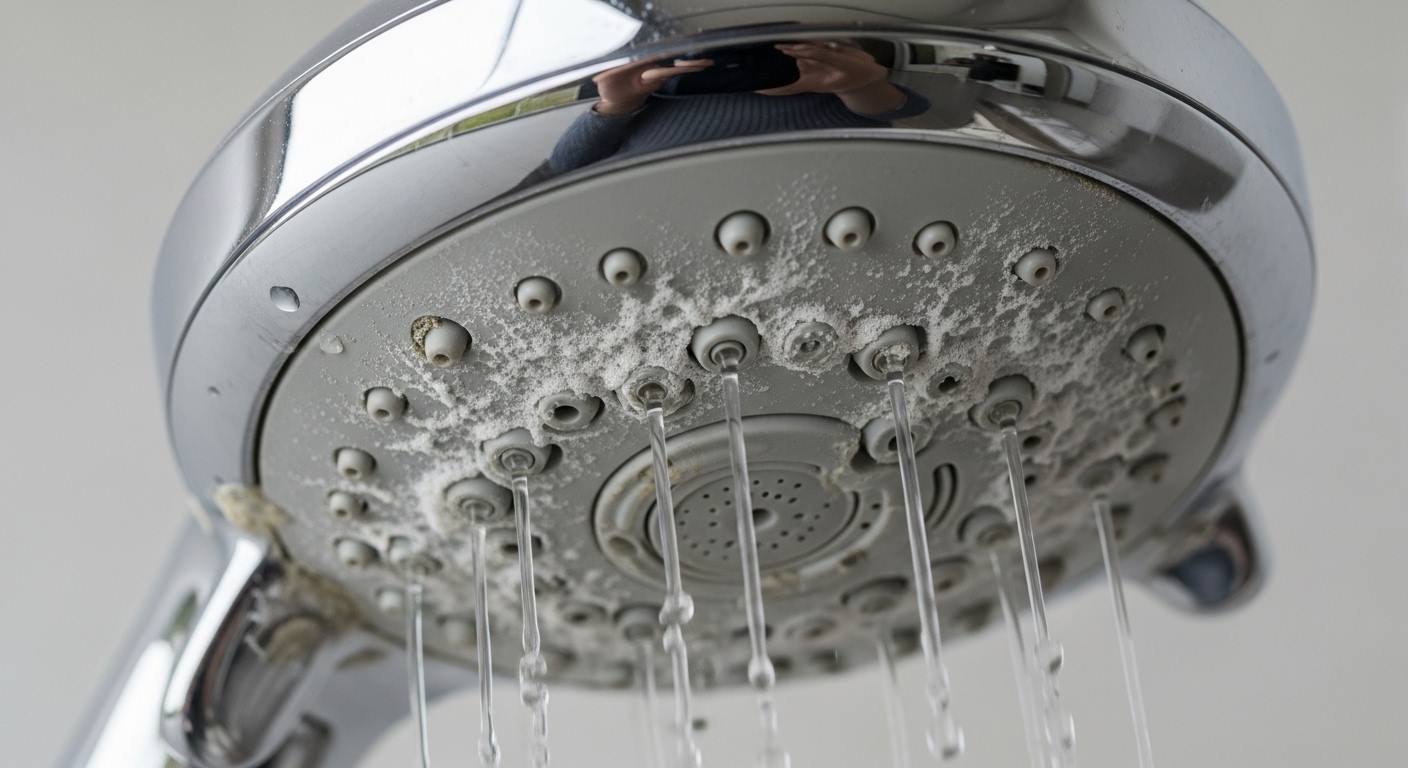
If your shower head water pressure is too low, the good news is that in about 8 out of 10 cases the fix is cheap, fast, and doesn’t require any plumbing skills. The culprit is usually hard-water scale clogging the tiny spray holes or a partially blocked flow restrictor inside the head — not a serious problem with your home’s plumbing. Before you assume you need a new pump or a pro, work through the simple checks below. They take minutes, cost almost nothing, and solve the vast majority of weak-shower complaints.
Below I’ll walk you through exactly how to diagnose why your pressure dropped, the order to test things in, and how to fix each cause — from a five-minute vinegar soak to spotting the rare problem that genuinely needs a plumber.
Why is my shower head water pressure suddenly so low?
If the drop was sudden, suspect a clog or a valve that got bumped; if it faded gradually over months, it’s almost certainly mineral buildup. Those two patterns point you straight to the cause. A sudden change after the water was shut off (for a repair, a new water heater, or street work) usually means a shut-off valve wasn’t fully reopened or sediment got stirred up. A slow fade is the classic signature of limescale slowly choking the nozzles and the internal screen.
Here’s the quick triage I use:
- Only the shower is weak, everything else is fine → the problem is in the shower head or arm, not your house. Easiest case.
- Only hot water is weak → sediment in the water heater or a hot-side supply issue, not the head.
- The whole house is weak → a main pressure regulator, a half-closed main valve, or municipal supply. The head isn’t your problem.
- It’s weak only at certain times of day → demand on your street or shared plumbing; pressure is genuinely lower at peak hours.
Run that triage first. It tells you whether to spend your time on the shower head (most common) or somewhere upstream.
How do I clean a clogged shower head to bring the pressure back?
Soak it in white vinegar for 30–60 minutes, then scrub the nozzles — this fixes the majority of low-pressure showers. Vinegar is mildly acidic, so it dissolves the calcium and magnesium scale that plugs the spray holes and the internal screen. You don’t need special chemicals; a gallon jug of distilled white vinegar costs a couple of dollars.
You have two ways to do it:
- The no-removal method: Fill a sturdy plastic bag with vinegar, slip it over the shower head so the whole head is submerged, and secure it with a rubber band or zip tie. Leave it 30–60 minutes (overnight for heavy scale), then remove and run hot water for a minute to flush loosened debris.
- The full-soak method (better): Unscrew the head from the shower arm by hand or with a wrench (wrap the connection in a cloth so you don’t scratch the finish). Take out the rubber washer, drop the head into a bowl of warm vinegar, and let it soak. While it soaks, scrub the face with an old toothbrush and poke each clogged nozzle with a toothpick or pin.
Most modern faces have soft rubber “nubs” over each hole specifically so you can rub the scale off with your thumb — give them a firm massage under running water. After soaking, rinse thoroughly, re-seat the washer, and hand-tighten back onto the arm with a wrap of plumber’s (PTFE) tape on the threads to stop drips.
One caution: if you have a brushed nickel, matte black, oil-rubbed bronze, or gold finish, don’t leave it in vinegar for hours — long acid exposure can dull or etch some coatings. Stick to 30 minutes for finished/colored heads, rinse well, and dry with a soft cloth. (For finish-specific care, our guide on polished nickel faucet maintenance covers what acids and abrasives to avoid on premium finishes.)
What is a flow restrictor, and should I remove it to boost pressure?
A flow restrictor is a small plastic disc inside the shower head that limits the gallons per minute to meet water-conservation standards — and yes, cleaning or carefully removing it can noticeably increase flow, but understand the trade-offs first. By U.S. federal standard, shower heads are capped at 2.5 gallons per minute (GPM), and many “eco” or WaterSense models run 1.8–2.0 GPM. That cap is a feature, not a fault, but a restrictor that’s also clogged with grit will choke flow far below its design rate.
To find it: unscrew the head, look into the inlet (the end that screws onto the arm), and you’ll usually see a colored plastic disc with a small hole in the center, often behind a screen or filter washer. Pull out the screen and rinse out any sediment first — that alone often restores normal flow. If you then choose to remove the restrictor itself, pry it out gently with a small flat screwdriver or needle-nose pliers.
| Approach | Effect on pressure | Water use / cost | Best for |
|---|---|---|---|
| Clean the restrictor & screen only | Restores designed flow | No change — stays code-compliant | Almost everyone; do this first |
| Remove the restrictor entirely | Noticeably stronger spray | Higher water + heating bills; not WaterSense-compliant | Genuinely low household pressure only |
| Buy a high-pressure / low-flow head | Strong feel at low GPM | $25–$80 up front, saves long-term | The smartest long-term fix |
My honest recommendation: clean the restrictor and screen before you remove anything. Removing it does increase flow, but it raises your water and water-heating bills and isn’t legal in some states. A well-designed high-pressure head that concentrates a 1.8 GPM stream usually feels stronger than an unrestricted old head anyway.
How do I tell if it’s the shower head or my home’s water pressure?
Test the shower arm with the head removed — if water blasts out of the bare arm but dribbles through the head, your head is the problem; if the bare arm is also weak, the issue is upstream. This single test saves hours of guessing. Unscrew the head, hold a bucket under the open arm, turn the shower on, and watch the force.
If you want a real number, measure it: hold a measuring jug under the head and time how long it takes to collect a gallon. Divide 60 by the seconds it took to get your GPM. A healthy head should hit close to its rated 1.8–2.5 GPM. For static pressure, a $10 gauge that screws onto an outdoor spigot or laundry tap will read your PSI — normal residential pressure is 45–80 PSI. Below ~40 PSI the whole house will feel weak, and that’s a regulator or supply issue, not the shower head.
Other upstream suspects worth a look:
- The shower’s own shut-off or the main valve isn’t fully open (a quarter-turn can cut flow a lot).
- A failing pressure-reducing valve (PRV) near your main line — these wear out and slowly strangle the whole house.
- A water-saving mixing/anti-scald valve in the shower that’s worn or scaled. If your handle also feels stiff or the temperature is hard to set, the valve cartridge may be the real issue — our walkthrough on a shower faucet handle that’s hard to turn covers cleaning and replacing that cartridge.
- Galvanized steel pipes in older homes that have corroded and narrowed internally — the one genuine “call a plumber” cause.
Does the type of shower head matter for low pressure?
Yes — handheld and rain heads behave very differently under low pressure, and choosing the right type can solve a weak shower without touching your plumbing. Big “rain” heads spread the same gallons over a huge surface, so each drop arrives gently; that’s luxurious if your pressure is strong but disappointing if it’s marginal. A compact head or a pressure-boosting handheld concentrates the flow, so it feels far more powerful at the exact same GPM.
If your home genuinely runs low on pressure, look for these design features:
- Pressure-compensating / turbocharged nozzles that accelerate water through narrower jets.
- Fewer, larger spray channels rather than dozens of tiny holes that clog fast.
- A handheld on a hose, which lets you bring the spray closer to you — instantly “stronger” with zero plumbing changes. Our guide to handheld shower heads breaks down which spray modes hold up best on lower pressure.
- Self-cleaning silicone nozzles so scale never builds back up.
If you’re upgrading the whole setup rather than swapping one head, our complete shower system installation guide covers matching the head, valve, and supply so you don’t accidentally bottleneck flow at the valve. And if you specifically have an eco-model that’s gone weak, the Moen Eco Performance low-pressure repair guide walks through that exact unit step by step.
What if cleaning didn’t fix the low pressure?
If a thorough vinegar soak and a cleared restrictor didn’t help, the problem is upstream of the head — work through the valves, the regulator, and finally the pipes, in that order. Don’t jump straight to replacing the head; you’ll just bolt a clean head onto a starved supply.
Go in this sequence:
- Confirm both the main shut-off and any shower-specific valve are fully open. Open is parallel to the pipe (lever) or fully counter-clockwise (round handle).
- Replace the shower hose or arm if you have a handheld — cheap hoses kink internally and crush flow.
- Test PSI with a gauge. Under 40 PSI house-wide points to a failing pressure regulator — a plumber can swap it for $150–$350.
- Check for galvanized pipe in homes built before ~1970. Corroded steel pipe is the one fix that’s genuinely a plumbing job (repiping in PEX or copper).
- Consider a shower pump or booster if you’re on a gravity-fed or well system that’s simply low at the source.
Working through that list tells you with confidence whether you’ve got a five-dollar fix or a real plumbing project — and you’ll never overpay for a problem a vinegar bag could have solved.
FAQ
Why does my shower head water pressure get worse over time?
Gradual loss is mineral scale. Calcium and magnesium in hard water slowly deposit inside the nozzles and on the internal screen, narrowing the openings month by month until the spray weakens. A vinegar soak every few months reverses it; a whole-house water softener prevents it long-term.
Is it legal to remove the flow restrictor from my shower head?
It’s federally limited and restricted or banned in some states (notably California and Colorado have strict flow rules), and removing it isn’t WaterSense-compliant. It’s your head to modify in most places, but you’ll pay more in water and water-heating bills. Cleaning the restrictor and screen usually restores plenty of flow without removing it.
Can hard water permanently ruin a shower head?
It rarely ruins the head itself — scale is removable with vinegar — but heavy buildup can eventually clog passages you can’t reach and pit some finishes. If a head no longer cleans up after a long soak, it’s cheaper to replace it with a self-cleaning, scale-resistant model than to keep fighting it.
How often should I clean my shower head to keep pressure up?
Every 3–6 months in hard-water areas, once a year in soft-water areas. A quick vinegar-bag soak overnight is enough as routine maintenance. If you notice the spray pattern getting uneven or veering off to one side, that’s your cue that scale is forming and it’s time to soak.
Will a new shower head fix low pressure on its own?
Only if the old head was the bottleneck — which it often is. A pressure-optimized head with concentrated nozzles can transform a weak shower at the same GPM. But if your home’s PSI is genuinely low (under 40), a new head won’t manufacture pressure that isn’t there; you’ll need to address the regulator, valves, or supply first.
Why is only my hot water pressure low in the shower?
That points to the hot side specifically: sediment built up in the water heater tank, a partly closed valve on the hot supply, or scale in the heater’s outlet. Flushing the water heater often restores it. If both temperatures are weak, the problem is the head or the cold-and-hot shared supply, not the heater.
About the author: This guide was written by the Vevetta fixtures team — product specialists who test shower heads, faucets, and valves for real-world flow performance, scale resistance, and finish durability before we recommend them. We’ve diagnosed weak-shower complaints across hard-water and low-pressure homes nationwide, and every fix here reflects what actually works in the field, not theory.
Why trust Vevetta: Vevetta designs and sells faucets and bathroom fixtures built to U.S. flow and safety standards. Our shower heads are tested against the federal 2.5 GPM cap and ASME/EPA WaterSense performance criteria, and our fixtures carry manufacturer warranties so you’re covered if a part fails. We publish repair guides like this one because a well-maintained fixture lasts longer — whether or not you bought it from us.