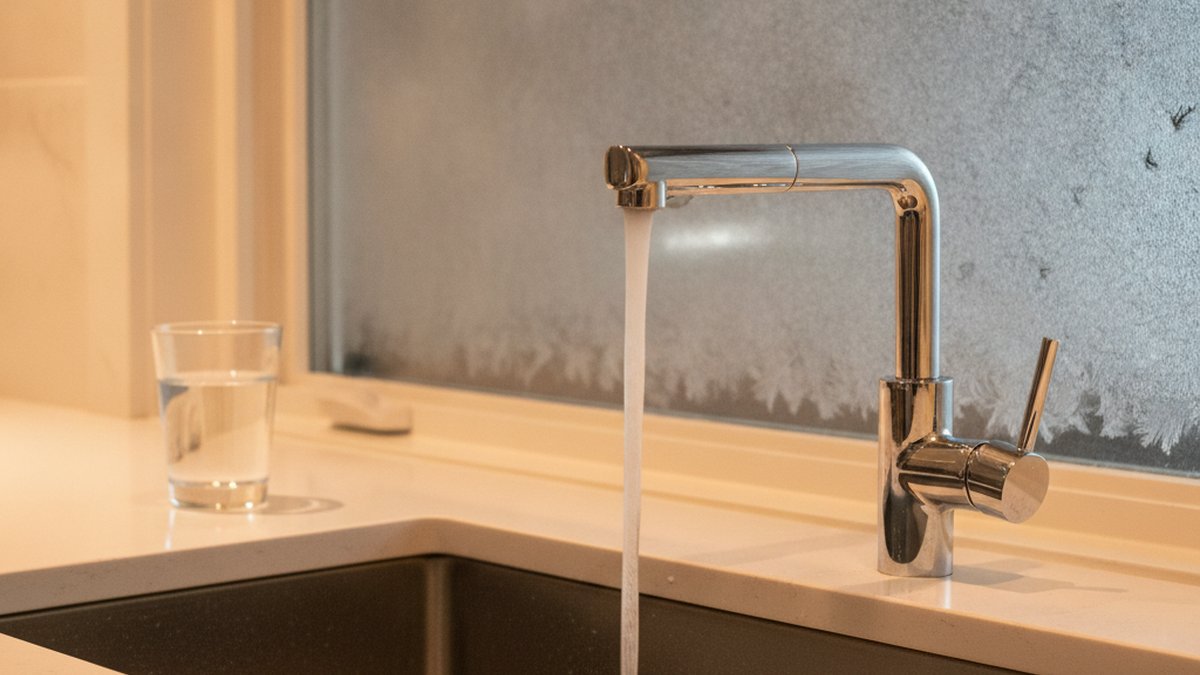
A dripping faucet during freeze conditions isn’t a plumbing problem you need to fix — it’s a plumbing trick that’s protecting you. Every winter, plumbers get flooded with burst-pipe calls, and the homes that stay dry are almost always the ones where someone cracked a tap open overnight. Below, I’ll explain exactly why the drip works (it’s not what most people think), which faucet to open, how much water you actually need, and — importantly — how to tell a protective drip apart from a leak or a faucet that’s genuinely failing on you.
Why does leaving a faucet dripping actually stop a pipe from bursting?
It stops the burst by relieving pressure, not by keeping water warm enough to prevent freezing. This is the part almost everyone gets wrong. A slow drip won’t stop water in your pipes from turning to ice — the water often still freezes. What the open faucet does is give the system somewhere to release the pressure.
Here’s the physics in plain language. When water freezes inside a pipe, it expands about 9% and forms an ice plug. If the faucet at the end of that pipe is shut tight, water gets trapped between the growing ice plug and the closed valve. As the ice keeps expanding, the pressure in that trapped section can spike to thousands of PSI — far beyond what copper or PEX can hold. That’s the pressure that splits the pipe, and it usually splits downstream of the ice, not at the frozen spot itself.
Open the faucet even slightly, and that trapped water now has an escape route. Pressure bleeds off through the spout instead of tearing the pipe apart. That’s why a faucet that’s barely dripping — or an ice-cold pipe that produces just a slow, sputtering trickle — is still doing its job. If water is moving at all, pressure isn’t building.
- The drip relieves pressure — it’s a controlled release valve, not a heater.
- Moving water freezes slower too, so you get a small second benefit: a trickle buys you time before an ice plug even forms.
- The faucet is the weakest, safest failure point. Better a few gallons down the drain than a split pipe inside a wall.
At what temperature should I start dripping my faucets?
Start dripping when the outside temperature is forecast to drop to around 20°F (-6°C) or below, especially overnight. That’s the widely cited threshold at which unprotected pipes — the ones in unheated or poorly insulated spaces — start to be at real risk.
But temperature alone doesn’t tell the whole story. The pipes that freeze first aren’t necessarily in the coldest outdoor air; they’re the ones with the least insulation and the most exposure to cold air movement. Prioritize dripping the faucets served by:
- Pipes running along exterior walls — the classic culprit, especially north-facing walls.
- Pipes in unheated spaces — crawl spaces, garages, basements, attics, and cabinets against outside walls.
- The faucet farthest from where water enters your home — the longest run through cold zones.
- Any line that has frozen before. Once a run has frozen, it’ll do it again in the same spot.
Two other factors lower that threshold, meaning you should drip even in less extreme cold: sustained wind (wind chill absolutely affects pipes in vented crawl spaces and along siding), and how long the cold lasts. A single hour at 25°F won’t freeze much, but 25°F holding steady for 12 hours overnight can. When a hard freeze or “polar vortex” warning is in the forecast, don’t overthink it — drip.
| Outdoor temp (sustained overnight) | Pipe risk | What to do |
|---|---|---|
| Above 32°F (0°C) | Very low | No dripping needed |
| 20–32°F (-6 to 0°C) | Low, unless pipes are exposed/uninsulated | Drip exposed-wall & crawl-space faucets |
| Below 20°F (-6°C) | Moderate to high | Drip vulnerable faucets; open cabinet doors |
| Below 0°F (-18°C), or high wind | High — even insulated pipes at risk | Drip multiple faucets, hot & cold; consider heat tape |
How much should the faucet actually drip — a drip, or a stream?
Aim for a slow, steady trickle about the thickness of a pencil lead or a thin piece of spaghetti — not a single “drip… drip… drip” every few seconds. A true intermittent drip may be too little water movement to reliably relieve pressure, while a wide-open tap just wastes gallons for no extra protection.
The right amount is the smallest continuous flow you can see moving. Think roughly a stream you could thread a needle through. Over a full freezing night, that adds up to only a few gallons — pennies of water compared to the hundreds or thousands of dollars a burst pipe and water damage will cost you.
If your faucet is a single-handle mixer, set the handle to the middle position so both the hot and cold lines flow. This matters more than people realize: your hot-water pipes freeze too, and in some homes they run through even colder spaces. Dripping only the cold side leaves your hot line unprotected. On a two-handle faucet, crack both the hot and cold valves open a little.
Faucet type changes how easy this is to set. A worn cartridge or a faucet with a stiff ceramic disc can make a fine trickle hard to dial in — if yours only wants to go from “off” to “gushing,” that’s a sign the internal cartridge or washer is worn, and it’s worth reading our guide on how to fix a leak from a faucet yourself once the cold snap passes.
Is my faucet dripping to protect the pipe, or is it actually leaking?
If you opened the tap on purpose during a freeze, that’s protection — turn it off once temperatures climb back above freezing and it should stop cleanly. If a faucet keeps dripping after you’ve shut it firmly, that’s a leak, and freezing weather makes it worse, not better.
The distinction matters because cold weather can turn a small, ignorable leak into a real hazard. Here’s how to tell them apart:
- Protective drip: water flows only while the handle is open; closing the handle stops it completely. This is intentional and good.
- Worn-washer or cartridge leak: the faucet drips even when fully closed. In a freeze, that constant seepage can freeze right at the spout or aerator and, more dangerously, means the valve isn’t fully sealing — trapped water behind a partly-open seat can still build pressure.
- Freeze-damaged faucet: reduced flow, sputtering, or no water at all from a tap that worked yesterday often means there’s already an ice plug forming upstream. That’s your cue to act fast (see the next section).
Outdoor faucets (hose bibs and sillcocks) deserve special attention, because a dripping or leaking one going into winter is a burst waiting to happen. If your outside tap weeps at the handle, fix it before the freeze — our walkthrough on fixing a leaking outdoor faucet handle covers the packing nut and washer repair that usually solves it. And always disconnect garden hoses before a freeze: a connected hose traps water in the bib and is a leading cause of burst outdoor lines.
What do I do if the faucet already stopped dripping and no water comes out?
If a faucet you left running slows to nothing during a freeze, assume a pipe has started to freeze and act immediately — the pipe hasn’t necessarily burst yet, and quick action can save it. Do this:
- Leave that faucet open. Don’t close it. As the ice melts, the open tap gives the water somewhere to go and lets you see when flow returns.
- Find the frozen section. It’s usually the coldest, most exposed run feeding that tap — along an exterior wall, in a cabinet, or in the crawl space.
- Apply gentle heat to the frozen area: a hair dryer, a space heater kept a safe distance away, or towels soaked in hot water wrapped around the pipe. Work from the faucet end back toward the frozen spot so meltwater can escape.
- Never use an open flame — no blowtorch, no propane. You’ll damage the pipe, and thawing too fast can crack it or start a fire.
- Open nearby cabinet doors to let warm room air reach pipes under sinks.
If you thaw the pipe and water gushes from a split once it melts, shut off your home’s main water supply immediately — know where that shutoff is before winter, not during the emergency. If you can’t locate the frozen section, can’t thaw it, or suspect the pipe is already inside a wall, that’s the moment to call a licensed plumber rather than guess.
What else should I do besides dripping to keep pipes from freezing?
Dripping is your overnight insurance, but a few cheap habits make it far more effective and can let you skip the drip on borderline nights. The best freeze protection is layered — drip plus a warmer environment around the pipe.
- Open cabinet doors under kitchen and bathroom sinks so heated room air reaches the supply lines. This alone raises pipe temperature by several degrees.
- Insulate exposed pipes with foam pipe sleeves — a few dollars per length at any hardware store, and they slip right on.
- Seal drafts near pipes: gaps around the rim joist, crawl-space vents, and where lines pass through exterior walls let freezing air blow straight onto copper.
- Keep the thermostat steady, even at night and when you’re away — no lower than about 55°F (13°C) during a cold snap. Don’t let the house cool down overnight during a hard freeze.
- Use heat tape or heat cable on chronically problem pipes; it’s thermostatically controlled and turns on only when needed.
- Winterize outdoor faucets: disconnect hoses, shut off and drain the outdoor supply line if you have an interior shutoff, and add insulated faucet covers.
A quick note on faucet condition, since it’s our world: a faucet in good repair is easier to protect. Worn cartridges make it hard to set a clean trickle, gummed-up aerators reduce flow so you can’t tell whether a pipe is freezing, and failing washers leak in ways that freeze. Heading into winter, it’s worth servicing any tap that’s already misbehaving — if yours is dripping at the base or the handle, our guide on removing an old tap washer without wrecking the faucet will get you sorted before the cold sets in.
How long can I leave a faucet dripping, and will it spike my water bill?
You can leave it dripping for the entire duration of the freeze — hours or even a few days straight — without worry, and the water cost is trivial. A pencil-thin trickle over a 12-hour freezing night uses only a handful of gallons. Even across a multi-day cold snap, you’re looking at cents to a couple of dollars of water, versus an average burst-pipe insurance claim that runs into the thousands.
Turn the drip off once outdoor temperatures rise reliably above freezing and stay there — usually mid-morning after a cold night. There’s no need to keep dripping through a mild afternoon. If another freezing night follows, just start the drip again in the evening. Think of it as a nightly routine during a cold spell, not a set-and-forget fixture.
Author note & how we test
This guide was written by the Vevetta fixtures team — plumbers and product testers who install, stress-test, and repair faucets, valves, and supply lines year-round, including in cold-climate homes. We’ve thawed our share of frozen lines and replaced plenty of burst-pipe casualties, so the advice here reflects what actually keeps homes dry, not just textbook theory.
At Vevetta (vevetta.net), we design and pressure-test our faucets and cartridges to standard residential supply pressures (typically 60–80 PSI) and thermal-cycle our valve components so they seal cleanly across the temperature swings a real home sees through winter. Our faucets meet standard U.S. plumbing certifications for lead-free wetted surfaces, and we back their cartridges and finishes with a manufacturer’s warranty — because a faucet that seals properly is also a faucet you can trust to shut off (and to trickle) exactly when you need it to during a freeze.
FAQ
Should I drip both hot and cold faucets during a freeze?
Yes. Hot-water pipes freeze just like cold ones, and in many homes they run through equally cold spaces. On a single-handle faucet, set the lever to the middle so both lines flow; on a two-handle faucet, crack open both the hot and cold valves.
Does a faucet have to actually drip, or is trickling enough?
A steady trickle about the width of a pencil lead is actually better than an intermittent “drip… drip.” The goal is continuous water movement to relieve pressure — a slow, unbroken stream does that more reliably than occasional drops, while still using very little water.
Which faucet should I drip if I can’t drip them all?
Drip the faucet served by the most exposed, least-insulated pipe — usually the one farthest from where water enters your home, along an exterior wall, or in an unheated crawl space, garage, or against an outside wall. If a line has frozen before, drip that one.
Will leaving a faucet dripping actually raise my water bill much?
No. A pencil-thin trickle over a freezing night uses only a few gallons — cents’ worth of water. Even over several days of hard freeze, it’s a dollar or two at most, which is nothing compared to the cost of repairing a burst pipe and water damage.
My dripping faucet stopped flowing during the freeze — what does that mean?
It usually means ice is forming in the pipe feeding that tap. Leave the faucet open and gently warm the coldest exposed section with a hair dryer, space heater, or hot towels — working from the faucet back toward the frozen spot. Never use an open flame, and if you can’t restore flow or suspect a burst, shut off your main water and call a plumber.
Do I need to drip indoor faucets if my pipes are insulated?
Insulation slows freezing but doesn’t stop it in extreme or prolonged cold, especially with wind. Below about 0°F (-18°C) or during a multi-day freeze, drip vulnerable faucets even if pipes are insulated. Insulation plus a drip plus open cabinet doors is the safest combination.