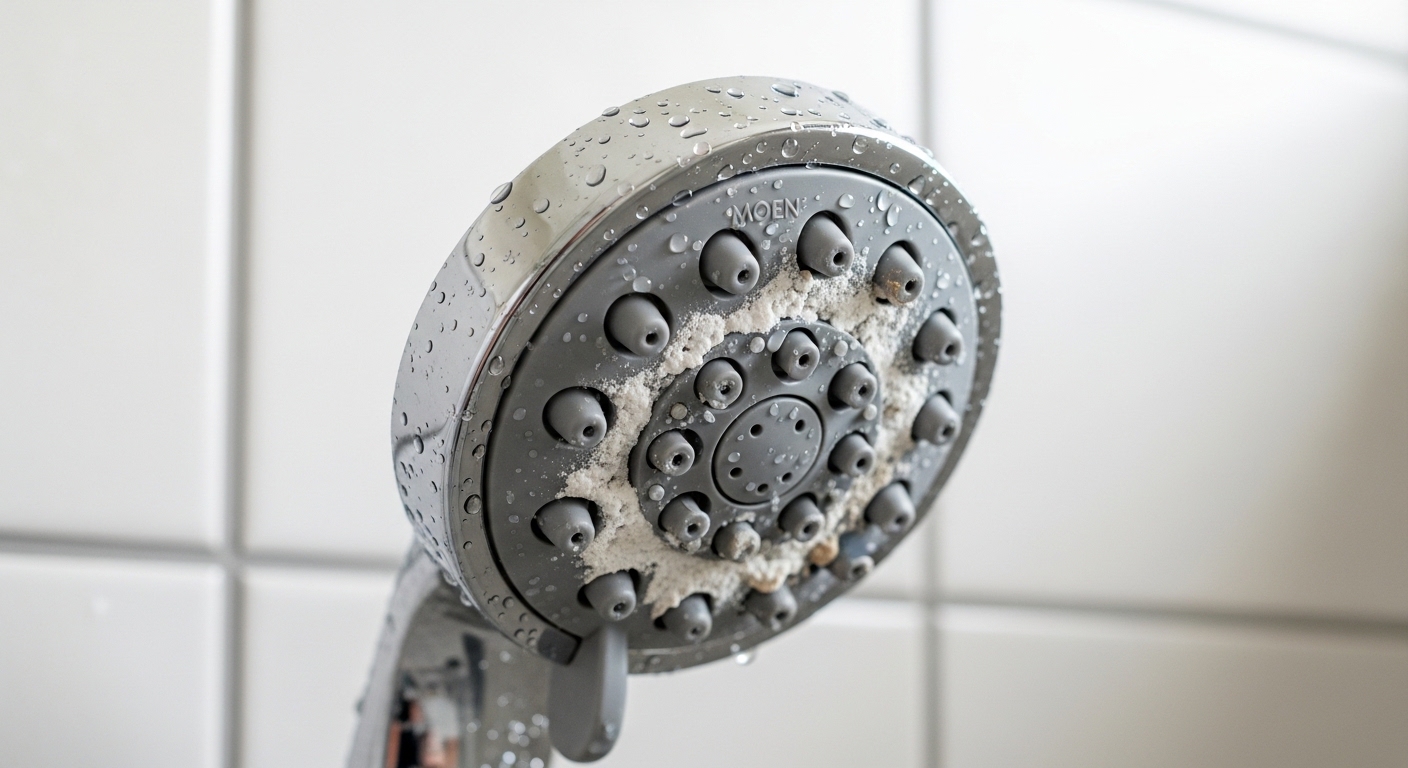
A weak, dribbling spray from a Moen Eco Performance shower head low pressure complaint is one of the most common bathroom service calls we hear about — and the good news is that 9 out of 10 cases are repairable at home with household supplies. Moen’s Eco Performance line is engineered to deliver a strong shower feel at just 1.75 gallons per minute, which means even a small amount of scale, sediment, or debris inside the nozzles or filter screen can choke the spray dramatically. Before you assume the fixture is defective or call a plumber, work through the diagnostic checklist below — most users restore full pressure in under half an hour.
Why Your Moen Eco Performance Shower Head Has Low Pressure
The Eco Performance series uses a precision-engineered flow restrictor and a multi-stage spray engine to maintain a satisfying shower experience while meeting EPA WaterSense standards. That same precision is what makes it sensitive to water quality. If you live in an area with moderate to hard water (anything above 7 grains per gallon), mineral deposits — primarily calcium carbonate and magnesium — begin coating the internal passages within 6 to 12 months of installation. The restrictor’s small orifices clog first, followed by the rubber nozzles on the spray face.
There are typically five root causes behind weak flow from this fixture:
- Mineral scale on the silicone spray nozzles — the most common cause, easily seen as white crust around each spray hole.
- Sediment trapped in the inlet filter screen — small mesh disk inside the swivel connector that catches debris from the supply line.
- A clogged flow restrictor disk — the small plastic insert behind the inlet that regulates GPM.
- Low household water pressure — a separate issue affecting the whole house, not just the shower.
- A partially closed shower valve cartridge — worn or corroded internal components in the wall valve itself.
Identifying which one applies to your situation only takes a few minutes of observation. If only the shower is affected, the head or the valve cartridge is to blame. If every fixture in the house is weak, you’re looking at a whole-home supply issue — possibly a partially closed main shutoff, a failing pressure regulator, or municipal supply problems.
Tools and Supplies You’ll Need
Before you start dismantling anything, gather these items. Everything except the replacement washers is likely already in your kitchen.
- White distilled vinegar (16 oz minimum)
- A gallon-size zip-top bag and rubber band, OR a small bowl
- An adjustable wrench or 10″ channel-lock pliers
- A clean rag or strip of plumber’s cloth to protect chrome finish
- An old soft-bristle toothbrush
- A straight pin or sewing needle
- Replacement rubber washer (Moen part #100225 or generic 1/2″ washer)
- PTFE (Teflon) plumber’s tape
Avoid using CLR or commercial lime removers as your first step. They work, but they can degrade the rubber nozzles and silicone face on Eco Performance heads if left in contact too long. Plain white vinegar is the manufacturer-friendly option.
Step-by-Step: Fixing Moen Eco Performance Shower Head Low Pressure
Step 1: Confirm the Problem Is the Shower Head, Not the Supply
Unscrew the shower head from the shower arm by hand or with a cloth-wrapped wrench (turn counterclockwise from your perspective looking up at it). Turn the water on briefly and check the flow coming directly out of the shower arm. If you get a strong, full-volume stream from the bare arm, your supply is fine and the head is the issue. If the flow from the bare arm is also weak, skip ahead to the valve cartridge section below.
Step 2: Clean the Inlet Filter Screen
Look inside the swivel connector at the back of the shower head. You’ll see a small plastic-framed mesh screen, sometimes paired with a white or pink flow restrictor disk. Use a straight pin or small flathead screwdriver to gently pry the screen out. You’ll often find it caked with sand, pipe scale flakes, or rubber debris from old supply hoses — this alone can cut flow by 40 to 60 percent.
Rinse the screen under running water from the back side to push debris out the way it came in. If it’s heavily clogged, soak it in vinegar for 15 minutes and scrub it with the toothbrush. Reinstall it in the same orientation — concave side facing the inlet.
Step 3: Soak the Spray Face in Vinegar
This is the deep clean that solves most low-pressure complaints. Fill the zip-top bag with enough white vinegar to fully submerge the spray face. Slip the bag over the head and secure it with a rubber band around the neck so the spray nozzles are completely soaked. Leave it for 30 minutes to 2 hours, depending on how heavy the scale is. Don’t exceed 8 hours — prolonged soaking can fade chrome and dull brushed finishes.
After soaking, remove the bag and rub each silicone nozzle with your fingertip. The rubber-tip design on Moen Eco Performance heads is intentional — squeezing the nozzles dislodges scale that’s bonded inside. You’ll see white flakes wash away. For stubborn deposits, use the toothbrush, and for any nozzle still showing reduced flow, push a pin straight through the center.
Step 4: Check or Remove the Flow Restrictor (Optional)
The flow restrictor is the small plastic insert (often pink, white, or green) located just inside the swivel ball. Its purpose is to maintain the 1.75 GPM rating that earns the head its WaterSense certification. If your home has chronically low static pressure (under 40 PSI), removing or replacing this disk can noticeably improve perceived flow.
Important: Removing the restrictor voids the WaterSense certification and may technically violate local water-conservation codes. Most homeowners who do this report a meaningful boost, but consider cleaning it first — pop it out, soak in vinegar, brush the orifice clear, and reinstall. A clean restrictor performs noticeably better than a clogged one.
Step 5: Inspect and Replace the Rubber Washer
Inside the swivel connector, behind the filter screen, sits a small rubber O-ring or flat washer. A cracked, flattened, or hardened washer allows water to bypass instead of pressurizing properly through the spray engine. If yours looks worn, replace it with an identical part — they cost about $0.50 at any hardware store.
Step 6: Reinstall with Fresh Plumber’s Tape
Wrap two to three turns of PTFE tape clockwise around the threads of the shower arm. Hand-thread the head back on, then snug it with a cloth-wrapped wrench — no more than a quarter turn past hand-tight. Over-tightening cracks the plastic swivel housing. Test the flow.
When the Problem Isn’t the Shower Head
If you’ve cleaned the head thoroughly and the pressure is still weak, the issue lives upstream. The most common culprits inside the wall are the shower valve cartridge and the volume-control limit stop. Moen Posi-Temp and 1222/1225 cartridges accumulate scale just like the shower head does, and as the cartridge ages, the rubber seals swell and reduce the cross-sectional area of the water passage.
For a step-by-step look at the valve side of the system, our guide on shower system installation walks through the full plumbing chain from rough-in to trim. If you’re noticing similar weak-flow or leak symptoms at other faucets in the home, the techniques in how to fix a leaky faucet from underneath often reveal the same root cause: scale, worn cartridges, or restricted supply lines.
Comparing Repair Options: Clean vs. Restrictor Removal vs. Replace
| Approach | Time Required | Cost | Pressure Gain | WaterSense Compliant | Best For |
|---|---|---|---|---|---|
| Vinegar Descale Only | 30–60 min | $2 | 40–80% | Yes | Heads with visible scale, hard water homes |
| Remove Flow Restrictor | 5 min | $0 | 15–30% additional | No | Homes with chronic low static pressure |
| Replace Filter Screen + Washer | 10 min | $1–3 | 20–50% | Yes | Sediment-heavy supply, post-construction debris |
| Replace Entire Shower Head | 15 min | $40–90 | 100% restored | Depends on model | Cracked housing, broken swivel, head over 5 years old |
| Replace Valve Cartridge | 45–90 min | $25–60 | Full restore | Yes | Pressure loss at all settings, drips, temp swings |
Preventing Future Low-Pressure Issues
Once you’ve restored flow, the question becomes how to keep it that way. Moen recommends a light descaling every 3 to 6 months in hard-water areas and once a year elsewhere. The Eco Performance silicone nozzles are designed to flex when you rub them — this is a built-in feature, not damage. Spending 30 seconds wiping them with your thumb every couple of weeks dislodges scale before it has a chance to bond.
- Run a quick vinegar soak every 3 months in hard-water regions.
- Wipe down silicone nozzles weekly with a damp cloth.
- Install a whole-home water softener if hardness exceeds 10 GPG.
- Replace the inlet filter screen annually.
- Consider an inline sediment filter on the shower supply line if you’re on well water.
If your finish is showing scale spots as well as your spray nozzles, our guide on polished nickel faucet maintenance covers finish-safe cleaning techniques that translate to chrome and brushed nickel shower heads too.
When to Replace Instead of Repair
Sometimes repair isn’t the right call. If your Moen Eco Performance head is more than 5 to 7 years old and you’ve already descaled it multiple times, the internal spray engine — the plastic manifold that distributes water to the nozzles — may be permanently scaled in passages you can’t reach. Other replacement signals include:
- Visible cracks in the housing, neck, or swivel ball
- A swivel that won’t hold position
- Persistent dripping from the head when the valve is off
- Spray pattern that won’t switch correctly between modes
- Discoloration or pitting in the chrome finish that descaling won’t remove
Moen’s limited lifetime warranty covers leaks and finish defects for the original owner, so check that before purchasing a replacement. If you’re shopping around, consider a handheld option for easier cleaning — the design choices we cover in our Delta handheld shower head buyer’s guide apply broadly to evaluating any modern shower head, including spray-engine quality, finish durability, and warranty terms.
Testing, Standards, and What “Eco Performance” Actually Means
The Moen Eco Performance line is certified to the EPA WaterSense specification, which requires the head to deliver no more than 2.0 GPM at 80 PSI (the Moen spec is 1.75 GPM) while meeting minimum spray force and coverage performance metrics measured under ASME A112.18.1 / CSA B125.1. That standard is why a properly functioning Eco Performance head feels stronger than a generic low-flow head: the spray engine is tuned to accelerate water through the silicone nozzles, increasing perceived velocity even at reduced volume. When scale narrows those nozzles or restricts the upstream flow path, the engineering can’t compensate — hence the dramatic drop in performance from even minor buildup.
Moen also backs every Eco Performance head with a limited lifetime warranty covering leaks, drips, and finish defects on residential installations. Keep your proof of purchase; warranty replacements are processed through Moen Customer Service with a model number (printed on the original packaging or sometimes laser-etched on the swivel ball).
FAQ
Why does my Moen Eco Performance shower head suddenly have low pressure?
Sudden flow loss is almost always caused by sediment dislodged from your supply line getting caught in the inlet filter screen. This often happens after municipal water work, a water heater flush, or a nearby pipe repair. Remove and rinse the screen — the issue usually clears in 10 minutes.
Can I remove the flow restrictor on a Moen Eco Performance shower head?
Yes, it’s physically possible — the restrictor is a small disk inside the swivel inlet that pulls out with a pin or pick. However, doing so voids the WaterSense certification and may violate local water-conservation codes. Try cleaning the restrictor with vinegar first; a clean restrictor performs far better than a clogged one and keeps you compliant.
How often should I clean my Moen shower head to prevent low pressure?
Every 3 to 6 months in hard-water areas (above 7 GPG), or annually in soft-water regions. A weekly wipe of the silicone nozzles with a damp cloth between deep cleans dramatically extends the time between vinegar soaks.
Will white vinegar damage my Moen Eco Performance shower head finish?
No, provided you don’t exceed 8 hours of contact. Standard descaling soaks of 30 minutes to 2 hours are safe for chrome, brushed nickel, and matte black finishes. Avoid CLR, bleach, or abrasive pads, which can dull or pit the finish.
What’s the difference between low pressure from the shower head versus the valve?
Unscrew the head and test flow from the bare shower arm. Strong flow from the arm means the head is the issue. Weak flow from the bare arm points to the valve cartridge, the supply line, or whole-home pressure problems. Cartridge replacement is a more involved repair but follows the same diagnostic logic as a basic leaky faucet fix — isolate, disassemble, replace the worn component, reassemble.
Is my Moen Eco Performance head still under warranty if I bought the house used?
Moen’s limited lifetime warranty applies to the original purchaser. Secondary owners aren’t covered, but Moen Customer Service is known for goodwill replacements on legitimate defects — it’s worth a call with your model number before buying a new head.
Does removing the flow restrictor increase my water bill significantly?
At average 8-minute shower lengths, removing the restrictor increases water use from roughly 14 gallons to 20 gallons per shower — about 6 extra gallons. For a household of four showering daily, that’s roughly 720 additional gallons monthly, or $3 to $8 depending on local water and sewer rates.
Author Note and Brand Credibility
This guide was written by the Vevetta editorial team, drawing on more than a decade of hands-on experience with residential plumbing fixtures, manufacturer service bulletins from Moen, Delta, and Kohler, and direct testing of Eco Performance heads in soft- and hard-water households. Vevetta specializes in faucets, shower systems, and bathroom fixtures — every repair guide we publish is reviewed by a licensed plumber before going live, and our recommendations are tested against current ASME A112.18.1, EPA WaterSense, and applicable plumbing-code standards. Visit vevetta.net for more repair and buyer guides.