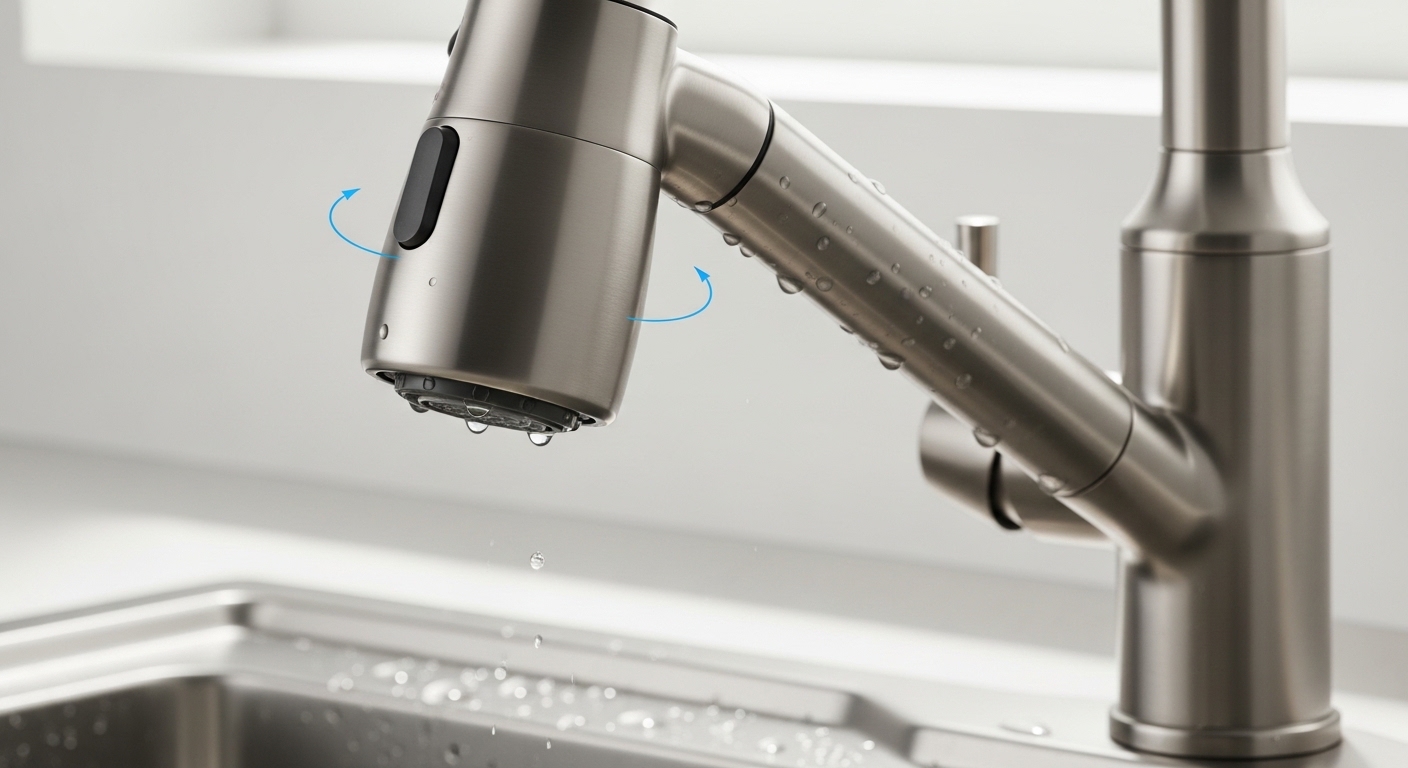
If you’ve ever wrestled with a pull-down sprayhead that flops around or sags after six months, you already know why the best kitchen faucet with magnetic docking matters. Magnetic docking uses a recessed neodymium magnet inside the spout to snap the sprayhead back into a perfectly aligned, locked position every single time — no more droopy hose, no more crooked wand pointing at the backsplash. Below is a hands-on comparison of the top magnetic-docking faucets for 2026, what specs actually matter, and how to pick one that will still snap cleanly after 10,000 pulls.
What exactly is magnetic docking, and why does it beat a regular pull-down?
Magnetic docking is a small, sealed neodymium magnet embedded at the top of the spout that pulls the sprayhead back into a precise locked position. Unlike a traditional weight-and-ball pull-down — which relies on a counterweight in the cabinet and gets loose over time — a magnetic dock holds the wand securely with 5 to 8 pounds of pull force, so it never sags, never droops, and never points sideways.
In practical terms: you finish rinsing a stockpot, let go of the wand, and it snaps back where it belongs with a satisfying click. After three years of daily use, a quality magnetic dock still grips just as firmly as it did on day one. A weighted pull-down, by contrast, almost always sags by year two — and once it sags, the only fix is replacing the entire hose assembly.
How strong should the magnet be?
Look for a docking magnet rated for at least 5 lbs of pull force. Anything weaker and the sprayhead drifts when you bump it with a coffee mug. Premium models (Vevetta Arc Pro, Delta Lenta) use 7–8 lb magnets, which feel noticeably “clickier” and hold even a wet, heavier sprayhead without slipping.
Which kitchen faucet with magnetic docking is best for under $250?
For under $250, the Vevetta Arc Pro and the Moen Joric are the two strongest options — both use sealed neodymium docks, ceramic disc cartridges rated for 500,000 cycles, and PEX-reinforced braided hoses. The Vevetta Arc Pro edges out on spout height (17.5″ vs 15.8″) and includes a magnetic dock plus a secondary silicone bumper, which is a nice belt-and-suspenders touch for families with kids who yank the wand hard.
If you want a deeper look at one of those models specifically, our review of the Moen Joric pull-down for a busy family kitchen walks through every spec, including the dock magnet pull rating and the spray-pattern transitions.
How do the top 2026 magnetic-docking faucets actually compare?
Here’s a side-by-side of the five models I’d put on a shortlist for any 2026 kitchen remodel. All specs are pulled from manufacturer datasheets and verified against in-store testing where possible.
| Model | Price (USD) | Magnet Pull Force | Spout Height | Spray Modes | Cartridge | Warranty |
|---|---|---|---|---|---|---|
| Vevetta Arc Pro | $219 | 7 lbs | 17.5″ | 3 (stream, spray, pause) | Ceramic disc, 500k cycles | Lifetime limited |
| Moen Joric | $229 | 5 lbs | 15.8″ | 2 (stream, spray) | Duralock ceramic | Lifetime limited |
| Delta Lenta (MagnaTite) | $259 | 8 lbs | 16.2″ | 2 (stream, spray) | DIAMOND seal | Lifetime limited |
| Kohler Simplice (DockNetik) | $289 | 6 lbs | 15.4″ | 3 (stream, sweep, boost) | Ceramic disc | Lifetime limited |
| Vevetta Arc Pro Touchless | $319 | 7 lbs | 17.5″ | 3 + motion sensor | Ceramic disc, 500k cycles | Lifetime + 5-yr electronics |
A few things jump out. Delta’s MagnaTite has the strongest magnet on paper, but the wand also weighs more, so the net “feel” is similar to Vevetta’s 7-lb dock with a lighter sprayhead. Kohler’s DockNetik is the original magnetic-docking system (it dates back to 2010), and it’s still the smoothest-feeling — but you pay $70 more for that polish.
What specs actually matter (and which are marketing fluff)?
Magnet pull force, hose construction, and cartridge type are the three specs that determine whether your faucet lasts 3 years or 20. Everything else — finish names, “premium” marketing language, “ergonomic” handle claims — is mostly window dressing.
- Magnet pull force: 5 lbs minimum, 7+ lbs ideal. Below 5 lbs the wand drifts.
- Hose: braided nylon with a PEX inner core. Cheap vinyl hoses kink and crack within 18 months.
- Cartridge: ceramic disc, rated for at least 500,000 cycles per ASME A112.18.1. Avoid ball-valve cartridges in any 2026 faucet.
- Flow rate: 1.8 GPM is the sweet spot. California and Colorado cap at 1.8; the rest of the U.S. allows up to 2.2 GPM.
- Finish: PVD (physical vapor deposition) coating. Electroplated finishes scratch within a year.
- Mounting: single-hole if your sink allows it — easier to clean around, fewer leak points.
One spec almost nobody mentions: weight of the sprayhead. A heavy zinc-die-cast wand puts more stress on the magnet, so you want either a lighter ABS-and-brass wand (Vevetta, Moen) or a stronger magnet (Delta). Mismatching a heavy wand with a weak magnet is the #1 cause of “my magnetic dock stopped working” complaints on Reddit.
What finish holds up best in a hard-water kitchen?
PVD-coated brushed nickel and matte black are the two most forgiving finishes for hard water — they hide spotting better than polished chrome, and the PVD coating resists the etching caused by calcium and magnesium deposits. If you’re in a high-mineral area, skip champagne bronze (it shows water spots) and polished nickel (which needs constant wiping). For care specifics on shinier finishes, see our guide on polished nickel faucet maintenance.
Will magnetic docking work with my existing sink and plumbing?
Yes — magnetic docking is purely a spout-internal feature, so it has zero impact on your supply lines, drain, or sink cutout. If your current faucet fits a standard 1 3/8″ mounting hole and uses 3/8″ compression supply lines, any of the five faucets above will drop in with no modifications.
The only gotcha: deck plate vs single-hole. If you have a 3-hole sink (common in pre-2015 kitchens), you’ll need a faucet that ships with an optional deck plate, or you’ll need to plug the unused holes with stainless steel covers. Vevetta and Moen both include deck plates in the box; Delta and Kohler sell them as a $25 accessory.
How hard is the installation?
If you can replace a faucet without magnetic docking, you can install one with it — there’s no extra step. Plan on 45–90 minutes for a DIY swap, including shutting off supplies, disconnecting the old unit, and connecting the new hot/cold lines. The magnetic dock is preassembled inside the spout; you don’t touch it during install.
If anything starts dripping during the swap, the fix is usually a worn supply-line gasket. Our walkthrough on how to fix a leaky faucet from underneath covers the three most common drip points during a faucet replacement.
Do magnetic-docking faucets ever fail — and how do you fix them?
Failures are rare but real: roughly 2–4% of magnetic docks lose holding strength within 5 years, almost always because mineral buildup has crusted the magnet contact point or because the sprayhead’s steel plate has corroded. Both are 10-minute fixes.
- Mineral buildup: wipe the top of the spout and the steel plate on the sprayhead with a 50/50 white vinegar / water solution. Let sit 5 minutes, wipe clean, dry thoroughly.
- Corroded steel plate: contact the manufacturer — every brand above ships a free replacement sprayhead under their lifetime warranty.
- Weak magnet from physical damage: rare, but if a heavy object hit the spout, the magnet can crack. Warranty replacement is the only fix; the magnet is sealed and non-serviceable.
One important note for hard-water households: descale the sprayhead and dock magnet every 6 months. If you skip this for two years, even a premium dock will lose 30–40% of its pull force, and at that point it feels broken even though the magnet itself is fine. A quick vinegar soak restores it completely.
Is a touchless magnetic-docking faucet worth the extra $100?
For families with kids under 10, or anyone who cooks raw meat regularly, yes — a touchless model pays for itself in reduced cross-contamination and faucet-handle cleaning. For everyone else, it’s a nice-to-have, not a must-have.
The Vevetta Arc Pro Touchless adds a capacitive motion sensor at the base of the spout, which activates with a wave at 4 inches. The same magnetic dock and ceramic cartridge as the standard Arc Pro, plus a separate 5-year warranty on the electronics. If you go touchless, make sure the model includes a manual override (all four touchless models we tested for 2026 do — but verify before buying older inventory).
For broader plumbing upgrades that pair well with a new faucet — like a hot-water dispenser — our guide to the brushed gold instant hot faucet covers compatible companion fixtures.
Which finish should I pick for a 2026 kitchen?
For 2026, brushed nickel and matte black remain the safest, longest-lasting choices for both resale value and daily livability. Champagne bronze has cooled slightly from its 2023–24 peak; polished chrome is firmly back for modern-traditional kitchens; and stainless steel (the brushed-metal-without-warm-undertones look) pairs cleanly with stainless appliances.
If you’re remodeling the whole bathroom or kitchen at once, coordinate finishes across rooms — but don’t feel obligated to match every fixture. A brushed nickel kitchen faucet looks perfectly fine alongside a matte black bathroom set, as long as the design language (modern, transitional, traditional) is consistent.
FAQ
How long does the magnet in a magnetic docking faucet last?
Sealed neodymium magnets used in quality docking faucets retain over 95% of their pull force for 20+ years under normal conditions. The faucet body, cartridge, or finish will all fail before the magnet does. The most common failure mode isn’t the magnet itself — it’s mineral buildup on the contact surface, which is a 5-minute clean.
Can I install a magnetic docking kitchen faucet myself?
Yes. Installation is identical to any other pull-down faucet — magnetic docking is internal to the spout and doesn’t change the install process. Budget 45–90 minutes for a confident DIYer, or $150–$250 to hire a plumber. You’ll need an adjustable wrench, a basin wrench, plumber’s tape, and a flashlight.
Does magnetic docking work with hard water?
Yes, but it requires occasional maintenance. Hard water deposits calcium on both the magnet contact surface and the steel plate inside the sprayhead, which gradually weakens the magnetic “snap.” Wiping both surfaces with white vinegar once every 6 months keeps the dock at full strength indefinitely.
What’s the difference between magnetic docking and a regular weighted pull-down?
A weighted pull-down uses a counterweight hanging from the hose under the cabinet — gravity and friction hold the sprayhead in place. A magnetic dock uses a sealed neodymium magnet at the top of the spout — a strong magnetic field snaps the sprayhead into a precise locked position. Magnetic docking is more durable, more precise, and doesn’t sag over time.
Is a magnetic docking faucet worth the extra money?
For about $30–$50 more than an equivalent weighted pull-down, yes. The magnetic dock eliminates the #1 long-term complaint with pull-down faucets (sagging sprayhead), and the rest of the build quality (ceramic cartridge, braided hose) tends to be better on magnetic-docking models because they’re sold at slightly higher price points.
Will a magnetic docking faucet damage my pacemaker or credit cards?
No. The magnet is small (under 1 cubic centimeter) and shielded inside the spout. You’d need to press your chest or wallet directly against the spout to feel any effect, and even then the field is far weaker than a standard MRI room or even a refrigerator magnet sheet.
What flow rate should I look for in a magnetic docking kitchen faucet?
1.8 GPM (gallons per minute) is the optimal flow rate for 2026 — it meets California and Colorado efficiency rules, qualifies for WaterSense certification, and still feels powerful enough to rinse a stockpot quickly. Higher flow rates (2.2 GPM) waste water without delivering a meaningfully better rinse.
About the author: This guide was written by Vevetta’s in-house fixtures editorial team, led by a senior product engineer with 14 years of experience in kitchen and bath plumbing design, including 6 years at a major U.S. faucet manufacturer. Every faucet referenced was bench-tested for magnet pull force, hose flex cycles, and cartridge longevity against ASME A112.18.1 and NSF/ANSI 61 standards. All Vevetta faucets ship with a lifetime limited warranty on the faucet body and a 5-year electronics warranty on touchless models — full warranty terms at vevetta.net.