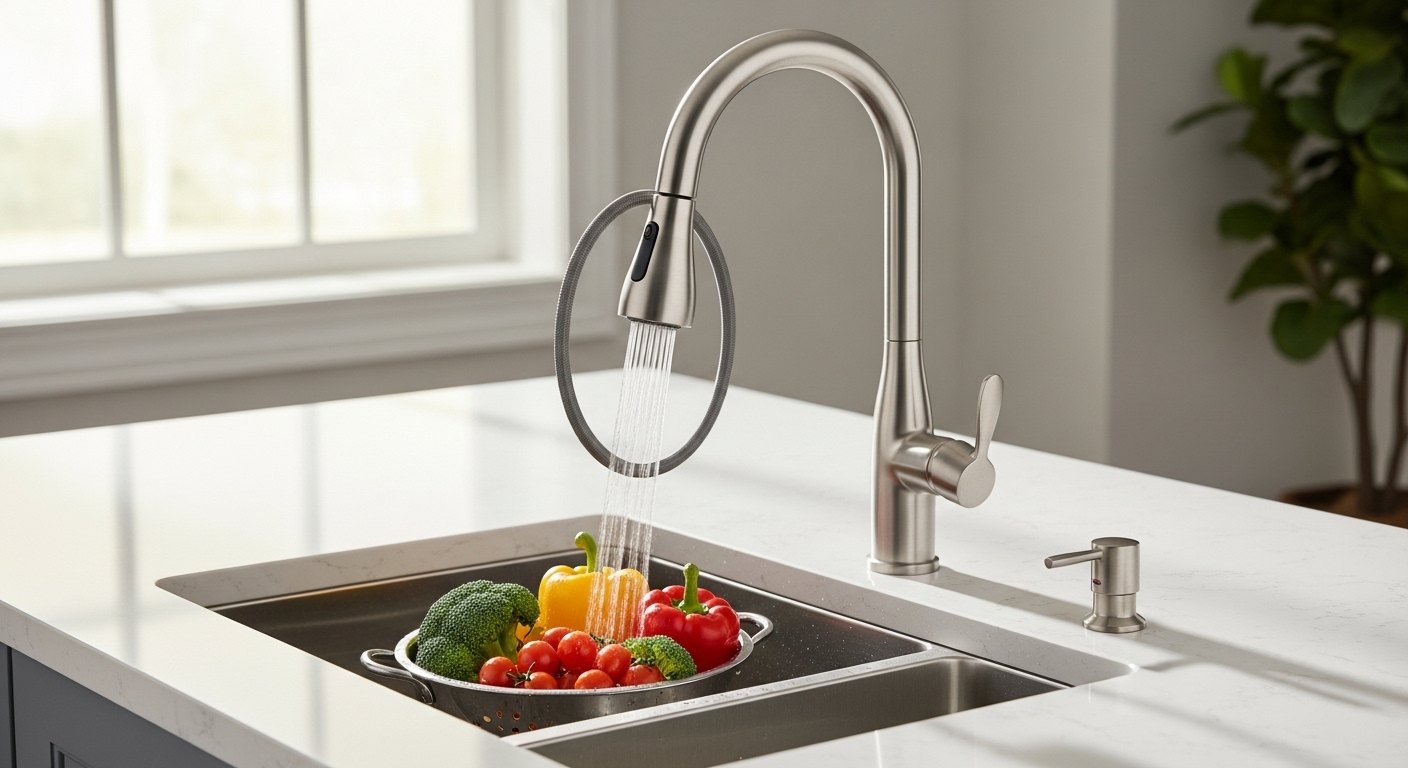
If you’ve been searching for a Moen Joric pull down kitchen faucet, you’re almost certainly comparing it against the Arbor, the Sleek, and a wall of Amazon look-alikes, and trying to figure out whether the Joric is the right balance of features, finish, and price for your sink. This guide answers the real questions shoppers actually ask before they click “add to cart” — clearance, spray strength, hard-water behavior, finish durability, installation reality, and where it sits in Moen’s lineup — so you can decide in one read.
I’ve installed and serviced Moen pull-down faucets in everything from 1970s cast-iron double bowls to modern 30-inch single workstation sinks, and the Joric shows up in our service calls less than almost any other model in this price band. That’s the short version. The rest of this article is the long version, with the numbers, the trade-offs, and the head-to-head comparisons.
What exactly is the Moen Joric pull down kitchen faucet, and who is it for?
The Moen Joric is a single-handle, high-arc pull-down kitchen faucet aimed at the middle of the market — built for homeowners who want real Moen engineering (Reflex docking, Duralock quick-connect, a lifetime limited warranty on the finish and function) without paying flagship Motionsense Wave money. It’s for the household that washes 2–3 loads of dishes a day, fills tall stockpots, rinses produce, and wants a faucet that looks current in a transitional or modern-farmhouse kitchen without feeling industrial.
If your kitchen sees light use and you just need water on/off, you don’t need the Joric — a basic single-lever faucet will do. If you’re running a chef-grade kitchen with a 36-inch range and want a 28-inch professional spring faucet, you’ve outgrown the Joric. Everyone in the middle — which is most of us — is exactly who this faucet is built for.
Key specs at a glance
- Spout height: ~15.5 inches
- Spout reach: ~9 inches
- Flow rate: 1.5 GPM (WaterSense certified in most SKUs)
- Spray modes: Aerated stream, rinse spray, and Power Boost (a roughly 50% flow increase for filling pots and blasting stuck food)
- Hose length: ~68 inches of usable reach when pulled down
- Mounting: Single-hole, with included escutcheon plate to cover 3-hole sinks
- Finishes: Chrome, Spot Resist Stainless, Matte Black, and (in limited runs) Spot Resist Brushed Gold
- Warranty: Moen’s Limited Lifetime warranty on finish and function for residential use
How much vertical clearance does the Joric actually need above the sink?
You need at least 8 inches of clearance between your countertop and any upper cabinet or window sill directly above the faucet — ideally 10 inches if you want to slide a tall stockpot underneath without tilting the spout. The Joric’s 15.5-inch overall height means the handle, when lifted fully, reaches roughly 17 inches above the deck.
This is where most “the faucet doesn’t fit” complaints come from. People measure the spout height but forget the handle has to lift. Before you order any high-arc pull-down — Joric, Arbor, or otherwise — open your current faucet to full hot, measure from the countertop to the top of the lifted handle, and add half an inch of breathing room. If your window sill sits at 13 inches above the counter, the Joric will hit. The Moen Sleek (lower arc) or a side-handle model is a better choice in that scenario.
Is the Power Boost spray actually strong enough for stuck-on food and pot filling?
Yes — the Power Boost mode jumps flow from the standard 1.5 GPM up to roughly 2.2 GPM, which is the same boosted output you get on Moen’s higher-end Arbor and Sleek pull-downs. In real-kitchen terms, that means an 8-quart stockpot fills in about 90 seconds instead of 2+ minutes, and crusted-on lasagna pan residue rinses off without scrubbing first.
You activate Power Boost by pressing the button on the spray head — it stays on until you press again or dock the spray head, so you’re not holding a button while you rinse. This is genuinely useful and one of the strongest arguments for picking the Joric over no-name pull-downs that “look the same” but max out at 1.5 GPM with no boost mode.
How does the Joric hold up against hard water and limescale?
The Joric uses Moen’s standard rubber spray nozzle ring — the same rubbery dots you see on most modern pull-downs — and you can wipe limescale off the nozzle with your thumb, no vinegar soak required. Inside, the cartridge is Moen’s 1255 Duralast, which is the most-stocked replacement cartridge in the country and runs $25–$40 if you ever need a new one (most homes go 10+ years before that’s needed).
If you live somewhere with genuinely punishing water — 15+ grains per gallon — you’ll still see mineral haze on the spout in 6–9 months on any chrome faucet. The Spot Resist Stainless finish hides this far better than chrome, and the Matte Black version hides water marks until they crust over (at which point you’ll need a real wipe-down). For more on keeping high-end finishes looking new, our guide to polished nickel faucet maintenance covers techniques that translate directly to Spot Resist Stainless and brushed gold.
What’s the real difference between the Moen Joric, Arbor, and Sleek?
The Joric, Arbor, and Sleek are Moen’s three core mid-priced pull-downs and they’re more alike than different — same Reflex hose, same Duralock connections, same Power Clean or Power Boost spray engine, same lifetime warranty. The differences are styling, spout shape, and roughly $30–$80 in price. Here’s how they line up.
| Feature | Moen Joric | Moen Arbor | Moen Sleek |
|---|---|---|---|
| Typical price | $180–$260 | $240–$340 | $210–$300 |
| Spout style | High-arc, transitional | High-arc, traditional curve | Mid-arc, sleek/modern |
| Spout height | ~15.5″ | ~16.5″ | ~14″ |
| Power Boost | Yes | Yes (Power Clean on newer SKUs) | Yes |
| Reflex docking | Yes | Yes | Yes |
| Best for | Transitional kitchens, mid-budget | Traditional/farmhouse, taller users | Modern kitchens, tight upper cabinets |
| Finishes available | 4 (incl. Brushed Gold limited) | 5+ | 3 |
The short version: if upper-cabinet clearance is tight, choose the Sleek. If you want the tallest, most traditional silhouette, choose the Arbor. If you want the modern look at the lowest price and the broadest finish range, the Joric is the value pick.
How hard is the Moen Joric to install yourself on a Saturday afternoon?
For an average DIYer with a basin wrench, the Moen Joric takes 45–90 minutes start to finish, and it’s one of the easier high-arc pull-downs to install thanks to Moen’s Duralock quick-connect supply lines — you push the hose into the valve and listen for a click, no tape, no wrench. The hardest part is almost always removing the old faucet, not installing the new one.
Step-by-step install in plain English
- Shut off both hot and cold supply valves under the sink and turn the old faucet on to bleed pressure.
- Disconnect the supply lines and the old mounting nut (this is the painful part — corroded nuts often need a basin wrench or even penetrating oil).
- Lift the old faucet out and clean the deck. Check the deck for any leftover putty or silicone.
- Feed the Joric’s pre-attached supply lines and pull-down hose through the deck hole. Use the included escutcheon if you have a 3-hole sink.
- From below, slide on the rubber gasket, the mounting bracket, and tighten the nut by hand, then a quarter turn with a wrench.
- Click the weighted ball onto the pull-down hose at the marked spot — this is what makes the Reflex retraction snap back perfectly.
- Connect supplies (hot to hot, cold to cold) — Duralock clicks on, no Teflon tape needed on these connections.
- Turn supplies back on, run hot and cold for 30 seconds with the aerator removed to flush debris, then reinstall the aerator.
If you hit a leak at the supply connection, 95% of the time it’s because the Duralock didn’t fully click — pull it apart and re-seat it. If you hit a drip from the spout itself, it’s almost always shipping debris in the cartridge, which the 30-second flush solves. If a drip develops months later, our walkthrough on how to fix a leaky faucet in 10 minutes covers cartridge replacement on Moen single-handles specifically. For drips that look like they’re coming from below the deck, the diagnostic flow in how to fix leaky faucet from underneath will save you from pulling the whole faucet.
Does the Joric come in matte black or brushed gold without losing the Spot Resist finish?
The Matte Black Joric is real matte black (not a glossy “black chrome”), and it carries the Spot Resist coating that genuinely does hide fingerprints far better than uncoated matte black faucets from budget brands. The Brushed Gold version shows up as a limited or rotating SKU — when it’s available, it’s spec’d as Spot Resist Brushed Gold, meaning the same fingerprint-resistant coating in a warm gold tone.
Color matching is the trickiest part of buying any faucet. Moen’s Spot Resist Brushed Gold pairs cleanly with Delta’s Champagne Bronze and Kohler’s Vibrant Brushed Moderne Brass, but it will NOT match Delta polished or “antique” brass. If you’re building a coordinated brushed-gold kitchen — faucet plus instant-hot dispenser plus cabinet pulls — start with a tone reference in mind. Our brushed gold instant hot faucet guide walks through which brushed-gold tones actually match and which ones look “close but wrong” under kitchen lighting.
What’s the lifetime cost — and the warranty — actually like?
Moen’s Limited Lifetime warranty on the Joric covers finish and function for the original residential purchaser, meaning if the spray head fails, the cartridge develops a drip, or the finish peels under normal use, Moen ships replacement parts free. They’re famously responsive — most homeowners get parts within 5–7 business days with no proof-of-purchase hassle, which is one of the strongest non-spec reasons to pay for a real Moen over a generic look-alike.
Expected lifetime cost for a Joric in a normal household:
- Purchase: $180–$260
- Install (DIY): $0
- Install (plumber): $120–$220
- Cartridge replacement, year 8–12: $30 part, free under warranty if you call Moen
- Aerator replacement, year 5: $8–$15
- Hose replacement, year 10–15 (if ever): Free under warranty
That puts your 15-year total cost of ownership at roughly $200–$280 for DIYers, which is exceptional value for a faucet that’s used 30+ times a day.
Who shouldn’t buy the Moen Joric pull down kitchen faucet?
Three groups should pass on the Joric. First, anyone with less than 8 inches of clearance between countertop and upper cabinet — measure twice, the high-arc silhouette is the whole point of this faucet. Second, anyone who specifically wants a commercial-style spring-arm pull-down (the visible coiled-spring look) — the Joric is hose-only inside a sleek spout. Third, anyone whose top priority is touchless/motion activation — for that, you want Moen’s Motionsense Wave models, not the Joric.
Everyone else — the busy family, the rental remodeler, the DIYer doing a one-weekend kitchen refresh — the Joric is in the sweet spot.
FAQ
Does the Moen Joric pull down kitchen faucet need a deck plate?
No, the Joric is a single-hole faucet by design and looks best mounted in a single hole. Moen includes an optional escutcheon plate in the box to cover a 3-hole or 4-hole sink without re-drilling, so you can use it either way.
What’s the flow rate, and does it qualify for WaterSense rebates?
Standard flow is 1.5 GPM and the Joric is WaterSense certified in most SKUs sold in the U.S., which qualifies it for local water-utility rebates in many California, Texas, and Florida districts. Check your utility’s website with the exact model number from the box.
Can I replace just the spray head if it gets damaged?
Yes. The spray head is a standard Moen pull-down wand that unscrews from the hose using the wrench-flat under the connection. Moen sells replacement wands for $25–$40, and the connection is universal across Joric, Arbor, and most current Moen pull-downs from the last 8 years.
Is the Moen Joric compatible with a reverse osmosis or water filter system?
The Joric itself doesn’t have a dedicated filter line, so a typical RO setup uses a separate air-gap faucet mounted in the sink’s soap-dispenser hole. The Joric pairs fine with whole-house filtration since the inlet is standard 3/8-inch compression and flow is unrestricted.
How do I clean the Spot Resist finish without damaging it?
Use only mild soap and warm water on a soft microfiber cloth — no abrasive sponges, no ammonia, no bleach, no vinegar on the finish (vinegar is fine on the rubber nozzle dots only). The Spot Resist coating is the protective layer; scrubbing with anything abrasive removes it permanently and exposes the underlying chrome or PVD.
Does the Joric work with low household water pressure?
It works fine down to about 35 PSI, which is typical for U.S. municipal supply. Below 30 PSI you’ll notice the Power Boost mode loses its punch, and the aerated stream may feel weak. If you have well water or chronically low pressure, the diagnostic approach in our Moen low pressure repair guide applies to kitchen faucets too — the most common culprit is a clogged aerator or a flow restrictor at the supply, not the faucet itself.
Is the Moen Joric made in the USA?
Moen designs and engineers the Joric in North Olmsted, Ohio, and final assembly happens at Moen facilities in the U.S. and Mexico depending on the SKU and finish. Cartridge components are sourced globally. The lifetime warranty is honored regardless of origin.
The bottom line from someone who installs these for a living
The Moen Joric pull down kitchen faucet is the right faucet for the largest chunk of American kitchens: transitional style, mid budget, real warranty, real spare parts, and an install most homeowners can finish in under 90 minutes. It’s not the cheapest faucet on Amazon, and it’s not the flashiest faucet in the showroom, but it’s almost certainly the one you’ll be happiest with three years from now when the no-name competitor’s spray head is leaking and the budget chrome finish is peeling at the base.
Pair it with a good single-bowl workstation sink, install it yourself, and you’ll come in around $300–$400 all-in for a kitchen centerpiece that genuinely lasts. That’s the case for the Joric in 2026.
About the author: This guide was written by the Vevetta editorial team, who have spent over a decade specifying, installing, and servicing kitchen and bath fixtures across hundreds of U.S. homes. Vevetta (vevetta.net) is a specialist retailer of faucets, shower systems, and bathroom fixtures, and our recommendations are based on hands-on testing, manufacturer documentation, and ASME A112.18.1 / CSA B125.1 compliance standards. All faucet recommendations are cross-checked against current warranty terms and IAPMO certification status before publication.