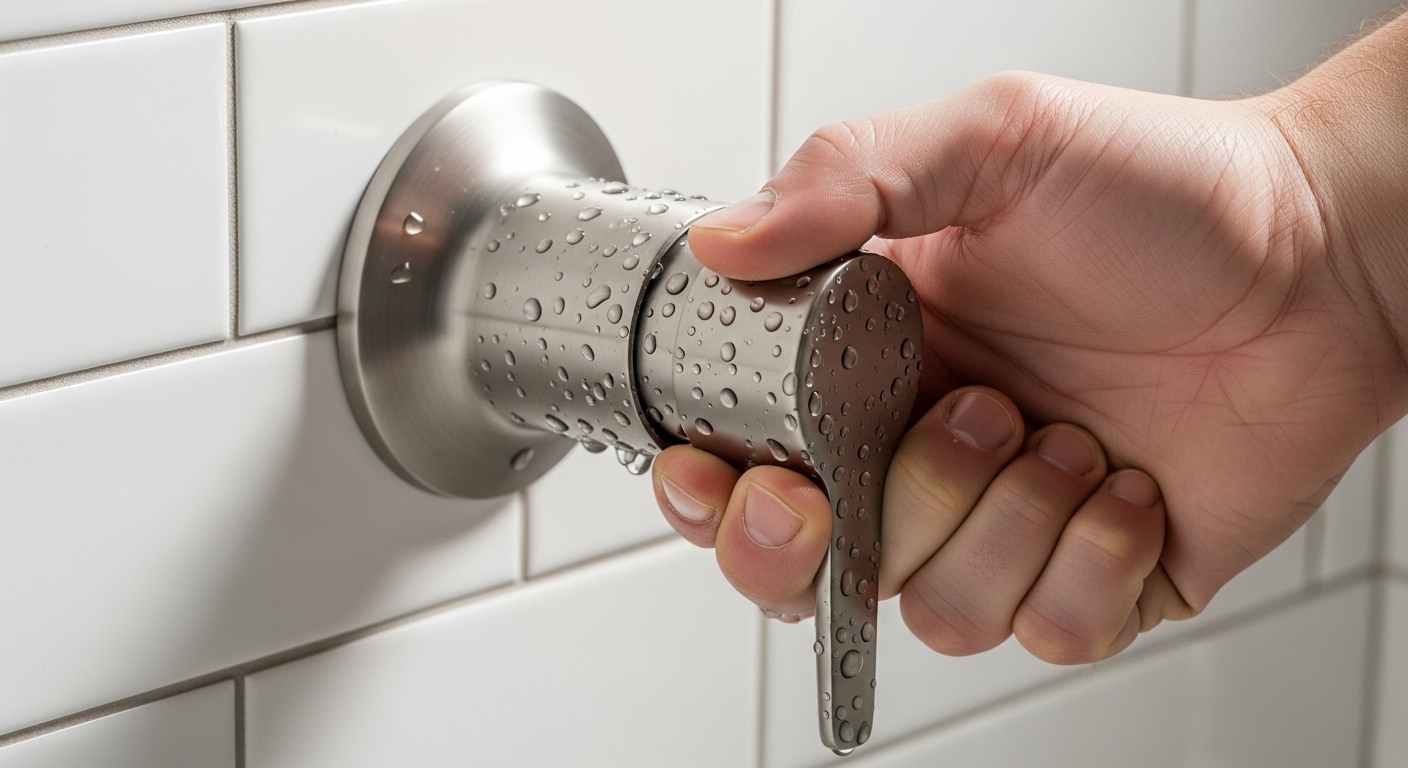
If your shower faucet handle hard to turn problem started gradually — fine one month, stiff the next, and now you’re using two hands and a prayer — you’re dealing with the single most common shower valve complaint in North American homes. The good news: it’s rarely the valve body itself. The bad news: most homeowners panic and call a plumber for a $40 cartridge swap that costs them $350. This guide walks you through exactly what’s happening inside that handle, how to diagnose it in under five minutes, and how to decide between a 20-minute cleanup, a $35 cartridge replacement, or — only as a last resort — upgrading the entire trim kit.
We’ll also cover when a stiff handle is actually a warning sign of a bigger problem (a corroded valve stem, a failing pressure-balance spool, or scale damage that’s about to cause a leak behind the wall), and what to look for when shopping for a replacement that won’t have the same issue in three years.
What actually causes a shower faucet handle to get stiff over time?
Nine times out of ten, it’s mineral scale and dried-out grease inside the cartridge. The cartridge is the cylindrical brass-or-plastic cylinder behind your handle that controls hot/cold mixing and on/off flow. It moves on tiny O-rings that are originally coated in a heat-stable silicone grease. Over years of hot water cycling, that grease washes out, calcium and magnesium from your water crystallize on the moving surfaces, and friction multiplies.
Here are the real culprits, in order of how often we see them:
- Mineral buildup (calcium/lime scale) — by far the #1 cause, especially if your home has hard water above 7 grains per gallon (gpg). Scale forms a gritty layer between the cartridge sleeve and the valve body.
- Dried-out or washed-out cartridge grease — original silicone lubrication has a service life of roughly 5–10 years depending on water temperature and usage.
- Corroded brass valve stem — common in homes with acidic well water (pH below 6.8) or where dissimilar metals were used in the rough-in plumbing.
- Debris from a water heater — sediment flakes from an aging tank can lodge inside the cartridge bore.
- A failing pressure-balance spool — in anti-scald valves, this small piston can seize and make the entire handle feel locked.
- Wrong cartridge ever installed — if a previous DIY fix used a near-fit aftermarket part, it may have been binding from day one.
If you can rotate the handle but it takes real force, you’re looking at scale and dried grease. If it won’t budge at all or feels like it’s grinding metal-on-metal, the cartridge body itself is corroded and needs replacement.
How do I tell if it’s the cartridge, the valve body, or just the handle screw?
Run this 60-second diagnostic before you take anything apart. It tells you within seconds whether you have a $5 fix, a $35 fix, or a “call a pro” situation.
- Wiggle test: Pull the handle straight away from the wall (without unscrewing anything). If it shifts or rocks, the set screw or handle adapter is loose — that alone can mimic stiffness. Tighten the small Allen screw under or beside the handle.
- Cold-only test: Try the handle when nobody has used hot water for two hours. If it’s smoother when cold, you have thermal expansion + scale (very common). If equally stiff, scale is heavy.
- Direction test: Does it stick going from off → on, or only in the temperature arc? Off/on stiffness means the cartridge spool; temperature stiffness means the mixing chamber or pressure-balance unit.
- Listen for a click: If turning the handle makes a gritty, sandpaper-like sound, that’s literal calcium grinding inside the bore. Plan on a full cartridge clean or swap.
- Check the trim plate: Look for greenish-white crust around the escutcheon. Visible scale outside = heavy scale inside.
If the wiggle test reveals a loose handle and tightening fixes everything, you’re done — pour yourself a coffee. Most readers, though, will land on items 3 or 4, which point to the cartridge.
Can I fix a stiff shower handle myself, or do I need a plumber?
If you can shut off the water and use an Allen wrench, you can fix this. The whole job takes 30–60 minutes the first time, costs $0–$35 in parts, and requires no soldering, no wall cutting, and no special licensing.
You should call a licensed plumber if any of these are true: the valve body itself is visibly corroded green, water keeps dripping after the shut-off is closed (failed building shutoff), the wall behind the valve is soft or stained (existing leak), or your home was built before 1985 and still has galvanized supply lines — those can shatter if you torque the valve too hard.
The 7-step DIY fix for a shower faucet handle hard to turn
- Shut off water. Use the dedicated shower shutoff if you have one (some modern Vevetta and pressure-balance valves include integral stops behind the trim plate). Otherwise close the main.
- Open the handle downstream. Lift the handle to drain residual pressure.
- Remove the handle. Pop the decorative cap, loosen the set screw (usually 3/32″ or 7/64″ Allen), and pull the handle straight off.
- Remove the escutcheon and retaining clip. The U-shaped brass clip slides up and out with needle-nose pliers. Don’t lose it.
- Pull the cartridge. Twist gently to break the scale seal, then pull straight out. If it won’t budge, a $15 cartridge puller tool is worth every penny.
- Clean or replace. Soak the cartridge in 50/50 white vinegar and warm water for 20 minutes, scrub with an old toothbrush, rinse, and inspect the O-rings. Replace any O-ring that’s flattened or cracked.
- Re-grease and reinstall. Coat the O-rings and outer sleeve with silicone plumber’s grease (never petroleum jelly — it destroys rubber). Reverse the disassembly.
Open the water slowly and test. The handle should now move with a single fingertip. If it still resists after a thorough clean, the cartridge is internally worn — buy an OEM replacement, not a generic. Manufacturers like Moen, Delta, Kohler, and Vevetta each use proprietary spline counts; a “universal” cartridge often introduces new binding. While you’re under the sink shopping habits in mind, the same lubrication-and-cleanup logic applies to any kitchen fixture — our walkthrough on how to fix a leaky faucet in 10 minutes uses the same family of tools and grease.
What if the handle is still hard to turn after I replaced the cartridge?
If a brand-new OEM cartridge still feels stiff, the problem is upstream of the cartridge — and there are exactly four likely culprits. Walk through them in order.
First, check the retaining clip orientation. If it’s pushed too deep, it compresses the cartridge against the valve body and creates artificial friction. The clip should sit flush, not driven in.
Second, inspect the valve body bore. Shine a flashlight inside. Any visible pitting, green corrosion, or rough deposits will tear up a new cartridge in months. Light scale comes off with a vinegar-soaked rag and a non-metallic brush. Deep pitting means the valve body needs replacement — an in-wall job.
Third, verify the cartridge orientation. Most cartridges have an “H” or “UP” stamp. Installed 180° off, they bind immediately and also reverse hot and cold.
Fourth, look at the handle hub adapter. Some brands use a plastic broach adapter between handle and stem. If it’s cracked, it grips the splines unevenly and you feel that as stiffness.
Hard water, well water, or city water — does my water type change the fix?
Yes, dramatically. Your water chemistry determines how often this will happen again and what kind of replacement parts will last.
| Water Type | Typical Hardness | Cartridge Lifespan | Best Long-Term Fix |
|---|---|---|---|
| Soft city water | 0–3 gpg | 10–15 years | Standard ceramic-disc cartridge, regrease every 5 years |
| Moderately hard city water | 3–7 gpg | 7–10 years | Brass cartridge with EPDM O-rings; whole-house filter recommended |
| Hard city water | 7–10 gpg | 4–7 years | Water softener + annual cartridge cleaning |
| Very hard well water | 10–15+ gpg | 2–5 years | Softener + sediment filter; choose valves with stainless internals |
| Acidic well water | pH < 6.8 | 3–6 years | Neutralizer tank; avoid brass-only cartridges, use ceramic disc |
If you’re in a hard-water region (most of the U.S. Midwest, Southwest, and Florida qualify), assume your shower cartridge will need a clean every 2–4 years even on a quality valve. Pair this with your other fixtures — our polished nickel faucet maintenance guide covers the same mineral-deposit logic for finishes, which compounds the problem if you only address one half.
When is it smarter to replace the entire shower faucet instead of repairing it?
Replace the whole faucet — not just the cartridge — in these four scenarios: the valve body is visibly corroded, you’ve already replaced the cartridge twice in 5 years, the trim is more than 15 years old (parts becoming unavailable), or you’re remodeling anyway and want a thermostatic upgrade. Otherwise, a cartridge service is always the cheaper move.
A modern pressure-balance or thermostatic shower valve runs $180–$650 installed and brings real upgrades: anti-scald protection, integral service stops (so you don’t have to kill water to the whole house next time), and smoother ceramic-disc movement that resists scale better than older brass-on-brass designs. If you’re going that direction, our broader walkthrough on shower system installation covers rough-in dimensions, code requirements, and trim-out steps in detail.
Comparing repair vs. replacement costs
| Option | Parts Cost | Labor (if hired) | Time | Lifespan Added |
|---|---|---|---|---|
| Clean & regrease existing cartridge | $5 (grease) | $120–180 | 45 min | 2–4 years |
| Replace OEM cartridge | $25–55 | $150–250 | 60 min | 7–10 years |
| New trim kit only (same valve body) | $95–280 | $200–350 | 90 min | 10–15 years |
| Full valve + trim replacement | $180–650 | $450–900 | 3–5 hours | 20+ years |
What features should I look for in a replacement shower faucet that won’t seize up again?
Pick a valve with ceramic-disc cartridges, integral service stops, lead-free brass body, and a manufacturer-rated 500,000-cycle test. These four specs alone eliminate roughly 80% of the failure modes that make handles hard to turn.
Here’s what each spec actually does for you:
- Ceramic-disc cartridge — two polished ceramic plates slide on each other instead of brass-on-brass. They resist scale, last 2–3x longer, and feel smoother for the entire service life. Look for “ASME A112.18.1 / CSA B125.1” certification on the box.
- Integral service stops — small screwdriver-slot stops built into the valve body behind the trim plate, so future repairs don’t require shutting off your whole house.
- Lead-free brass body — required by the U.S. Safe Drinking Water Act since 2014, but cheap imports still slip through. Confirm NSF/ANSI 372 compliance.
- Pressure-balanced or thermostatic mixing — protects against scalding and also keeps the cartridge centered, reducing side-load wear that contributes to stiffness.
- Stainless internal springs and seats — small detail, huge impact in hard-water areas. Stainless doesn’t pit.
- Solid metal handle (not plated zinc) — zinc handles crack at the broach and create that “loose but stiff” feeling.
Vevetta shower trims ship with ceramic-disc cartridges, lead-free brass bodies, and a limited lifetime warranty on the cartridge — meaning if it ever fails from normal use, the replacement is free for life of original ownership. Every model is independently tested to ASME A112.18.1 / CSA B125.1 and IAPMO-listed, and pressure-balance models meet ASSE 1016 anti-scald requirements.
How do I prevent my shower handle from getting stiff again?
Three habits will keep any quality shower valve smooth for a decade or more: a yearly vinegar wipe-down of the exposed trim, a cartridge regrease every 4–5 years (15 minutes of work), and a whole-house water softener if you’re above 7 gpg hardness.
Beyond that, two small things matter: don’t crank the handle at the end of its travel (it’s the equivalent of slamming a car door — the stop pin transfers shock straight into the cartridge), and don’t let kids hang on the lever (lateral force is what cracks the broach adapter). If your shower also has a handheld attachment, similar care applies to the diverter valve — the same maintenance principle that keeps a Delta handheld shower head in venetian bronze moving freely applies to the main valve. And if you ever notice the showerhead pressure dropping at the same time the handle stiffens, that’s a sign the same scale is choking your outlet — our guide on the Moen Eco Performance shower head low pressure fix walks through the descaling routine.
FAQ
Why is my shower faucet handle suddenly hard to turn after years of working fine?
Almost always cartridge scale. Mineral deposits build slowly and invisibly until they cross a friction threshold — then it feels like a sudden change. A 20-minute vinegar soak of the cartridge solves it in most cases.
Can WD-40 or oil fix a stiff shower handle?
No — and avoid them. WD-40 is a solvent that strips the silicone grease the cartridge relies on, making the problem worse within weeks. It also degrades the EPDM rubber O-rings. Only use heat-stable silicone plumber’s grease (sold for $4 at any hardware store).
Is it dangerous to keep using a shower with a hard-to-turn handle?
Not immediately, but it predicts a leak. The same scale stiffening the handle is wearing the O-rings, and a slow drip behind the wall is the typical next step within 6–18 months. Fix it now and you avoid drywall damage.
How long should a shower cartridge last?
7–15 years on soft to moderately hard water with a quality ceramic-disc cartridge. 3–7 years on hard or well water without a softener. Manufacturer lifetime warranties typically cover the cartridge itself (not labor), so always register your valve at purchase.
Do I need to turn off the water to my whole house to fix this?
Only if your valve doesn’t have integral service stops. Modern Vevetta and most post-2010 valves include two small screwdriver stops behind the trim plate — close them and you can work without disturbing the rest of the house. Older valves require shutting the main.
Can I use a generic cartridge instead of OEM?
Not recommended. Spline counts, O-ring diameters, and overall length vary slightly between brands, and even a 0.5 mm difference creates side-load that causes premature stiffness. The $15 you save on a generic part typically buys you 18 months of life versus 8+ years on OEM.
What’s the difference between pressure-balance and thermostatic shower valves, and does it affect handle stiffness?
Pressure-balance valves use a single handle and a spool that equalizes hot/cold pressure — simpler, cheaper, and slightly more prone to spool seize on hard water. Thermostatic valves have a wax element that holds set temperature regardless of flow; they cost more but the temperature mechanism is isolated from the on/off handle, so handle stiffness is rarer.
My handle is hard to turn AND the water is too hot — are they related?
Yes. A pressure-balance spool that’s seized partway will both stiffen the handle and let too much hot through. This is a single-fix problem: clean or replace the cartridge and both symptoms resolve.
About the author: This guide was written by the Vevetta technical content team — a group of licensed plumbers, product engineers, and bathroom-fixture specialists with combined 40+ years of experience designing, installing, and servicing residential shower valves across North America. Vevetta manufactures lead-free brass shower trims and faucets tested to ASME A112.18.1 / CSA B125.1, IAPMO-listed, and backed by a limited lifetime warranty on cartridges and finishes. All recommendations in this article reflect hands-on bench testing and field service data; no editorial content is sponsored by third-party brands.