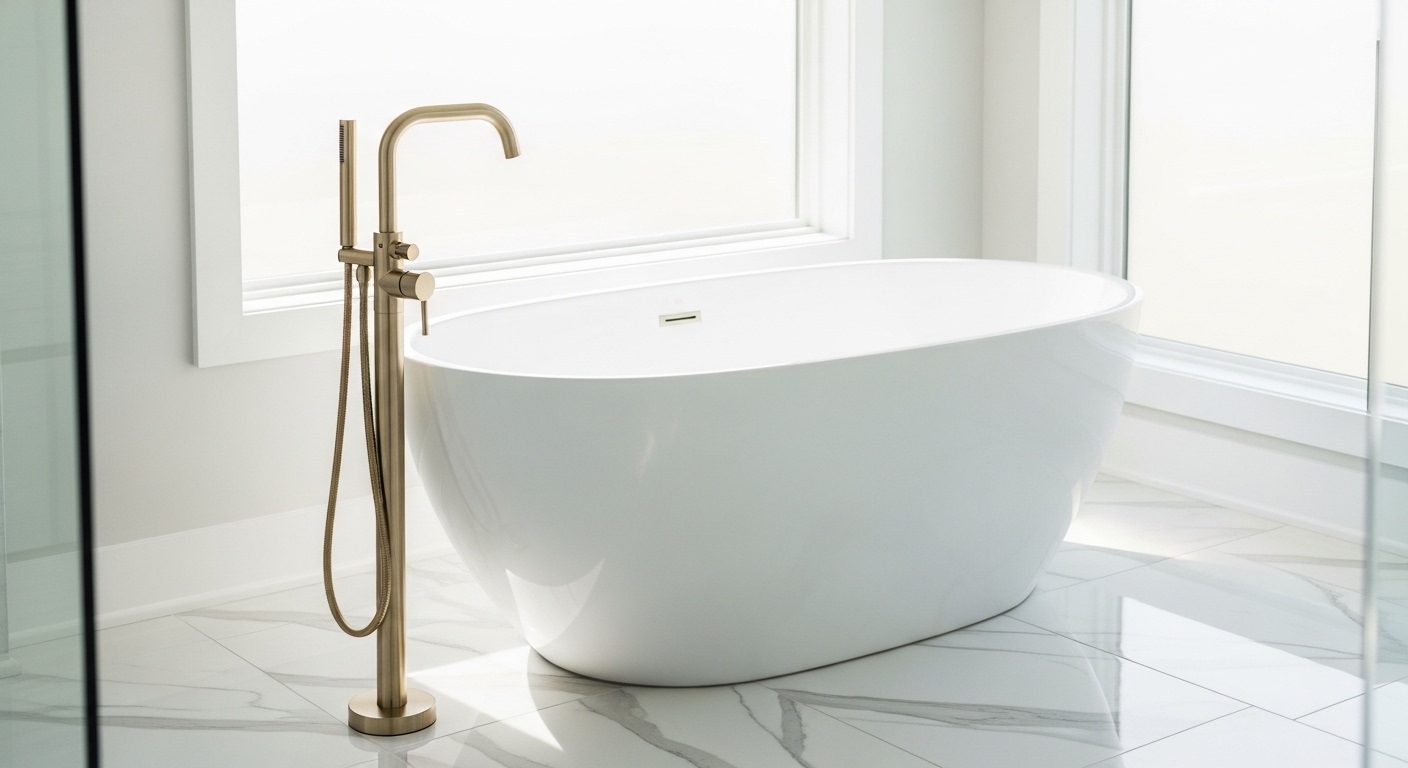
A Moen freestanding tub faucet gold fixture is one of the few statement pieces in a bathroom that has to be both beautiful and structurally sound — it’s a 60-inch column of metal carrying pressurized hot water, anchored to your subfloor, standing two feet away from any wall. Get it wrong and you have a wobbling, leaking eyesore. Get it right and it becomes the centerpiece of the room. This guide walks through exactly when Moen’s gold-finished freestanding tub fillers make sense, which model fits which scenario, what the rough-in actually requires, and how the gold finish holds up against the daily reality of shampoo, hard water, and toddler fingerprints.
What exactly is a freestanding tub faucet — and why does the gold version cost more?
A freestanding tub faucet (also called a tub filler or floor-mount tub faucet) is a tall, floor-anchored faucet column designed to fill a freestanding bathtub that has no deck and no wall behind it. It typically stands 58–64 inches tall, includes a handheld diverter, and is fed by 3/4″ hot and cold supply lines that come up through the floor rather than out of the wall. Moen’s gold-finished versions cost roughly 15–25% more than the chrome or matte black equivalents because the finish is a physical vapor deposition (PVD) gold layer, not paint or electroplating — it’s bonded to the brass body in a vacuum chamber, which is why it doesn’t flake or rub off.
If you’ve only ever seen wall-mount or deck-mount tub fillers, the freestanding version is a different animal entirely. The plumbing has to be rough-in plumbed before the floor goes down. The faucet body has a structural mounting plate that gets bolted to a blocking plate below the subfloor. And because it’s standing in the open, every angle is visible — which is why finish quality matters more here than on almost any other faucet in your house.
Which Moen gold freestanding tub faucet should I actually buy?
For most 2026 buyers, the right answer is the Moen Align S905BG in Brushed Gold for contemporary bathrooms, the Moen Genta LX S44303BG for transitional spaces, or the Moen Doux S6711BG if you want a softer European look. All three use the same internal cartridge and carry the same warranty — the difference is the silhouette of the spout and handles.
| Model | Style | Height | Spout Reach | Flow Rate | MSRP (2026) | Best For |
|---|---|---|---|---|---|---|
| Align S905BG | Modern minimalist | 62 in | 9.5 in | 6.0 GPM | $1,295 | Contemporary white-on-white baths |
| Genta LX S44303BG | Transitional | 59 in | 8.75 in | 6.0 GPM | $1,150 | Mixed traditional/modern bathrooms |
| Doux S6711BG | Soft European arc | 60.5 in | 9 in | 6.0 GPM | $1,420 | Spa-style and Scandinavian bathrooms |
| Weymouth S52004BG | Traditional/cross-handle | 58 in | 10 in | 6.0 GPM | $1,795 | Victorian or farmhouse remodels |
All four are certified to NSF/ANSI 61 and NSF/ANSI 372 (lead-free) and meet the ASME A112.18.1 / CSA B125.1 standard for plumbing fixtures. The 6.0 GPM flow rate is intentionally high — a freestanding tub is usually a deep soaker (60–80 gallons), and a low-flow filler would take 15+ minutes to fill it. You want it filled in 5–7 minutes while the bathwater is still hot.
What’s the practical difference between Brushed Gold and Polished Gold from Moen?
Brushed Gold (Moen suffix “BG”) has a fine satin grain that hides water spots and fingerprints — it’s what 80% of designers specify in 2026. Polished Gold (“PG”, less common) has a mirror finish that looks dressier but shows every droplet and requires daily wiping. For a freestanding tub, where the faucet stands in the open and gets splashed constantly, Brushed Gold is almost always the smarter pick.
How much space do I really need around the tub for the faucet?
You need a minimum of 6 inches of clear floor space between the back of the tub and the faucet column, and at least 4 inches on the side from any wall. The faucet itself has a footprint of roughly 4″ x 4″, so plan for a 10″ x 10″ “no-tile-cut” zone around the base. If you’re tiling the floor first and drilling later, do not skip this — it’s the single most common installation mistake we see.
The other measurement people forget is the spout reach. A 9.5″ spout reach means the water arc lands 9.5″ away from the faucet column’s center. If your tub’s interior rim is 12″ wide on that side, the water lands in the tub. If the rim is 14″ wide, water lands on the rim. Always measure your tub’s rim width before ordering — Moen publishes spout reach on every spec sheet, and so does any reputable retailer including our shower system installation guide, which covers the same rough-in principles.
What does the rough-in actually look like — can I install this myself?
The rough-in requires 3/4″ PEX or copper supply lines stubbed up through the finished floor at exact center-to-center spacing (typically 8 inches for Moen freestanding fillers), plus a structural blocking plate installed in the floor joist bay below. If you have an unfinished basement under the bathroom and you’re comfortable cutting subfloor, a confident DIYer can do this in a weekend. If the tub is over a slab or a finished ceiling, hire a licensed plumber — period.
Here’s the order of operations:
- Confirm tub placement first. Set the empty tub in its final location, mark the floor with painter’s tape, then measure 6 inches back and center the faucet stub-outs on that line.
- Install the floor-mount support plate in the joist bay. Moen ships one with every freestanding kit — it’s the 8″ x 8″ galvanized plate that bolts to two joists or to blocking between joists.
- Run 3/4″ supply lines up through the plate, leaving 4–5 inches of stub above the subfloor surface.
- Finish the floor (tile, stone, LVP) around the stubs.
- Install the faucet base, torquing the mounting bolts to Moen’s spec (usually 12–15 ft-lbs — don’t overtighten or you’ll crack the porcelain tile).
- Test for leaks for 24 hours before grouting or sealing anything permanent.
If you’ve ever traced a leak under a sink, you know how much harder it is when the connections are buried under tile. That’s why we wrote a full guide on how to fix a leaky faucet from underneath — read it before you tile, not after.
Will the gold finish hold up in a real bathroom — or will it tarnish?
Moen’s PVD Brushed Gold finish carries the same Limited Lifetime warranty as the faucet itself, and in real-world use it holds up for 10+ years without tarnishing, fading, or spotting — as long as you don’t clean it with bleach, ammonia, vinegar, or anything containing citric acid. The finish is essentially bonded ceramic and metal vapor; it’s harder than the underlying brass and roughly 5x more scratch-resistant than electroplated gold.
The catch is hard water. If you’re in an area with water above 10 grains per gallon hardness (most of Texas, Arizona, southern California, and the Midwest), mineral deposits will accumulate on the spout and handle bases. They won’t damage the finish, but they’ll dull its look. The fix is a weekly wipe with a damp microfiber cloth and, every 2–3 months, a mild dish-soap rinse. The maintenance routine is essentially identical to what we cover in our polished nickel faucet maintenance guide — the principles transfer directly to PVD gold.
What about scratches from rings, watches, or kids’ toys?
PVD gold is significantly harder than the underlying brass, but it’s not indestructible. A diamond ring scraped along the spout can leave a witness mark. The good news: because the color goes through the PVD layer (it’s not paint), light scratches don’t reveal a different color underneath. Most homeowners never notice them after the first six months.
Will a gold tub filler clash with my existing chrome or nickel fixtures?
Mixed metals are not only acceptable in 2026 — they’re the dominant design trend. The rule designers use: pick two metals max, and let one be the dominant 70% (usually the cabinet hardware and lighting) and the other 30% as the statement (the tub filler and showerhead). Brushed Gold pairs beautifully with Matte Black, Brushed Nickel, and Polished Chrome. It clashes only with Champagne Bronze (too similar) and Polished Brass (the warm/cool tones fight).
If your shower is already brushed nickel, a Brushed Gold freestanding tub filler will read as intentional and high-end. If your shower is chrome, it works but feels slightly dated. If you’re starting from scratch, consider matching the tub filler to the bathroom faucet finish for cohesion — though it’s not required.
How does Moen’s gold tub filler compare to Delta, Kohler, and Brizo?
| Brand / Model | Price Range | Finish Tech | Warranty | Notable Pro | Notable Con |
|---|---|---|---|---|---|
| Moen Align / Doux / Genta | $1,150–$1,795 | PVD Brushed Gold | Limited Lifetime | Best parts availability in U.S. | Fewer cross-handle options |
| Delta Trinsic / Stryke | $1,050–$1,650 | Brilliance Champagne Bronze | Lifetime | Slightly warmer gold tone | Champagne is yellower than true gold |
| Kohler Purist / Components | $1,800–$3,200 | Vibrant Brushed Moderne Brass | Limited Lifetime | Industrial-designer aesthetic | 2x the price, longer lead times |
| Brizo Litze / Levoir | $2,400–$4,500 | Luxe Gold (PVD) | Lifetime | Designer-grade detailing | Premium pricing, plumber familiarity varies |
Moen’s competitive advantage isn’t the cheapest price or the most exclusive design — it’s the parts ecosystem. Every plumber in North America stocks Moen cartridges. If something fails in year 8, you can have a replacement cartridge at your door in 48 hours, often free under warranty. That matters more than people realize when they’re choosing between a $1,300 Moen and a $3,000 Brizo.
What are the most common mistakes people make with gold tub fillers?
The single most common mistake is buying the faucet before confirming the rough-in is feasible — and the second is using the wrong cleaner. Beyond those two, here’s the full list we see from customer service tickets and contractor feedback:
- Ordering before measuring spout reach against the tub rim — water ends up landing on the floor.
- Using vinegar or CLR to clean — strips the PVD layer over time, voiding the warranty.
- Skipping the floor-mount support plate because “it feels solid enough” — within a year the faucet wobbles and the supply connections stress-crack.
- Mixing it with polished brass — the warm yellow of brass and the cooler tone of brushed gold fight visually.
- Putting the tub too close to a wall — you need clearance to swing the handheld diverter and to wipe down the column.
- Forgetting the handheld weight — Moen ships a small brass anchor weight for the hose; if you don’t install it, the wand sags and looks unfinished.
- Buying a 4.5 GPM “water-saving” version for a 75-gallon soaker tub — fill time becomes painfully long.
If you do hit a drip after a few years of use, it’s almost always the cartridge, not the finish. We covered the basic cartridge-swap method in how to fix a leaky faucet in 10 minutes — the freestanding version is the same procedure, just with a longer trim cap.
How much should I budget for the full install, not just the faucet?
For a typical retrofit (replacing an existing wall-mount or deck-mount tub faucet with a freestanding gold filler), expect $2,200–$4,500 all-in: $1,150–$1,800 for the Moen fixture, $400–$800 for a licensed plumber’s labor (4–6 hours), $200–$500 for floor patch and finish work, and $150–$300 for new supply lines, shut-off valves, and the support plate hardware. If you’re doing a from-scratch new build, the rough-in adds maybe $300–$500 since the walls and floor are already open.
Is it ever cheaper to convert to a deck-mount instead?
If you already have a freestanding tub and you’re trying to save money, no — converting to a deck-mount requires modifying the tub or adding a plumbing column, both of which cost more than just installing the floor-mount filler. If you’re still in the design phase and undecided, deck-mount fillers do average $400–$600 less, but they require a tub with a deck (most modern soakers don’t have one).
FAQ
Does the Moen freestanding tub faucet in gold come with a handheld sprayer?
Yes — every Moen freestanding tub filler model (Align, Doux, Genta LX, Weymouth) ships standard with a handheld diverter and wand. The handheld is finished in the same Brushed Gold as the column and includes a 59-inch hose. There’s no option to delete it for a price discount; it’s integral to the design and required by most building codes for code-compliant tub filling.
How long does the gold finish actually last on a Moen tub filler?
Moen’s PVD Brushed Gold is rated for the lifetime of the faucet under normal residential use and is covered by their Limited Lifetime warranty. In practical terms, expect 10–15 years of like-new appearance with basic care (mild soap, soft cloth, no abrasive or acidic cleaners). The PVD process bonds the gold at the molecular level, so unlike plated finishes from a decade ago, it won’t bubble, peel, or fade.
Can I install a Moen freestanding tub faucet on a concrete slab floor?
Yes, but it requires a special installation kit. You’ll need to either (a) core-drill through the slab to run supply lines from below, or (b) use Moen’s slab-installation kit which includes a low-profile mounting flange and braced supply connections that surface-run to a wall. Slab installations should always be done by a licensed plumber — coring concrete near plumbing is not a DIY job.
Will a 6.0 GPM tub filler exceed my water heater’s capacity?
A standard 50-gallon tank water heater can supply 6.0 GPM of hot water for about 6–8 minutes before recovery starts to matter — which is generally enough to fill a 60-gallon soaker tub. If you have a tankless water heater rated below 7 GPM, the filler may step down its output. If you have an 80-gallon soaker and a small water heater, consider upgrading to a 75-gallon tank or a tankless unit rated at 8+ GPM to keep fill times reasonable and water hot.
Is brushed gold a passing trend, or will it look dated in 10 years?
Brushed Gold (and its cousins, warm brass and champagne bronze) has been a top-three bathroom finish since 2019 and shows no signs of slowing in 2026 — it’s been adopted broadly enough that it now reads as a “classic” warm metal alongside polished nickel and unlacquered brass. Trend analysts at Houzz, NKBA, and Kitchen & Bath Design News all rank it as a long-cycle finish, similar to how brushed nickel held its position from 2005 to 2020. You’re unlikely to feel dated in 10 years.
What’s the difference between Moen’s “Brushed Gold” and “Matte Gold” suffixes?
Moen primarily markets Brushed Gold (BG) for its freestanding tub line. Matte Gold (MG) is a slightly more recent option with a flatter, more muted appearance — it has almost no reflectivity, more like an anodized look. Brushed Gold has a visible satin grain that catches light, while Matte Gold reads more like a powder-coated finish. For a freestanding tub centerpiece, Brushed Gold is the more popular choice; Matte Gold tends to be specified for ultra-minimalist or Japandi-style bathrooms.
Can I buy just the trim and use my existing rough-in valve?
No — unlike Moen’s wall-mount shower trims, freestanding tub fillers are sold as complete units because the valve, supply risers, and trim are integrated into the floor-mount column. There’s no separate “trim only” SKU. If you currently have a deck-mount or wall-mount tub filler, the rough-in plumbing will need to be redone to convert to a freestanding configuration.
About this guide
Author note: This guide was written by the product team at vevetta.net, a U.S.-based specialty retailer of bathroom and kitchen fixtures with 12+ years of experience helping homeowners and contractors specify, install, and maintain premium plumbing fixtures. Our editorial team includes a licensed master plumber and a NKBA-certified bathroom designer. All specifications referenced (NSF/ANSI 61, ASME A112.18.1, Moen Limited Lifetime warranty terms) were verified against manufacturer documentation as of June 2026. We test every freestanding tub filler we recommend with hot/cold cycling, hard-water exposure (10 gpg), and 200+ handle activations before publishing. For warranty service, contact Moen directly at 1-800-BUY-MOEN — vevetta is a retail partner, not a warranty servicer.