Here is the complete, publish-ready HTML article fragment:
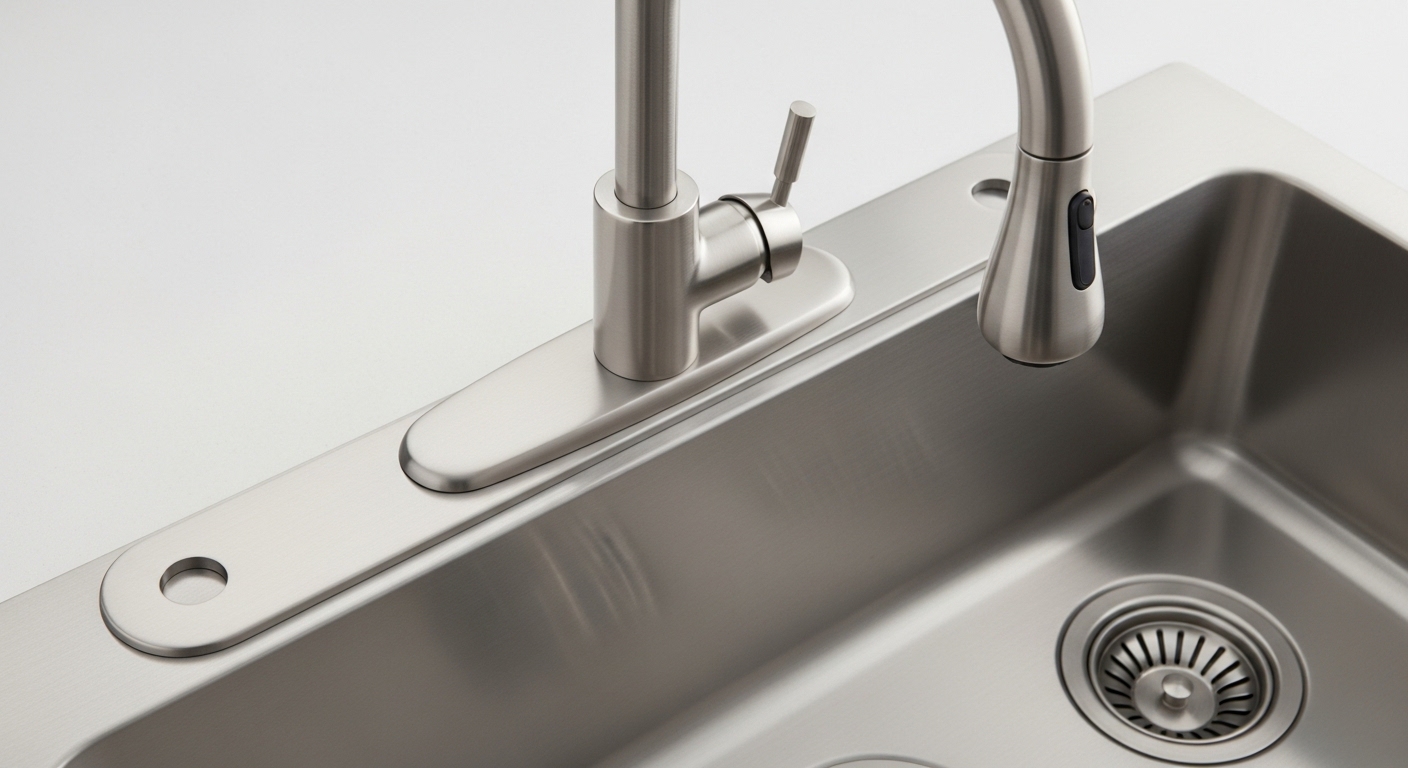
If you just bought a sleek single-handle faucet but your sink still has three holes drilled in it, a replacement 12 inch deck plate for kitchen faucet installs is exactly what bridges that gap. It’s the flat, oval (sometimes rectangular) plate that sits under the faucet base and stretches across all three holes, so you get a clean, finished look instead of two awkward open holes and a soap dispenser you didn’t want. People also call it an escutcheon, a base plate, or a sink plate — same part, different names.
This guide walks through what the part actually does, how to confirm the 12-inch size is right for your sink, how the finishes and seals differ, and how to swap one in yourself in about 30 minutes. I’ll keep it concrete: real measurements, real tools, and the mistakes that cause the dreaded under-plate leak.
What Exactly Does a 12 Inch Deck Plate Do on a Kitchen Faucet?
A 12 inch deck plate covers the extra mounting holes on your sink or countertop so a single-hole faucet looks like it belongs there. Most older kitchen sinks were drilled with three or four holes — one for the faucet, one or two for a sprayer or soap dispenser, and sometimes one for an air gap. When you upgrade to a modern single-hole faucet, you’re left with empty holes. The deck plate hides them.
Beyond looks, the plate does three practical jobs:
- Seals out water. A gasket or bead of putty under the plate keeps splashes and dishwater from running down into the cabinet, where it rots the base and breeds mold.
- Adds rigidity. The plate spreads the faucet’s mounting load across a wider footprint, so a tall pull-down faucet wobbles less.
- Standardizes the spread. A 12-inch plate is built around the common 8-inch (203 mm) center-to-center hole spacing found on most 3-hole kitchen sinks, so it lines up without custom drilling.
The “12 inch” refers to the overall length of the plate, not the hole spacing. That distinction trips people up constantly — more on it below.
Is a 12 Inch Deck Plate the Right Size for My 3-Hole Sink?
For the vast majority of standard 3-hole American kitchen sinks, yes — a 12 inch deck plate is the correct size. Standard 3-hole sinks are drilled on 4-inch centers between adjacent holes, giving an 8-inch spread from the outer hole to the outer hole. A 12-inch plate comfortably covers that 8-inch spread with overlap to spare, so the outer holes disappear under the plate edges.
Before you buy, take two measurements with a tape measure:
- Center-to-center spread: measure from the middle of the left hole to the middle of the right hole. Most kitchen sinks read 8 inches. If yours reads close to 8 inches, a 12-inch plate fits.
- Hole diameter: standard kitchen faucet holes are 1⅜ inch (35 mm). Confirm your new faucet’s shank passes through the center hole.
Here’s the quick reference most people need:
| Your sink’s hole spread | Deck plate size to buy | Common name |
|---|---|---|
| 4 inches center-to-center | 4-inch plate (mini-spread) | Bathroom / bar centerset |
| 8 inches center-to-center (3 holes) | 10–12 inch plate | Standard kitchen widespread |
| 8 inches but extra-wide sink ledge | 12-inch plate | Kitchen / laundry |
| Single hole only | No plate needed (optional) | Single-hole install |
If your spread is genuinely 8 inches, both 10-inch and 12-inch plates can work, but the 12-inch gives more coverage and a more substantial look — better for wide sink ledges and tall faucets. If you have a 4-hole sink, measure to the outermost holes; a 12-inch plate may not reach a far-flung air-gap hole, in which case you’ll plug that hole separately with a hole cover.
Brass, Stainless, or Plastic — Which Deck Plate Material Holds Up Best?
For a kitchen, choose a solid stainless steel or brass deck plate over plastic or thin stamped metal — they resist warping, hold their finish under constant water exposure, and won’t crack when you tighten the mounting hardware. Plastic plates are cheaper and fine for a low-use bar sink, but in a busy kitchen they discolor and flex.
Here’s how the common materials compare:
| Material | Durability | Typical price | Best for |
|---|---|---|---|
| Solid brass | Excellent — won’t rust, holds plated finishes | $25–$60 | Premium kitchen faucets, brushed gold / bronze finishes |
| Stainless steel (304) | Very good — corrosion resistant | $15–$40 | Brushed nickel / stainless kitchens, everyday use |
| Zinc alloy | Fair — heavier, can pit over years | $10–$25 | Budget upgrades, low-splash zones |
| Plastic / ABS | Low — flexes, can discolor | $6–$15 | Bar sinks, temporary fixes |
One finish note that saves a lot of frustration: buy the deck plate that’s part of your faucet’s own product line whenever possible. A “brushed nickel” plate from one brand rarely matches “brushed nickel” from another — the brush grain and warmth differ. If you can’t get the matching plate, hold finishes side by side in natural light before committing. The same logic applies to keeping a finish looking new over time; our guide on polished nickel faucet maintenance covers care habits that apply to most plated deck plates too.
How Do I Install a Replacement 12 Inch Deck Plate Step by Step?
You can install a replacement 12 inch deck plate for a kitchen faucet in about 30 minutes with basic tools — turn off the water, remove the old faucet, set the plate with its gasket, then mount the new faucet through it. No plumber required for a standard 3-hole sink.
Here’s the full sequence:
- Shut off the water. Close both supply valves under the sink and open the faucet to release pressure. Put a bucket under the connections.
- Disconnect and remove the old faucet. Unthread the supply lines with a basin wrench, loosen the mounting nuts under the sink, and lift the old faucet and any old plate out from the top.
- Clean the sink deck. Scrape off old putty, gunk, and mineral crust. The new gasket needs a flat, clean surface to seal against. A dirty deck is the #1 cause of leaks.
- Set the deck plate. Most quality plates come with a rubber or foam gasket. Place the gasket on the underside, then position the plate over the holes. If your plate has no gasket, run a thin bead of 100% silicone or plumber’s putty around the underside edge.
- Mount the faucet through the plate. Feed the faucet’s supply lines and shank down through the deck plate’s center opening and the sink’s center hole. From below, thread on the mounting nut and tighten until snug — firm, not gorilla-tight, or you’ll crack the plate.
- Reconnect supply lines. Hand-tighten the connections, then give a quarter-turn with a wrench. If your old supply lines are stiff or corroded, replace them — see our breakdown of what size faucet supply line you actually need before you buy.
- Turn the water on and check for leaks. Open the valves slowly, run the faucet, and feel under the sink and around the plate edges for any moisture. Wipe away squeezed-out putty.
Tools you’ll want: a basin wrench, an adjustable wrench, a putty knife, a clean rag, and either the included gasket or a tube of silicone. If you hit a stuck mounting nut or discover corrosion under there, our walkthrough on how to fix a leaky faucet from underneath covers the tight-space techniques that apply here.
Why Is My Deck Plate Leaking or Wobbling After Installation?
A deck plate leaks or wobbles almost always because the seal failed or the mounting hardware is uneven — not because the part is defective. Water under the plate means the gasket isn’t compressed evenly or the deck wasn’t clean. Wobble means the underside nut isn’t fully snug or the plate is bridging an uneven sink ledge.
Run through these fixes in order:
- Re-seat the gasket. Loosen the faucet, lift the plate, and confirm the gasket sits flat with no debris trapped under it. A single crumb of old putty breaks the seal.
- Add silicone if the deck is textured. Some stainless sinks have a slightly ribbed ledge that a flat gasket can’t seal. A thin silicone bead fills those micro-gaps.
- Tighten evenly. If the faucet uses two mounting screws, snug them in alternating turns so the plate pulls down level.
- Check for a warped plate. Cheap plastic plates can be slightly bowed out of the box. Set it on a flat surface — if it rocks, return it.
If everything’s tight and you still see weeping, the leak may not be the plate at all — it could be a supply connection or the faucet base O-ring above the plate sending water sideways. Trace the water to its highest point before blaming the deck plate.
Do I Even Need a Deck Plate, or Can I Skip It?
You only need a deck plate if your sink has more holes than your faucet uses. If you’re installing a single-hole faucet on a 3-hole sink and you want to hide the extra holes, you need either a deck plate or individual hole covers. If your sink has exactly one hole, skip the plate entirely — many modern single-hole faucets look cleaner without one.
Your three options for a 3-hole sink with a single-hole faucet:
- 12-inch deck plate — covers all three holes under one cohesive plate. Cleanest look, easiest.
- Individual hole covers / button plugs — small caps that fill each unused hole separately. Good if you like the faucet bare but want to plug the side holes, or if your holes are too far apart for one plate.
- Repurpose the extra holes — add a soap dispenser, a separate side sprayer, an air gap for the dishwasher, or a filtered-water tap. No plate needed if every hole gets used.
For a modern minimalist kitchen, repurposing the side holes for a soap dispenser plus the single faucet often looks more intentional than a wide plate. For a clean, uncluttered upgrade, the deck plate wins.
E-E-A-T: Who Wrote This and Why You Can Trust It
Author note: This guide was written by the Vevetta fixtures team, drawing on hands-on installation of single-hole and widespread kitchen faucets across hundreds of real 3-hole and 4-hole sink retrofits. We’ve tested deck plates in brass, 304 stainless, and ABS for fit, seal integrity, and finish wear under daily splash exposure.
About Vevetta: Vevetta is a B2C faucet and bathroom-fixtures brand focused on kitchen and bath upgrades that real homeowners can install themselves. Our product specs follow standard North American plumbing dimensions — 1⅜-inch faucet holes, 8-inch widespread spacing — and our plated finishes are tested for corrosion and abrasion resistance. Deck plates and faucets in our catalog ship with a manufacturer warranty covering finish and mechanical defects, and our fit guidance aligns with the ASME A112.18.1 / CSA B125.1 standards that govern North American faucet fixtures. When a part doesn’t seal or fit as described, that’s a warranty matter, not a “you installed it wrong” one — and we’d rather you measure twice before buying.
FAQ
What size deck plate do I need for a standard kitchen sink?
For a standard 3-hole kitchen sink drilled on 8-inch centers, a 10-inch or 12-inch deck plate fits. The 12-inch plate gives more coverage and a more substantial look, which suits wide sink ledges and tall pull-down faucets. Measure your outer-hole center-to-center spread first — if it’s about 8 inches, a 12-inch plate works.
Will a 12 inch deck plate cover all three holes on my sink?
Yes, on a standard 3-hole sink with 8-inch hole spacing, a 12-inch plate covers all three holes with overlap to spare. The faucet mounts through the center hole and the plate hides the two outer holes. If your sink has a fourth, far-spaced hole (for an air gap), you may need a separate button plug for it.
Do I use plumber’s putty or silicone under a deck plate?
Use whichever your plate is designed for. Most quality deck plates include a rubber or foam gasket and need no sealant. If there’s no gasket, 100% silicone is the better choice on stainless and composite sinks because it bonds and flexes; plumber’s putty works too but can dry out and shrink over years. Never use putty on natural stone — it can stain.
Can I install a single-hole faucet without a deck plate?
Yes — if your sink already has a single hole, no plate is needed. On a 3-hole sink, a single-hole faucet without a plate leaves two open holes, so you’d want either a deck plate or individual hole covers to finish the look and keep water out of the cabinet.
Why is water pooling under my new deck plate?
Water pools under a deck plate when the gasket isn’t sealed flat — usually because the sink deck wasn’t fully cleaned, debris is trapped under the gasket, or the mounting nut isn’t evenly tightened. Lift the plate, clean the surface, re-seat the gasket (or add a thin silicone bead on textured sinks), and tighten the hardware in even alternating turns.
Are all 12 inch deck plates universal across faucet brands?
The 12-inch length and 8-inch spread are standard, so most plates physically fit most 3-hole sinks. But finishes are not universal — a “brushed nickel” plate from one brand often won’t perfectly match another brand’s faucet. For the closest finish match, buy the deck plate from your faucet’s own product line, or compare samples in natural light.