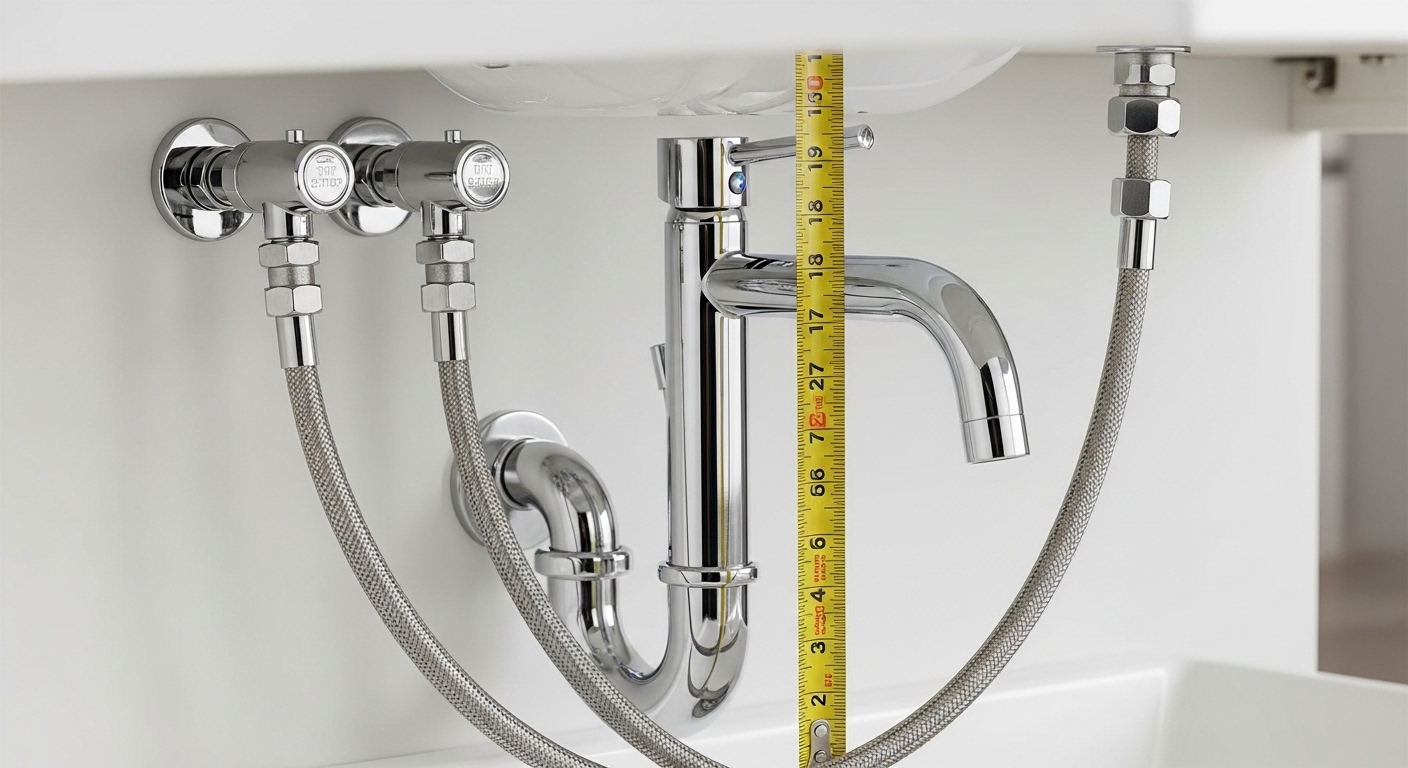
If you’ve ever stood in the hardware store aisle staring at a wall of braided hoses wondering what size is faucet supply line supposed to be for your sink, you’re not alone. The honest answer is that “faucet supply line size” is really three measurements stacked together: the diameter of the water line, the thread type on each end, and the overall length. Get any one of those wrong and you’ll either have a leak, a kinked hose, or a $40 trip back to the store. This guide walks through every common size, how to measure your existing setup in under five minutes, and how to pick the right replacement the first time.
At Vevetta, we design and ship faucets to homes across the U.S. every day, and supply-line mismatches are the single most common reason a DIY install turns into a callback. So we put together this guide using the same checklist our installation support team uses on the phone — no fluff, just the dimensions, connectors, and gotchas that actually matter.
What size is a faucet supply line in a standard American home?
In 99% of U.S. homes built or remodeled in the last 30 years, the faucet supply line is 3/8-inch compression on the valve end and the faucet end matches whatever the faucet manufacturer specifies — usually 1/2-inch FIP (Female Iron Pipe), 3/8-inch compression, or a metric M10 x 1.0 threaded coupling. The hose itself is typically a braided stainless steel sleeve over a PEX or EPDM core, rated for 125 PSI and 180°F.
That 3/8″ measurement refers to the outside diameter (OD) of the small copper or PEX tube that slides into the angle-stop shut-off valve. The water actually flowing through it is only about 1/4″ of internal bore, which is plenty for any residential faucet — kitchen faucets need around 1.5–2.2 GPM, and a 3/8″ line delivers far more than that. You don’t get more pressure by going to a 1/2″ line; the bottleneck is almost always the aerator or the cartridge, not the supply hose.
The three measurements you actually need
- Diameter: Almost always 3/8″ OD compression at the shut-off valve. Toilets and some older homes use 1/2″, but faucets are 3/8″.
- Connector type at the faucet end: 1/2″ FIP (most kitchen faucets), 3/8″ compression (many bathroom faucets), or M10 x 1.0 / M8 x 1.0 metric (most pre-attached hoses on modern pull-down faucets).
- Length: 12″, 16″, 20″, 24″, or 30″. 20 inches is the most common stocked size and works for the vast majority of standard vanities.
How do I know if my faucet needs 3/8″ or 1/2″ supply lines?
Look at the inlet threads on the underside of the faucet itself: if you can see a clearly threaded brass nipple roughly the size of a nickel, that’s 1/2″ FIP and you need a hose with a 1/2″ FIP female nut on one end. If the inlet is a smaller smooth copper or braided tail already attached to the faucet, you’re dealing with a pre-attached supply line and you only need the shut-off side to match — typically 3/8″ compression or 1/2″ FIP depending on what tail the faucet came with.
A quick visual rule: 1/2″ FIP threads are about the diameter of a U.S. dime; 3/8″ compression nuts are about the diameter of a pencil eraser. If you’re unsure, take the old supply line with you to the store, or photograph the threads next to a coin for scale.
Kitchen vs. bathroom: do they use different sizes?
Short answer: same diameter, different end connectors. Kitchen faucets almost universally have 1/2″ FIP inlets because they need to support higher-flow installations and side spray diverters. Bathroom faucets are split — older two-handle widespread faucets often use 1/2″ FIP, while modern single-hole bathroom faucets and pull-down models usually come with pre-attached braided hoses ending in 3/8″ compression or M10 metric fittings. Pull-down kitchen faucets like the ones we cover in our Moen Joric pull-down kitchen faucet review almost always ship with pre-attached hoses, so you only need to source the angle-stop side.
What length faucet supply line should I buy for a vanity or kitchen sink?
For a standard 32″ bathroom vanity with shut-off valves mounted at the back wall, a 20-inch supply line is the right call about 80% of the time. Kitchen sinks usually need 20″ or 24″ depending on whether your valves are inside the cabinet or down by the floor. The rule: measure from the center of the shut-off valve outlet to the faucet inlet, then add 4 to 6 inches of slack so the line can curve gently without kinking.
| Fixture | Typical Diameter | Common Length | Faucet-Side Connector |
|---|---|---|---|
| Bathroom faucet (single-hole) | 3/8″ OD | 16″–20″ | 3/8″ compression or M10 x 1.0 |
| Bathroom faucet (widespread, 8″) | 3/8″ OD | 20″ | 1/2″ FIP |
| Kitchen faucet (standard) | 3/8″ OD | 20″–24″ | 1/2″ FIP |
| Kitchen faucet (pull-down) | 3/8″ OD | 24″–30″ | Pre-attached, M10 or 3/8″ compression on valve side |
| Wet bar / prep sink | 3/8″ OD | 12″–16″ | 1/2″ FIP or M10 |
| Bar / utility (single-hole) | 3/8″ OD | 16″ | 3/8″ compression |
Why you should never use a supply line that’s too short
A taut supply line is a leak waiting to happen. When water hits a faucet cartridge, the line absorbs a small pulse of pressure — that’s water hammer. If the hose is stretched bowstring-tight, every pulse stresses the compression ferrule until it weeps. The fix is dirt cheap: buy the next size up and let the hose form a gentle “S” curve under the sink. There should never be sharp 90-degree bends within 2 inches of either fitting.
What’s the difference between braided stainless, PEX, and poly supply lines?
Braided stainless steel is the right answer for almost every modern install. The braided sleeve resists abrasion, the inner PEX or EPDM core handles thermal cycling, and quality lines carry burst ratings of 1,500+ PSI even though residential water rarely exceeds 80 PSI. PEX-only and poly (white plastic) lines are cheaper but they degrade faster, especially under hot-water lines and inside cabinets that get warm from a garbage disposal.
- Braided stainless steel (recommended): 10-year typical lifespan, burst rating 1,500–2,500 PSI, UPC and cUPC certified, $4–$12 per line.
- PEX-only: Lighter and more flexible, but no abrasion protection. Better for tight corners. 5–7 year lifespan.
- Polymer/poly (white plastic): Cheapest option, often included with budget faucets. Replace at the first sign of cloudiness or stiffness. 3–5 year lifespan.
- Copper rigid: Found in older installs. Long-lasting but requires perfect alignment and a tubing bender. Most plumbers replace these with braided when remodeling.
How do I measure my existing faucet supply line correctly?
Shut off the water at the angle-stop valves under the sink, then unscrew the existing line and lay it flat next to a tape measure. You’re capturing four data points: the end-to-end length of the hose (nut-to-nut, not counting the threads), the OD of the small tube that goes into the valve, the thread type at the faucet end, and the overall outer sleeve diameter (this matters for tight cabinet routing).
Step-by-step measurement
- Turn both shut-off valves clockwise until they stop. Open the faucet to release pressure.
- Place a small bowl under the connection and unscrew the compression nut at the valve with an adjustable wrench.
- Unscrew the top end from the faucet inlet. If it’s a pre-attached braided line, you’ll disconnect at the valve only.
- Lay the line flat — don’t stretch it — and measure from the back of one nut to the back of the other.
- Inspect the threads: count threads per inch with a thread gauge if you have one, or photograph and bring the old line to the store.
If you’re already under the sink, take five extra minutes to inspect the shut-off valves themselves. Sticky, calcified valves are a common source of mystery leaks — the same root cause we explain in our guide to fixing leaky faucets from underneath. Replace any valve that won’t fully close or that drips when you operate the handle.
What about metric supply lines on imported or modern faucets?
Many imported and modern designer faucets — including a lot of European-style single-hole bathroom faucets and some high-end kitchen pull-downs — use metric threads, most commonly M10 x 1.0 on the faucet-side coupler. M10 means a 10mm thread diameter with a 1.0mm pitch. It is NOT interchangeable with 3/8″ compression even though they look almost identical to the naked eye. Forcing a 3/8″ compression nut onto an M10 stem will strip the threads and ruin the faucet’s pre-attached hose.
How to tell them apart: M10 nuts are slightly smaller (about 14mm across the flats vs. 9/16″ for 3/8″ compression) and the threads are finer. If you bought your faucet from a brand that uses metric — Hansgrohe, Grohe, many Vevetta models, and others — assume metric until you confirm otherwise. The good news: most metric faucets ship with pre-attached hoses that end in 3/8″ compression on the valve side, so you don’t need to source a metric supply line at all. You just need standard angle-stop valves.
What size faucet supply line do I need for a shower or tub valve?
Shower and tub rough-in valves are a different animal — they use 1/2″ copper, PEX, or CPVC pipe stubbed directly into the wall, not flexible supply lines. There’s no “supply line size” to buy because the connection is sweated, crimped, or threaded directly into the valve body. If you’re replacing a shower or tub setup, focus on the valve type (pressure-balanced vs. thermostatic) and trim compatibility instead. Our complete shower system installation guide walks through every connection type in detail.
One exception: handheld shower hoses. Those are typically 1/2″ NPSM (straight thread, not tapered) on both ends, with a rubber washer providing the seal. They’re not technically “supply lines” but they get lumped in by a lot of homeowners.
Common mistakes to avoid when replacing a faucet supply line
- Over-tightening compression nuts: Hand-tight plus a quarter turn with a wrench. Past that, you’ll crush the ferrule and cause the leak you were trying to prevent.
- Mixing metric and imperial: M10 and 3/8″ look the same. Confirm before threading.
- Reusing old supply lines: They’re $5. The braided sleeve crimps memory into the inner core, and you’ll never get a perfect seal twice. Always replace when you replace a faucet.
- Skipping the rubber washer at the faucet end: 1/2″ FIP connections need an internal washer (usually pre-installed). Lose it and you’ll get a slow drip you can’t trace.
- Buying lines that are too short: Always size up and let the line curve gently.
- Wrapping Teflon tape on compression fittings: Compression seals on the ferrule, not the threads. Tape on a compression nut actually prevents proper compression. Save the Teflon for NPT/FIP joints.
How much does a faucet supply line cost, and what brands are reliable?
A pair of quality braided stainless steel supply lines runs $8–$24 for residential use. Reliable brands carrying cUPC and NSF certifications include Fluidmaster, EastMan, BrassCraft, and SharkBite. Avoid bargain-bin no-name lines — supply lines are one of the top causes of catastrophic water damage in U.S. homes (insurance industry data consistently lists “supply line failure” as a top-5 claim category), and the $3 you save isn’t worth it. Look for at least a 5-year manufacturer warranty and a stated burst pressure rating on the packaging.
If you’re installing one of our Vevetta faucets, the box includes pre-attached braided hoses tested to ASME A112.18.1 / CSA B125.1 standards and backed by our limited lifetime warranty on the faucet body. You’ll only need to buy the angle-stop side if your existing shut-off valves are old or incompatible.
FAQ
Are all faucet supply lines the same size?
No. While the diameter on the shut-off valve side is almost always 3/8″ OD compression, the faucet-side connector varies between 1/2″ FIP, 3/8″ compression, and metric M10 x 1.0. Length also varies from 12″ to 30″. Always confirm both ends before buying.
Can I use a 1/2″ supply line on a 3/8″ faucet inlet?
Not directly, but you can use an adapter. The safer move is to buy a supply line with a 3/8″ end already — adapters add another joint that can leak. Most kitchen faucets that look like they need 1/2″ are actually 1/2″ FIP at the inlet but accept a 3/8″ OD line via the female nut.
How long do braided stainless steel supply lines last?
Quality braided stainless lines last 8–12 years in typical residential use. Plumbing professionals and many home insurance providers recommend proactive replacement every 10 years even if there’s no visible damage, because the inner core degrades before the outer braid shows wear.
Do I need plumber’s tape on a faucet supply line?
Only on FIP/NPT (tapered thread) connections. Apply 2–3 wraps of PTFE tape clockwise around the male threads. Never use tape on compression fittings — those seal mechanically on the ferrule, and tape interferes with the seal.
What size is the supply line on a Delta or Moen kitchen faucet?
Most Delta and Moen kitchen faucets ship with pre-attached 20″ or 24″ braided supply lines that end in 3/8″ compression on the valve side. You don’t need to buy a separate supply line — just standard 3/8″ compression angle-stop valves at the wall.
What’s the difference between OD and ID on a supply line?
OD (outside diameter) refers to the size of the small tube that fits into the angle-stop valve — always 3/8″ for residential faucets. ID (inside diameter) refers to the bore the water actually flows through, typically 1/4″ on a 3/8″ OD line. When someone says “3/8″ supply line” they almost always mean OD.
Why does my new supply line leak even though it’s hand-tight?
Three usual culprits: (1) the internal rubber washer is missing or torn, (2) the ferrule is over-compressed from being tightened past a quarter-turn beyond hand-tight, or (3) you wrapped Teflon tape on a compression fitting. Disassemble, inspect the washer, replace if needed, and retighten gently.
Can I cut a supply line shorter to fit?
No. Braided supply lines are factory-crimped at both ends and cannot be shortened without destroying the seal. If your only option is shorter, buy the correct length — 12″, 16″, and 20″ lines are all standard stock sizes.
About the author: This guide was written by the Vevetta installation support team, drawing on thousands of customer install calls and our in-house plumbing technicians’ field experience. Vevetta is a U.S.-based faucet and bathroom fixture brand — all of our faucets are tested to ASME A112.18.1 / CSA B125.1 standards and backed by a limited lifetime warranty on the faucet body and finish. For more installation guides, finish care, and product comparisons, browse the rest of the resources at vevetta.net, including our polished nickel faucet maintenance guide and our 10-minute leaky faucet fix.