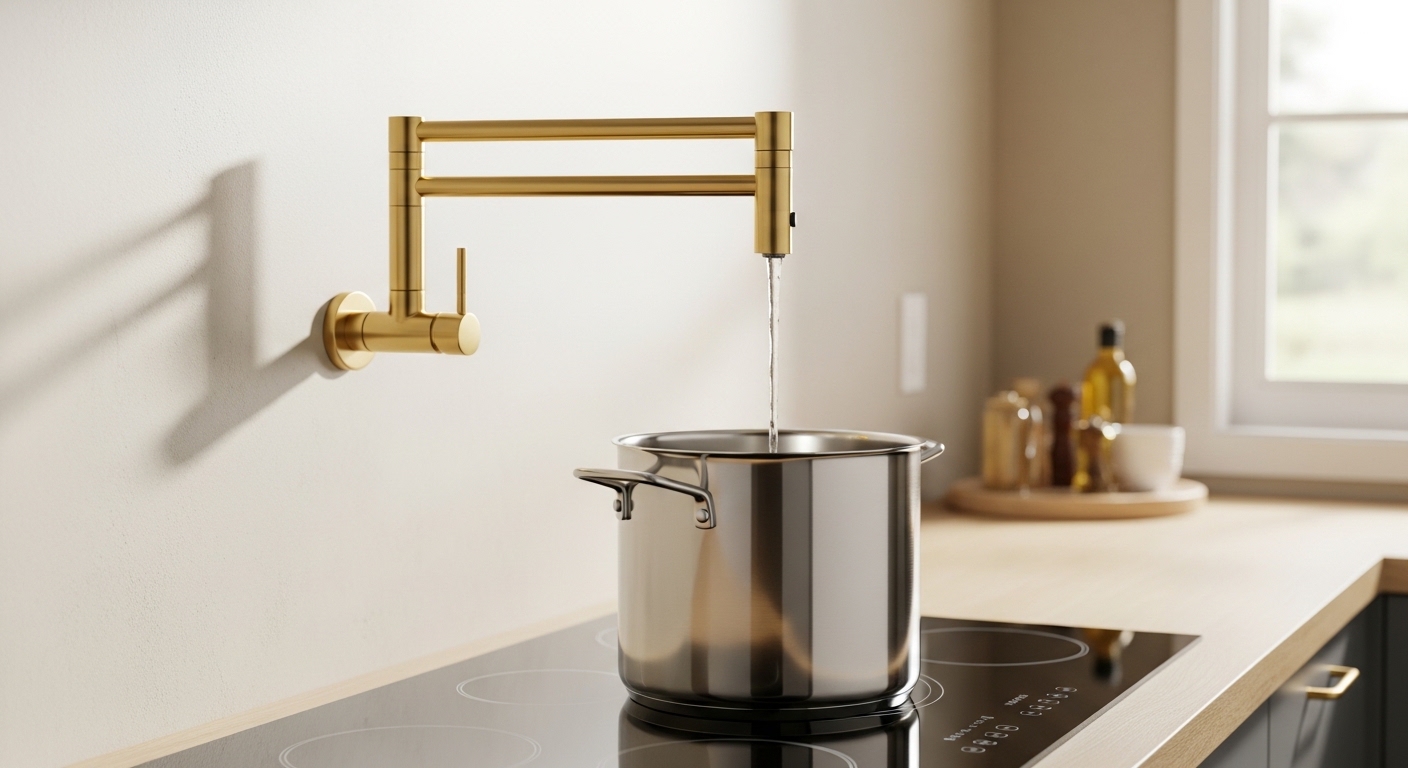
Whether a pot filler faucet is worth it comes down to one honest question: how often do you fill a big, heavy pot on your stove? If you’re boiling pasta water, canning, making stock, or cooking for a crowd every week, a wall-mounted pot filler over the range earns its keep by killing the sloshing walk from sink to stovetop. If you cook light most nights, it’s a beautiful convenience you’ll use a handful of times a month — nice, but not essential. Below, we break down the real cost, the plumbing reality, the situations where it genuinely pays off, and when to skip it, so you can decide before you commit to cutting into your backsplash.
At Vevetta, we sell and test kitchen and bath fixtures every day, and pot fillers are one of the most “love it or regret it” purchases in the catalog. The difference almost always comes down to matching the faucet to how you actually cook — so let’s get specific.
What exactly is a pot filler faucet, and how is it different from my regular kitchen faucet?
A pot filler is a cold-water-only faucet mounted on the wall (or occasionally the deck) directly behind or beside your cooktop, with a long articulating arm that folds flat when not in use and swings out to fill pots right on the burner. Unlike your main kitchen faucet, it isn’t for washing dishes or rinsing hands — it does exactly one job: delivering water to the stove so you never carry a heavy full pot again.
The defining feature is the double-jointed arm. It has two hinges, so it reaches out over a front or back burner and then folds tight against the wall to stay out of the way. Most run a cold-only supply line because you’re filling pots you’re about to heat anyway — there’s no reason to run hot water and add plumbing complexity. Most quality models also have two shut-off valves (one at the wall, one at the spout head), which matters for both safety and drip control.
Here’s the mental model: your kitchen faucet is a workhorse, your pot filler is a specialist. If you’re weighing overall kitchen faucet upgrades too, our guide to the best kitchen faucet with magnetic docking for a busy family kitchen pairs well with a pot filler for a full-range setup.
Is a pot filler faucet actually worth the money, or is it just for show?
It’s worth the money for frequent, heavy-pot cooks and mostly for show for everyone else. The break-even test is simple: if you fill a pot that weighs more than 10–15 pounds at least a few times a week, a pot filler saves real effort and reduces spills and back strain. If that’s an occasional event, you’re paying a premium largely for looks and resale value.
Let’s talk real numbers. A pot filler itself runs roughly $150 for a basic model to $600+ for a premium finish from a major brand. But the fixture is only part of the cost — the plumbing behind it is where budgets blow up.
- Faucet: $150–$600 depending on finish, brand, and single vs. double joint
- Running a new cold-water supply line into the wall: $200–$500 in an easy open-wall situation
- Cutting into a finished, tiled backsplash and patching: $500–$1,500+
- Total realistic installed cost: roughly $400 (new construction / open wall) to $2,000+ (retrofit behind existing tile)
That spread is the whole story. During new construction or a full remodel when the wall is already open, adding a pot filler is cheap and a no-brainer. Retrofitting one into a finished kitchen — where a plumber has to open the wall, tap a line, and someone has to re-tile — is where people question whether a pot filler faucet is worth it. Our honest answer: in a remodel, yes; as a standalone retrofit, only if you cook heavy and often.
How much does a pot filler add to home resale value?
A pot filler doesn’t have a fixed dollar return, but it reads as a “premium kitchen” signal to buyers and photographs beautifully in listings, which helps a home show better. Real estate agents generally treat it as a desirable feature that supports a higher asking price in mid-to-upscale homes rather than a line-item that recoups a specific amount. In a starter home or budget kitchen, though, an expensive pot filler can look mismatched — spend that money on the main faucet and countertops instead.
Who should actually buy a pot filler — and who should skip it?
Buy one if you regularly cook big batches; skip it if your stovetop mostly sees a skillet and a small saucepan. The feature is genuinely useful for a specific type of cook, and genuinely pointless for another. Here’s the honest breakdown.
| You should probably BUY a pot filler if… | You should probably SKIP it if… |
|---|---|
| You boil large pasta/stock pots weekly | You mostly cook single skillet meals |
| You can, brew, or cook for a big family | Your household is 1–2 people |
| Your sink is far from the range | Your sink is a step or two from the stove |
| You’re already in a remodel with an open wall | You’d have to cut into finished tile to add it |
| You have back/shoulder issues carrying weight | Budget is tight and the main faucet needs upgrading |
| You want a high-end kitchen look for resale | Your kitchen style is minimalist/budget |
Notice the pattern: the two biggest “yes” factors are cooking volume and whether the wall is already open. If both are true, a pot filler is one of the best small upgrades you can make. If both are false, your money goes further elsewhere.
What should I look for when buying a pot filler faucet?
Prioritize a double-jointed arm, two shut-off valves, a solid brass body, and a finish that matches your range and main faucet. Those four things separate a fixture you’ll love for 15 years from one that drips and looks cheap within two.
- Double joint vs. single joint: A double-jointed arm reaches both front and back burners and folds flatter against the wall. Single-joint models are cheaper but only reach one burner comfortably — fine for a small range, limiting for a big one.
- Dual shut-off valves: One valve at the wall base and one at the spout head. The spout valve lets you position the arm and then turn water on precisely over the pot; the base valve is your backup against drips and leaks.
- Solid brass construction: Brass resists corrosion and holds threads better than zinc-alloy budget bodies. This is the single biggest predictor of longevity.
- Reach: Measure from the wall to the center of your farthest burner. Most pot fillers extend 18–24 inches; make sure yours actually reaches the burner you’ll fill most.
- Finish match: Match or intentionally contrast your main faucet and appliance hardware. Popular pairings are matte black, brushed gold/champagne bronze, and stainless. If you’re leaning warm metals, our polished nickel faucet care guide covers how these finishes hold up over time.
One overlooked detail: check the supply line and connection size before you buy, because the rough-in plumbing has to match. If you’re not sure what your lines are, our explainer on what size a faucet supply line is and which one you need will save you a second trip to the hardware store.
How is a pot filler installed, and can I do it myself?
Installation means running a cold-water supply line inside the wall to a fixed point behind the stove, mounting the faucet base to blocking in the wall, and connecting it — doable as DIY only if the wall is open and you’re comfortable with in-wall plumbing. Once the wall is finished and tiled, this is a job for a licensed plumber.
The core steps look like this:
- Turn off the water at the main and confirm you’re tapping a cold line only.
- Route a new cold-water branch line to the spot behind the range, roughly 4–6 inches above the counter/backsplash line and centered on the burners.
- Add solid blocking (a wood brace) between the studs so the faucet mounts to something rigid — a pot filler cantilevers weight and can’t hang on drywall alone.
- Mount the faucet base, connect the supply, and pressure-test for leaks before the wall is closed and tiled.
- Close and finish the wall, then install the escutcheon (trim plate) and the arm.
The critical warning: never close the wall before pressure-testing. A leak behind finished tile is the single most expensive mistake here. If you find a slow drip after the fact, it’s the same class of hidden-connection problem we cover in our guide on how to fix a leaky faucet from underneath — easier to prevent than to chase later.
Do pot fillers leak or drip over the stove?
Quality pot fillers with two working shut-off valves rarely drip, because the spout valve seals right at the head over the pot. Cheap single-valve units are the ones that develop slow drips onto the cooktop. This is exactly why we push people toward the dual-valve, solid-brass tier — a drip over a gas burner or an induction glass top is more than annoying, it’s a nuisance you’ll notice every day. If a drip does start, it’s usually a worn cartridge or washer at the spout valve, a straightforward fix.
Cold water only — is that a real limitation?
For its intended job, cold-only is not a limitation at all, because you’re filling pots you’re about to boil anyway. Where people trip up is expecting a pot filler to double as a rinse station or hand-wash spot near the stove — it won’t, and it shouldn’t. It’s a filler, not a second sink.
A few people ask about running hot water to speed up boiling. Skip it. The plumbing gets more complex and expensive, and starting with hot tap water to boil is generally discouraged because hot water sits in your tank and can pick up more sediment and dissolved metals. Fill cold, heat on the range — that’s the design intent, and it’s the right one.
Pot filler vs. the alternatives: is there a cheaper way to get the same convenience?
Yes — a long, high-reach pull-down kitchen faucet or a simple over-the-counter setup gets you part of the convenience for a fraction of the cost and plumbing. A pot filler is the premium answer, but it’s not the only one. Here’s how the main options stack up.
| Option | Typical cost (installed) | Best for | Trade-off |
|---|---|---|---|
| Wall-mounted pot filler | $400–$2,000+ | Frequent big-batch cooks, remodels | Fills at stove; expensive retrofit; cold only |
| High-arc pull-down main faucet | $150–$400 | Most kitchens; all-around use | Still carry the pot to the stove |
| Deck-mounted pot filler on island | $300–$900 | Island cooktops | Takes up counter space; less common |
| Just a lightweight kettle/pitcher fill | $0–$30 | Light cooks, small pots | No help with heavy stockpots |
The takeaway: if you’re not sure you’ll use it enough to justify opening a wall, upgrade your main faucet to a tall, powerful pull-down first. You get better reach and flow everywhere, and if you remodel later, you can add the pot filler then with the wall open and the cost low.
The verdict: is a pot filler faucet worth it?
A pot filler faucet is worth it when your cooking volume is genuinely high or the wall is already open in a remodel — in those cases it’s a low-regret upgrade that saves your back and looks fantastic. For the occasional cook facing a costly retrofit behind finished tile, it’s a want, not a need, and your money does more on the primary faucet and countertops. Decide by how you cook, not by how the showroom photo looks, and you’ll get it right.
Author note: This guide was written by the Vevetta fixtures team, drawing on hands-on installation and testing of kitchen and bath faucets across a range of finishes and price tiers. We evaluate pot fillers for valve sealing, arm rigidity, finish durability, and real-world reach before we recommend them.
About Vevetta: Vevetta is a specialist faucet and bathroom fixtures brand focused on kitchen faucets, pot fillers, shower systems, and bath hardware. Our fixtures are built with solid-brass bodies where it counts, and we look for models that meet recognized U.S. plumbing standards (such as ASME A112.18.1 / cef-mark ceramic-disc valve durability and lead-free NSF/ANSI 61 compliance) and carry meaningful manufacturer warranties — many quality pot fillers come with limited lifetime coverage on the finish and valves. Always confirm the specific warranty on the model you buy.
FAQ
Is a pot filler faucet worth it in a small kitchen?
Usually not, unless you cook big batches often. In a small kitchen the sink is typically only a step or two from the range, which cancels out the main benefit of not carrying water. Spend the budget on a high-reach main faucet instead.
Does a pot filler need its own hot water line?
No. Pot fillers are cold-water-only by design because you’re filling pots you’ll heat on the stove anyway. Running hot water to one adds cost and plumbing complexity for no real benefit, and boiling from cold tap water is the recommended practice.
How high above the stove should a pot filler be mounted?
Typically about 4 to 6 inches above the cooktop surface or backsplash line, centered over the burners, so the arm clears your tallest stockpot yet still folds flat. Confirm the exact height against the tallest pot you regularly use before rough-in.
Can I add a pot filler to a finished kitchen without a remodel?
Yes, but it’s the expensive path. A plumber has to open the wall to run a cold line and add blocking, then the backsplash has to be patched and re-tiled — often $500–$1,500+ on top of the faucet. It’s far cheaper during new construction or a full remodel when the wall is already open.
Do pot fillers drip onto the stove?
Quality models with two shut-off valves rarely drip because the spout valve seals right over the pot. Cheap single-valve units are the usual culprits for slow drips. Choosing a solid-brass, dual-valve model is the simplest way to avoid it.
What size pot filler arm do I need?
Measure from the mounting point on the wall to the center of your farthest burner; most arms reach 18–24 inches. A double-jointed arm is worth it on a standard 30-inch or larger range so you can reach both front and back burners comfortably.