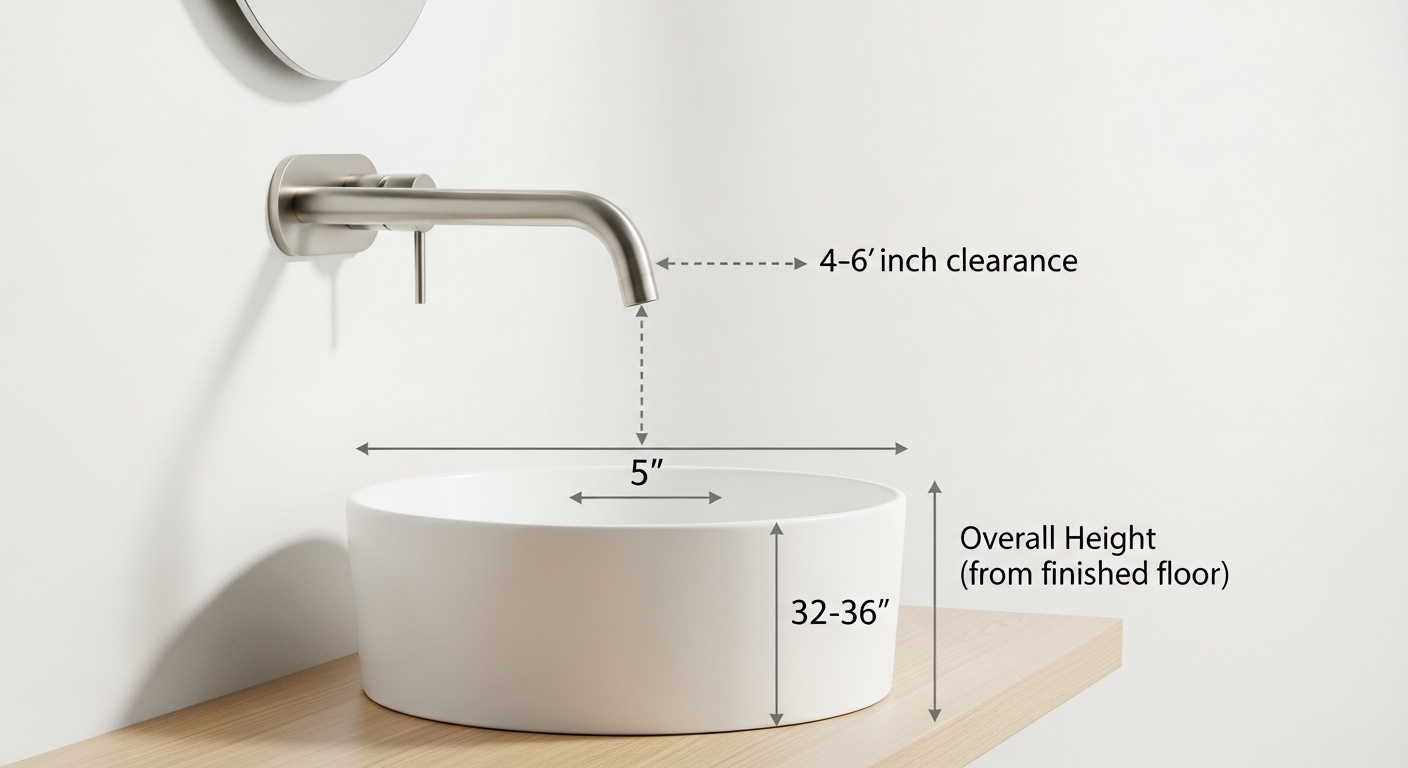
Getting the vessel sink wall mount faucet height right is the difference between a faucet that fills the bowl gracefully and one that splashes water all over your counter or, worse, dribbles awkwardly against the inside of the basin. Because a vessel sink sits on top of the counter instead of dropping into it, the whole math changes — your faucet has to clear a bowl that’s 4 to 7 inches tall before it even starts pouring. Below, we’ll give you exact numbers, the measure-once formula the pros use, and a few real scenarios (tall vanity, short bowl, his-and-hers) so you can rough in the valve with confidence the first time.
How High Should a Wall Mount Faucet Be Above a Vessel Sink?
Aim for the spout outlet to sit 4 to 6 inches above the rim of the vessel bowl. That clearance gives you enough room to slip your hands and a soap bottle under the stream without the water having so far to fall that it splashes back out of a shallow bowl.
Here’s why that range works. A stream of water that drops less than 3 inches feels cramped — you can’t get your hands under it comfortably, and a tall soap dispenser won’t fit. Go beyond 7 inches and the water gains enough speed that it slaps the bottom of the basin and bounces straight back onto your counter, especially with a narrow, deep vessel. The 4–6 inch sweet spot is the same logic plumbers use for the air gap on any faucet, just measured from the bowl rim instead of the deck.
Translate that into a wall rough-in and you typically land between 30 and 36 inches off the finished floor for the center of the faucet body. The spread is wide because it depends entirely on two things you control: how tall your counter is and how tall your bowl is.
What’s the Formula? Counter Height + Bowl Height + 4–6 Inches
The exact faucet height is: finished counter height + vessel bowl height + 4 to 6 inches of clearance = spout outlet height off the floor. Then you set the faucet body (the part in the wall) a little lower so the spout — which projects up and out — lands on that line.
Walk through a standard example:
- Finished counter (vanity) height: 32 inches off the floor — a common modern vanity height.
- Vessel bowl height: 5.5 inches (a typical round ceramic vessel).
- That puts your bowl rim at: 32 + 5.5 = 37.5 inches.
- Add 4–6 inches of clearance: the spout outlet should land at roughly 41.5 to 43.5 inches off the floor.
Now, the faucet body mounts below the spout, because a wall-mount spout angles upward and forward. Most wall-mount vessel faucets have a spout that rises 2 to 4 inches above the body’s centerline, so on this example you’d rough in the valve body around 38 to 40 inches off the finished floor. Always confirm the exact rise against your specific faucet’s spec sheet — every model is a little different, and the manufacturer’s installation template is the source of truth.
This is the step people skip, then regret. The wall valve gets plumbed inside a finished wall; if it’s an inch too low, the spout splashes the rim, and fixing it means opening drywall. Measure twice here. It’s the same care you’d take confirming a faucet supply line size before you buy fittings — getting the rough-in number right up front saves a teardown later.
Does the Vessel Bowl Height Change Where the Faucet Goes?
Yes — bowl height is the single biggest variable, and it’s the one most people underestimate. A 7-inch-tall vessel needs its faucet roughed in noticeably higher than a 4-inch low-profile bowl sitting on the identical vanity.
Vessel sinks come in a wide range of heights, and that range directly shifts your faucet:
| Vessel Bowl Height | Bowl Style | Rim Height on a 32″ Vanity | Target Spout Outlet Height (off floor) |
|---|---|---|---|
| 4 inches | Low-profile flat/oval | 36 inches | 40–42 inches |
| 5.5 inches | Standard round ceramic | 37.5 inches | 41.5–43.5 inches |
| 6.5 inches | Tall round / cylinder | 38.5 inches | 42.5–44.5 inches |
| 7 inches | Deep stone / glass vessel | 39 inches | 43–45 inches |
The lesson: if you change your bowl after the valve is in the wall, your clearance changes too. This is exactly why we tell customers to choose the vessel bowl and the faucet together, before the plumber roughs in. If you fall in love with a 7-inch glass cylinder later, that low rough-in you set for a 4-inch bowl will leave you with almost no clearance to wash your hands.
Why Choose a Wall Mount Faucet for a Vessel Sink at All?
A wall-mount faucet is the cleanest-looking and most practical pairing for a tall vessel sink because it gets the controls and spout up out of the way of the bowl, freeing the entire counter and making the basin far easier to wipe around. With a deck-mount faucet, a tall vessel forces you to buy an unusually tall faucet just to clear the rim; a wall mount sidesteps that problem entirely.
The practical advantages, in plain terms:
- No counter penetration around the bowl — nothing to caulk, nothing to leak where the faucet meets the stone, and a continuous easy-to-clean surface.
- Better proportions with tall bowls — a tall vessel plus a tall deck faucet often looks top-heavy; a wall spout floating above the bowl reads as intentional and modern.
- More usable counter space — no faucet footprint stealing room behind the sink.
- Easier deep cleaning — you can wipe the entire counter and the back of the bowl in one pass.
The trade-off is planning. A wall-mount valve has to be located and plumbed inside the wall before the drywall and tile go up, so there’s no easy “nudge it over” later. That’s the whole reason nailing the vessel sink wall mount faucet height at rough-in stage matters so much — and why this article exists.
How Far Should the Faucet Stick Out Over the Bowl?
The spout outlet should land roughly over the center of the bowl, or just slightly toward the back of center — typically you want the water hitting a point about 1 to 2 inches behind the bowl’s center, not dead-center and not at the front lip. Aim the stream so it lands on the sloped part of the basin, which kills splash.
For projection (reach), most wall-mount vessel faucets stick out 6 to 9 inches from the wall. The right number depends on how far your bowl center sits from the wall:
- Measure from the finished wall to the center of where your vessel bowl will sit.
- Pick a faucet whose spout reach lands the water 1–2 inches behind that center point.
- If your bowl is large (16–18 inches across) and set forward on the counter, you’ll need a longer-reach spout — confirm the projection on the spec sheet.
Get reach wrong and even a perfect height won’t save you: too short and the water hits the back rim; too long and it overshoots into the front of the bowl or onto the counter. Height and reach are a pair — solve them together.
What Goes Wrong If the Height Is Off — and How Do You Avoid It?
The two failure modes are too low (splashing and no hand clearance) and too high (water slaps the basin and bounces back out). Both are avoidable with one dry-fit before the valve is permanently set.
Before your plumber solders or sets the valve in the wall, do a physical mock-up:
- Set the actual vessel bowl on the actual (or a same-height stand-in) counter.
- Hold the faucet body against the wall at your calculated rough-in line.
- Check that the spout outlet sits 4–6 inches above the rim and lands just behind bowl center.
- Mime washing your hands — is there room for your hands and a soap bottle? Good.
A second common headache shows up later: leaks at a wall-mount valve are harder to reach than a deck faucet because the connections are behind the wall. Use quality valves, pressure-test the rough-in plumbing before you close up the wall, and know that if a drip ever does start, diagnosing it is more involved than a standard under-sink fix — our guide on fixing a leaky faucet from underneath walks through the connection points that tend to weep, and the quick leaky-faucet fix covers the cartridge and washer basics that apply to wall valves too.
Standard Heights at a Glance: Deck Mount vs. Wall Mount for Vessel Sinks
If you’re still deciding between mounting styles, here’s how the height planning compares. The short version: a deck-mount vessel faucet solves height by being a tall faucet; a wall mount solves it by being placed at the right spot in the wall.
| Factor | Wall-Mount Vessel Faucet | Deck-Mount Vessel Faucet |
|---|---|---|
| How height is set | Rough-in location in the wall | Overall faucet height (must be tall) |
| Typical spout-above-rim clearance | 4–6 inches | 4–6 inches |
| Typical overall height needed | N/A — set by rough-in | Faucet must be ~bowl height + 6″+ tall |
| Counter holes around bowl | None | One (behind the bowl) |
| Planning required before drywall | High — valve is permanent | Low — installs after counter |
| Best for | Tall bowls, minimalist counters | Renovations where the wall is already closed |
If your wall is already finished and you don’t want to open it, a tall deck-mount vessel faucet is the easier path. If you’re building or fully gutting the bathroom, the wall mount gives you the cleanest result — just commit to the height math now.
A Quick Word on Finish, Because You’ll See It Every Day
Height makes the faucet work; finish makes you love it. Wall-mount vessel faucets are a focal point — they float above the bowl with nothing else competing — so the finish carries a lot of visual weight. Brushed nickel, matte black, brushed gold, and polished chrome all read well over a vessel bowl. If you go with a brighter finish like polished nickel or chrome, plan for a little upkeep so it keeps its shine; our polished nickel faucet maintenance guide covers the wipe-down routine that keeps water spots from dulling that mirror finish. Whatever you pick, match it to the drain and any other hardware in the room so the whole vanity reads as one intentional design.
FAQ
How high above a vessel sink should the faucet be?
The spout outlet should sit 4 to 6 inches above the rim of the vessel bowl. That gives comfortable hand and soap-bottle clearance without the water falling so far that it splashes back out of the basin.
What height should I rough in a wall-mount faucet for a vessel sink?
For a standard 32-inch vanity with a 5.5-inch bowl, rough in the valve body around 38 to 40 inches off the finished floor, which lands the spout outlet roughly 41.5 to 43.5 inches up and 4–6 inches above the rim. Adjust up or down based on your exact counter height and bowl height, and always confirm against the faucet’s installation template.
Can I use a regular faucet on a vessel sink?
Only if it’s tall enough. A standard deck faucet is built to clear a drop-in or undermount sink, so it will sit too low against a vessel bowl’s raised rim and splash. For a vessel sink you need either a purpose-built tall vessel faucet or a wall-mount faucet positioned at the correct height above the bowl.
Why does my vessel sink faucet splash so much?
Usually it’s height or aim. If the spout is more than about 6–7 inches above the rim, the water gains speed and bounces off the basin; if it’s aimed at the front lip or dead-center of a deep bowl, it splashes back. Lowering the effective drop into the 4–6 inch range and aiming the stream just behind bowl center, where the basin slopes, fixes most splashing.
Does a taller vessel bowl need a higher faucet?
Yes. Because the faucet clearance is measured from the bowl rim, a taller bowl raises the rim and therefore raises where the spout needs to be. A 7-inch bowl needs its faucet roughed in about 3 inches higher than a 4-inch bowl on the same vanity, so always pick your bowl and faucet together before the valve goes in the wall.
How far should a wall-mount faucet stick out over a vessel sink?
Most wall-mount vessel faucets project 6 to 9 inches from the wall. You want the spout outlet to land 1–2 inches behind the center of the bowl, so measure from your finished wall to the bowl center and choose a spout reach that hits that target — larger or forward-set bowls need a longer projection.
Author Note & Why You Can Trust This Guide
Written by the Vevetta product team. Vevetta designs and sells faucets, shower systems, and bathroom fixtures direct to homeowners and trade pros, and these height recommendations come from our own installation testing and the rough-in templates we ship with every wall-mount faucet. Our vessel and wall-mount faucets are built to standard 1/2-inch NPT inlet connections and tested to meet the low-lead requirements and flow-rate standards (typically 1.2 GPM aerators for bathroom faucets) recognized across North America, and they’re backed by our limited lifetime warranty on finish and function. The numbers above reflect both published plumbing best practices and what we’ve measured holds up in real bathrooms — but your specific faucet’s installation sheet always wins, so confirm the spout rise and reach for your exact model before you set the valve. Questions on a specific pairing? Reach our team through vevetta.net and we’ll size it with you.